The Dawn of Ars Nova: The Emergence of the Northern Renaissance
 Early Netherlandish painting
Early Netherlandish painting is the body of work by artists active in the Burgundian and Habsburg Netherlands during the 15th- and 16th-century Northern Renaissance period, once known as the Flemish Primitives. It flourished especially in the cities ...
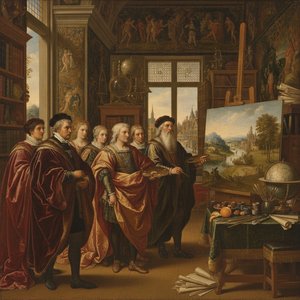
To understand the profound shift that occurred in the fifteenth century, one must look toward the bustling, prosperous cities of the Burgundian and Habsburg Netherlands. It was here, amidst the vibrant commerce of Bruges, Ghent, and Brussels, that a new artistic language began to breathe. This era, often referred to by the scholar Erwin Panofsky as ars nova—a new art—marked a departure from the stylized elegance of the International Gothic toward a breathtakingly visceral realism. Unlike the Italian Renaissance, which sought beauty through mathematical perspective and classical humanism, the Early Netherlandish masters found their truth in the microscopic observation of the world around them.
This period was not merely an evolution but a revolution of perception. Artists such as Robert Campin and Jan van Eyck began to bridge the gap between the earthly and the divine, treating every texture, from the heavy velvet of a merchant's robe to the cold glint of a brass ewer, with equal reverence. This movement, which we traditionally call the Flemish Primitives, was characterized by an intense devotion to the tangible. They did not seek to idealize; they sought to reveal. Through their eyes, the mundane became a vessel for the sacred, and every corner of the visible world was imbued with a quiet, spiritual significance.
Alchemical Brilliance: The Technical Mastery of Oil and Glaze
A glaze is a thin transparent or semi-transparent layer on a painting which modifies the appearance of the underlying paint layer. Glazes can change the chroma, value, hue and texture of a surface. Glazes consist of a great amount of binding medium i...
The true heartbeat of this era lay in the medium itself. While much of Europe continued to rely on the quick-drying, somewhat opaque nature of egg tempera, the Northern masters perfected the use of oil painting. This was an alchemical triumph. By utilizing drying oils like linseed or walnut, painters could achieve a depth of color and a luminosity that seemed almost supernatural. The technique of layering thin, transparent glazes allowed light to travel through the pigment, reflect off the underlying layers, and return to the viewer’s eye with a glowing, jewel-like intensity.
This mastery of oil painting enabled a level of detail that remains unparalleled. Consider the way light interacts with different surfaces: the soft, blended lines used to render human skin versus the sharp, crisp highlights on a pearl or a gemstone. Artists followed the "fat over lean" principle, carefully managing oil content to ensure the longevity and stability of their works. This meticulous process—building up layers of color to create volume and atmosphere—is what gives these works their characteristic luminous depth. It is a technique that invites the viewer to linger, searching for the subtle transitions of tone that define the very essence of reality.
Sacred Narratives and Devotional Depth: Iconography in the Netherlandish Tradition
 Triptych of the Sedano Family
A Tapestry of Devotion: Exploring the Triptych of the Sedano Family To stand before the Triptych of the Sedano Family is to step directly into the luminous heart of the Northern Renaissance. Painted by the masterful Gerard David in 1495, this work tr...
In the hands of the Netherlandish masters, a painting was rarely just a picture; it was a complex theological text. The subjects were predominantly religious, ranging from intimate portraits to monumental altarpieces like the triptychs that graced private chapels and cathedrals alike. Every element within these compositions carried a weight of symbolic meaning. A single bird, a specific flower, or the way a hand was positioned could communicate profound truths about redemption, sin, or divine grace.
Take, for instance, the Triptych of the Sedano Family by Gerard David. Here, the narrative arc moves through time and spiritual states, using the structure of the three panels to guide the soul from earthly motherhood to heavenly apotheosis. Similarly, in works attributed to the Northern Netherlandish tradition, such as The Crucifixion, the tragedy is rendered with a raw, unshielded vulnerability. The inclusion of anatomically precise figures and grounded, worldly details serves to make the celestial drama feel immediate and deeply personal. This use of complex iconography ensured that the act of viewing was, in itself, an act of prayerful meditation.
From Intricate Detail to Grand Scale: The Evolution of Landscape and Composition
 Franco-Flemish 15Th Century
The Enigmatic World of Hieronymus Bosch Hieronymus Bosch, a name synonymous with fantastical imagery and moral allegory, remains one of the most compelling and elusive figures in art history. Born around 1450 in 's-Hertogenbosch, Netherlands, little ...
While the early masters often relegated landscapes to a mere backdrop for religious drama, there was a gradual, beautiful expansion of the natural world within their frames. Initially, the landscape served as a symbolic setting—a lush, verdant stage for the unfolding of sacred events. However, as the 15th century progressed into the 16th, we begin to see a burgeoning interest in the landscape as a subject worthy of its own narrative. The world was becoming larger, more complex, and more deserving of the artist's gaze.
This evolution paved the way for later giants like Hieronymus Bosch, whose work moved away from the serene landscapes of his predecessors toward much more unsettling, fantastical, and crowded compositions. His world was one of hybrid creatures and moral allegories, where the landscape itself became a psychological space of temptation and chaos. This progression from the controlled, intimate settings of the early period to the expansive, often turbulent vistas of the later Northern Renaissance reflects a changing human consciousness—one that was increasingly aware of the vastness and the inherent fragility of the natural order.
A Lasting Influence: The Legacy of the Flemish Masters in Modern Art
 Corrupted oil jerry crude oil
Corrupted Oil Jerry by Banksy: A Detailed Examination Subject & Historical Context “Corrupted Oil Jerry,” created in 2003 by the enigmatic street artist Banksy, is a powerful commentary on environmental concerns and consumerism. The artwork masterful...
The legacy of the Early Netherlandish painters is woven into the very fabric of Western art history. Their innovations in oil technique provided the foundation upon which later masters, including the Baroque brilliance of Peter Paul Rubens, would build. Even the way we perceive light and texture today owes a debt to their pioneering spirit. Their ability to find the infinite within the infinitesimal continues to inspire collectors and artists alike, reminding us that there is profound beauty to be found in the smallest details of our existence.
In our modern era, we see echoes of this meticulousness even in unexpected places. The way a contemporary artist might use layering or contrast to create social commentary—much like the striking juxtaposition seen in Banksy’s Corrupted Oil Jerry—mirrors the ancient tradition of using familiar imagery to provoke deep reflection. Whether through a centuries-old oil on panel or a modern reimagining, the pursuit of truth through the mastery of light and medium remains a timeless human endeavor.
At TopImpressionists.com, we celebrate this enduring passion for the exquisite. We invite you to explore our collection of hand-painted reproductions and custom commissions, where the spirit of the Old Masters is brought to life on canvas for the modern home.