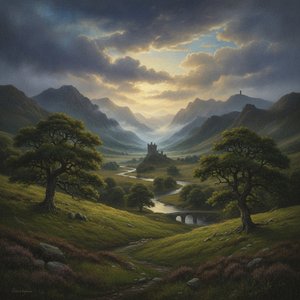
The Evolution of Sight: From Topographical Records to Artistic Vision
 Landscape painting
Landscape painting, also known as landscape art, is the depiction in painting of natural scenery such as mountains, valleys, rivers, trees, and forests, especially where the main subject is a wide view—with its elements arranged into a coherent compo...
Romanticism: A Reaction Against the Age of Enlightenment
 Richard Tongue
Richard Tongue: A Visionary of the British Landscape Richard Tongue (1795–1873) stands as a remarkably prescient figure in 19th-century British art, a painter who captured not merely the outward appearance of the countryside but its very essence – it...
The English Landscape Garden: Recreating Nature from Symmetry
 English landscape garden
The English landscape garden, also called English landscape park or simply the English garden (French: Jardin à l'anglaise; Italian: Giardino all'inglese; German: Englischer Landschaftsgarten; Portuguese: Jardim inglês; Spanish: Jardín inglés), is a ...
In the early 18th century, English land management underwent a radical transformation. The formal, symmetrical gardens of the French style—defined by rigid geometric patterns and manicured topiary—were replaced by the English landscape garden. Designers like William Kent and Charles Bridgman moved away from architectural control, instead creating vistas that appeared natural, even if they were carefully engineered. These gardens featured rolling lawns, winding paths, and strategically placed ruins to evoke an idealized, pastoral past.
This movement mirrored the broader shifts in European politics, where the structured order of the Baroque era began to face scrutiny. Just as the garden designers rejected the straight lines of Versailles to favor organic shapes, later landscape painters would reject rigid academic rules in favor of more fluid, naturalistic depictions. We see this same impulse today in the way urban planners attempt to integrate "wild" green spaces into concrete cities. The desire to introduce an element of the unscripted and the natural into highly controlled environments is a direct descendant of that 18th-century revolt against the straight line.
John Constable and the Elevation of the Everyday
 Mastering the English Landscape: The Top 25 John Constable Artworks
Introduction To step into the world of John Constable is to rediscover the profound poetry hidden within the everyday. There is a quiet, rhythmic soulfulness in his work—a sense that the rustle of willow leaves, the heavy moisture of an English sky, ...
Atmospheric Truth: Capturing the Ephemeral in Oil
 Landscape and Figures
A Tranquil Vision of Rural England: Sir Augustus Wall Callcott’s “The Entrance to the Pool of London” Sir Augustus Wall Callcott's "The Entrance to the Pool of London," painted in 1816, stands as a quintessential example of Romantic landscape paintin...
The Continuity of Tradition: Preserving the British Spirit
 Charles Crombie
life and artistic journey charles crombie , a british artist from the united kingdom, lived from 1880 to 1967. despite his prolific output, crombie's life remains somewhat of an enigma, with his artistic contributions often overshadowed by more promi...
The lineage of British landscape painting is a continuous thread that adapts to the changing realities of the land. In the late 19th century, George Clausen moved away from idealized scenery to capture a rustic naturalism, depicting the actual labor of peasants in works like *Winter Work*. This shift toward the tangible and the lived experience paved the way for 20th-century artists to explore even more specific, often overlooked environments. Where Clausen focused on the toil of the field, artists like Edward Chell later turned their attention to the peripheral landscapes of motorway verges, or Carol Rhodes captured the aerial perspective of industrialised spaces. This evolution shows how the subject of the landscape expands as human activity changes the terrain.
Today, as we navigate an era of digital abstraction, these works offer a sanctuary of stillness. Collecting or viewing these landscapes is an act of preserving a specific way of relating to the earth. Through the careful reproduction of these textures and tones on cotton canvas, we ensure that the quiet, enduring spirit of the English landscape remains accessible to future generations.