The Great Rebellion: Breaking the Silence of Minimalism
 Neo-Expressionism: The Raw Power and Emotional Return of Modern Art
The Rejection of Minimalism: The Emergence of Neo-Expressionism Neo-Expressionism Explained: A Professional Guide to Integrating Raw Power and Emotional Intensity into Modern Interior Design Defining Neo-Expressionism: The Rejection of Minimalism and...
To understand the seismic shift that occurred in the late twentieth century, one must look past the polished, sterile galleries and listen to the rhythmic, chaotic heartbeat of the city streets. For much of the 1970s, the art world resided within the intellectualized corridors of Minimalism and Conceptual Art—movements characterized by formal restraint, geometric precision, and a certain cool detachment from the human experience. While these movements pushed the boundaries of what could be considered art, they often left the viewer at an emotional distance, focusing on the objecthood of the work rather than the soul of the creator.
By the late 1970s, a profound fatigue had set in among a new generation of creators. There was a collective yearning to return to the visceral, to the tactile, and to the deeply subjective. This period saw the birth of Neo-Expressionism, a style that emerged as a defiant reaction against the austerity of its predecessors. It was an international phenomenon—often referred to as Transavantgarde in Italy or the Neue Wilden (the "New Wild Ones") in Germany—that sought to breach the boundaries of formal restraint. Where Minimalism offered silence and emptiness, Neo-Expressionism offered a roar, reclaiming the canvas as a site of intense psychological struggle.
A Symphony of Chaos: The Visceral Language of Color and Texture
 Neo-Expressionism Explained: A Professional Guide to Integrating Raw Power and Emotional Intensity into Modern Interior Design
Defining Neo-Expressionism: The Rejection of Minimalism and the Return to Visceral Painting Neo-expressionism - Tate --- title: Neo-expressionism | Tate url: https://www.tate.org.uk/art/art-terms/n/neo-expressionism hostname: tate.org.uk description:...
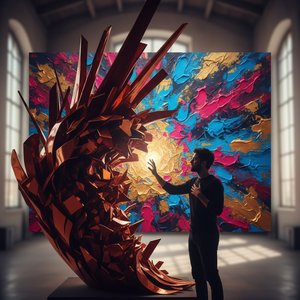
Neo-Expressionism is defined by its intense subjectivity and a famously rough handling of materials. It was a revival of painting in its most primal sense, reintroducing recognizable objects, the human body, and a heavy, almost violent application of paint to the global stage. The movement demanded a return to the palpable weight of the medium itself—the thick impasto, the visible energy of the artist's hand, and the unapologetic use of vivid, often clashing colors.
In these works, color does not merely decorate; it communicates. We see striking shades of pink, blue, and black colliding to create a sense of restless energy that refuses to let the eye rest. The technique is revolutionary because it de-emphasizes literal content to bring the raw materiality of painting—the brushstroke, the texture, and the pigment—to the forefront. This tactile depth provides a sense of permanence and soul that digital or mass-produced prints simply cannot replicate. It is an art of presence, where the surface of the canvas feels alive, breathing with a nervous, almost agonized vitality.
Masters of the Unbridled Spirit: From Baselitz to Basquiat
The movement found its most provocative voices in artists who were unafraid to confront history and identity through distortion. Georg Baselitz, a titan of the movement, offers us a profound testament to the genius of inversion. In his monumental Supper in Dresden, reality is turned on its head—quite literally. By famously inverting his subjects, Baselitz de-emphasizes the literal scene to force the viewer to experience the "how" rather than the "what." His work, shaped by the literal and metaphorical rubble of post-WWII Germany, uses a chaotic gathering around a dining table to explore themes of destruction and displacement.
Contrasting this European gravity is the high-energy rebellion of Jean-Michel Basquiat. Emerging from the streets of New York, Basquiat utilized the raw energy of graffiti to deconstruct identity and power. His work represents the genesis of chaos, where urban street culture meets museum-grade mastery. Similarly, artists like Christopher Robert Browning use canvases as conduits for unbridified human emotion, embracing the heavy, textured legacies of masters to create dreamlike landscapes where the boundaries between the physical and psychological realms dissolve. Even in Latin America, figures like Antônio Dias dos Santos utilized this visceral visual language to translate the complexities of identity into a haunting, evocative presence.
The Psychological Canvas: Exploring Subjectivity and Human Emotion
 christopher robert browning
The Visceral Vision of Christopher Robert Browning Christopher Robert Browning stands as a profound voice within the neo-expressionist movement, an artist whose canvases serve as conduits for the raw, unbridered currents of human emotion. Born in 195...
At its core, Neo-Expressionism is an exploration of the internal landscape. Unlike the detached intellectualism of the decades prior, these paintings serve as windows into the psyche. The movement embraces the fragmented and the distorted to mirror the complexities of modern life. This is achieved through a delicate balance between abstraction and hauntingly recognizable symbolism; a figure might be recognizable, yet stretched or colored in ways that suggest deep-seated trauma or ecstatic joy.
This era marked a transition from the cerebral to the emotional. The artists sought to excavate reality rather than merely represent it. By utilizing thick impasto and dramatic, gestural brushstrokes, they created surfaces that feel like sites of struggle. For the collector, these works offer an architectural anchor for spaces that require a commanding presence—a way to invite narrative depth and psychological resonance into a room. It is art that does not ask for quiet contemplation; it demands engagement, pulling the viewer into a world of intense, subjective truth.
Legacy of the Brushstroke: How Neo-Expressionism Reshaped Modernity
Neo-expressionism is a style of late modernist or early-postmodern painting and sculpture that emerged in the late 1970s. Neo-expressionists were sometimes called Transavantgarde, Junge Wilde or Neue Wilden ('The new wild ones'; 'New Fauves' would be...
The legacy of Neo-Expressionism remains etched in the annals of contemporary art history. It successfully re-established the connection between the viewer and the visceral reality of human experience, proving that the traditional medium of oil on canvas could still be a radical tool for social and personal commentary. The movement's ability to synthesize influences—from the dreamlike distortions of Surrealism to the emotive weight of earlier German Expressionists like Edvard Munch—ensured its lasting impact on the global art landscape.
Today, we see its echoes in the way contemporary artists continue to use texture and color to challenge the clinical nature of modern life. For those who cherish the tactile beauty of a hand-painted work, Neo-Expressionism serves as a reminder that the most profound truths are often found in the most unrefined moments. It remains a testament to the power of the human spirit to find beauty within chaos and meaning within the most turbulent of brushstrokes.