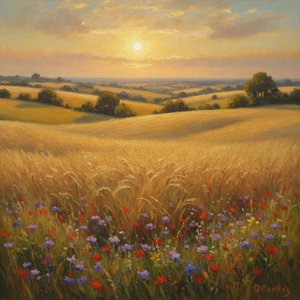
The Revolution of Sight: From Studio Shadows to the Open Air
 The Allure of Open Airs: Exploring Representations of Outdoors in Art History
The Dawn of Landscape: Early Representations & Romantic Ideals Richard Parkes Bonington: A Brief but Brilliant Career – Romantic Landscapes & the Dawn of Plein Air Painting Explore the short but impactful career of Richard Parkes Bonington, a pivotal...
For centuries, the sanctity of the artist’s studio served as a controlled sanctuary, a place where light was not experienced but meticulously recreated through careful calculation and shadow. Within these darkened walls, painters labored over compositions born from sketches and memory, striving for idealized representations of reality that often felt more constructed than lived. The landscape, in this era, existed primarily as a backdrop—a scenic element within larger narratives of mythology, religion, or portraiture. Artists like Jacob van Ruysdael and Claude Lorrain masterfully depicted perspective and atmosphere, yet their scenes often felt like carefully curated stages rather than direct observations of the breathing world.
The true shift began with a radical spirit that dared to look at the natural world not as a setting, but as a subject worthy of independent study. This nascent fascination was spearheaded by figures who signaled a move towards capturing the emotional resonance of specific places. As the Industrial Revolution transformed Europe, leading to rapid urbanization and a growing sense of alienation from the natural world, artists responded by elevating nature as a source of spiritual connection. The transition from the rigid, formal lines of traditional academic painting toward a more sensory experience marked the dawn of a new visual language, one that would eventually allow the boundaries between earth and sky to dissolve into a poetic haze.
En Plein Air: The Art of Capturing Ephemeral Moments
 En plein air
En plein air (pronounced [ɑ̃ plɛ.n‿ɛʁ]; French for 'outdoors'), or plein-air painting, is the act of painting outdoors. This method contrasts with studio painting or academic rules that might create a predetermined look. The theory of 'En plein air' ...
The term en plein air—literally meaning "in the open air"—represents more than just a change in location; it signifies a revolution in artistic philosophy. This method, which contrasts sharply with the predetermined looks of studio painting, enabled artists to better capture the changing details of weather and light in real time. While the theory of landscape portraiture can be traced back to Pierre-Henri de Valenciennes, it was the advent of portable paint tubes in the mid-19th century that truly liberated the artist. No longer tethered to the heavy, inconvenient task of grinding raw pigments within studio walls, painters could finally carry their palettes into the fields and forests.
This practice allowed for a profound engagement with the immediate sensory experience. To witness an Impressionist landscape is to experience a moment caught in flight—the precise second a sunbeam pierces through a cloud or the way light trembles upon the surface of a river. By working directly onto canvas in situ, artists could record the fleeting effects of atmosphere as they unfolded. This commitment to direct observation transformed the canvas from a static image into a living, breathing entity, where the artist's hand moved in rhythm with the shifting winds and the passing sun.
A Symphony of Color: How Light Defines the Impressionist Landscape
 10 Iconic Masterpieces That Defined Impressionist Landscapes
Introduction Imagine standing before a canvas where the world is not a static image, but a living, breathing entity. To witness an Impressionist landscape is to experience a moment caught in flight—the precise second a sunbeam pierces through a cloud...
In the hands of the Impressionists, light became the true protagonist of the canvas. The movement replaced the somber, muted palettes of the past with vibrant, broken brushstrokes that dance across the surface, inviting the viewer to complete the image with their own eyes. This was not merely about brightness; it was about the scientific and emotional study of how color shifts under different conditions. Claude Monet, perhaps the most consistent practitioner of this philosophy, famously utilized series paintings to demonstrate this phenomenon. By painting the same subject—be it haystacks, cathedrals, or water lilies—at different times of day, he revealed how sunlight, time, and weather fundamentally alter our perception of color and contrast.
This interplay of light and shadow creates a dynamic sense of movement and spontaneity. When we look at the works of this era, we see a world where colors are not applied in flat blocks but are layered to create a shimmering reality. The use of complementary colors and the avoidance of heavy blacks allowed the landscapes to glow with an inner vitality. This technique celebrates the imperfect, transient beauty of nature, offering a profound invitation to see the world anew through a lens of pure, unadelineated perception.
Masters of the Moment: Exploring Monet, Gauguin, and the Pioneers
 Martinique Landscape
Captivating Subject and Lush Landscape Immerse yourself in the vibrant beauty of a tropical paradise captured through the masterful brushwork of Paul Gauguin. This evocative scene depicts the lush, mountainous terrain of Martinique, where the natural...
The landscape of Impressionism is populated by masters who each brought a unique soul to the canvas. Claude Monet remains the foundational figure, whose very name became synonymous with the movement's essence. His ability to capture the ephemeral through repetitive study of light remains unparalleled. Yet, as the movement evolved into Post-Impressionism, artists like Paul Gauguin expanded this vocabulary even further. In his depictions of Martinique, Gauguin moved beyond mere observation toward a more symbolic and expressive use of color. His lush, mountainous terrains are alive with a vibrant, layered palette that emphasizes emotional resonance and the exotic allure of the tropics.
Other artists contributed distinct textures to this era of light. We see the English countryside captured in an evocative whisper by Sir Alfred James Munnings, where the boundaries between earth and sky dissolve into a heavy, atmospheric sky. We find the rural beauty of Scotland through the soft, loose brushstrokes of Edward Arthur Walton. Even those with academic foundations, such as Lorenzo Delleani, found themselves drawn toward the light, abandoning historical themes to embrace the hillsides of Piedmont. Each of these masters used the landscape to communicate something deeper than topography; they used it to convey memory, solitude, and the very breath of the natural world.
The Tactile Memory: Why Hand-Painted Textures Resonate Today
 Landscape with Stream
Admire 'Landscape with Stream' by Ernest Lawson – a serene 1915 Impressionist painting of Canadian countryside. Hand-painted reproductions available.
In our modern age of digital permanence and flat, screen-based imagery, there is a deep, soulful resonance in the tactile depth of an oil painting. To hold a piece of art that features visible, energetic brushstrokes is to connect with the physical presence of the artist. This is why hand-painted reproductions, such as those we meticulously craft at TopImpressionists.com, continue to hold such profound meaning. Unlike a computer-printed poster, which lacks depth and tonal range, a true oil painting on cotton canvas possesses a texture—an impasto—that catches the light and creates a sense of three-dimensional life.
The beauty of a handmade reproduction lies in its ability to preserve the "soul" of the original. Every stroke of the brush, every layer of pigment, and every subtle variation in color serves as a testament to the human hand. Whether it is the thick, expressive textures reminiscent of Van Gogh or the light-drenched, soft forms of Monet, these works offer a window into a world that feels tangible and real. For the collector, owning such a piece is not merely about decoration; it is about bringing a fragment of history’s most beautiful moments into one's own sanctuary, ensuring that the luminous spirit of the Impressionists continues to breathe within our homes for generations to come.