--- title: Italian Paintings of the Thirteenth and Fourteenth Centuries | National Gallery of Art url: https://www.nga.gov/research/publications/italian-paintings-thirteenth-and-fourteenth-centuries hostname: nga.gov sitename: National Gallery of Art...
Before the Renaissance brought a renewed focus on the human form, much of Italian religious art relied upon the flat, gilded backgrounds of the Byzantine tradition. These works were intended to represent a divine, eternal realm, far removed from the physical world. However, as the 14th century progressed, artists began to look toward the earth beneath their feet. This shift was not merely a change in style but a profound philosophical movement known as humanism, which sought to find the divine within the natural order.
The transition can be seen in the early works of masters like Giotto, who moved away from stylized, symbolic figures toward characters with weight and presence. This era, often called the Proto-Renaissance, laid the groundwork for a new way of seeing. Just as the Florentine architects began to use geometry to organize physical space, painters began to use light to organize the human experience. The goal was no longer just to depict a saint, but to depict a person inhabiting a recognizable world.
This movement found its most stable footing in the 15th century, where the rediscovery of classical texts encouraged artists to study anatomy and optics. When we look at these early shifts today, we see the beginning of a visual language that treats the subject not as an icon, but as a living, breathing entity.
Chiaroscuro: The Technical Art of Sculpting with Shadow
In art, chiaroscuro (English: kee-AR-ə-SKOOR-oh, -SKURE-, Italian: [ˌkjaroˈskuːro]; lit. 'light-dark') is the use of strong contrasts between light and dark, usually bold contrasts affecting a whole composition. It is also a technical term used by a...
To understand the depth of Renaissance painting, one must understand chiaroscuro. Derived from the Italian words for "light-dark," this technique involves the use of strong contrasts to create the illusion of three-dimensional volume on a two-dimensional surface. It is a method of sculpting with shadow. By carefully controlling where light hits a cheekbone or a fold of fabric, and where it recedes into darkness, an artist can give a figure a palpable sense of weight.
A profound example of this technique is found in the work of Jacopo Tintoretto. In his Portrait of a Bearded Venetian Nobleman, created around 1560, the light does not simply illuminate the subject; it carulates his very presence. The darkness behind the nobleman is not an empty void but a heavy, atmospheric space that pushes the illuminated face and hands toward the viewer. This use of shadow creates a psychological depth, inviting us to contemplate the character of the man behind the beard.
This technique finds its historical echo in the development of sfumato, another method used by Leonardo da Vinci to blur edges and create smoky transitions. While sfumato focuses on the softness of boundaries, chiaroscuro focuses on the strength of contrast. Both techniques share a singular objective: to bridge the gap between the flat canvas and the physical reality of the viewer.
Venetian Luminosity: Capturing the Atmosphere of the Lagoon
A Glimpse into Venetian Life: The Charm of Capriccio To gaze upon this Capriccio with the Archway of the Torre dell'Orologio is to step directly into a sun-drenched moment of Venetian history, a scene imbued with the gentle rhythm of daily life. Fran...
While Florence focused heavily on line and mathematical perspective, the Venetian School developed a different mastery: the mastery of color and atmosphere. Because Venice was a maritime power with easy access to high-quality pigments and canvas, its artists were uniquely positioned to experiment with light as if it were liquid. The Venetian style prioritized colore over disegno, allowing for a more sensory, emotive experience.
The air in Venice is thick with salt and moisture, a quality that painters like Titian and Bellini sought to replicate on canvas. They used layers of translucent glazes to capture the way sunlight filters through the mist of the lagoon. This approach created a sense of "atmospheric perspective," where distant objects appear softer and more blue-toned, mimicking the natural effect of looking through heavy air.
We see this same preoccupation with atmosphere in much later works, such as Francesco Lazzaro Guardi’s Capriccio with the Archway of the Torre dell'Orologio. Though painted around 1780, Guardi utilizes a loose, spontaneous brushwork that prioritizes mood over minute detail, much like the Impressionists would centuries later. He captures a sun-drenched moment in Venice, where the light seems to breathe life into the ancient stone, proving that the Venetian obsession with light is an enduring thread in the history of art.
Architectural Harmony: The Geometry of Space and Sight
Renaissance architecture is the European architecture of the period between the early 15th and early 16th centuries in different regions, demonstrating a conscious revival and development of certain elements of ancient Greek and Roman thought and mat...
The principles that governed Renaissance painting were inseparable from the evolution of Renaissance architecture. Architects like Filippo Brunelleschi revolutionized the urban landscape by introducing symmetry, proportion, and geometry. They looked back to Roman ruins to find a sense of order, replacing the irregular, soaring profiles of Gothic structures with the stability of the semicircle and the dome.
This architectural logic provided the "stage" upon which painters performed. A painter could not effectively use perspective without an understanding of the mathematical laws that governed physical space. The columns, pilaster, and arches seen in Renaissance buildings provided the structural framework for artists to create depth within their compositions. When a painter placed a pillar behind a subject, they were using architectural language to anchor that person within a stable, rational universe.
This dialogue between the built environment and the painted image is evident in the very way we perceive classical beauty today. The same sense of proportion found in a Brunelleschi basilica can be felt in the balanced compositions of High Renaissance portraits. The architecture provides the bones, while the painting provides the flesh and light.
The Legacy of the Workshop: Preserving the Mastery of Hand
Italian Workshop: A Fragment of Fifteenth Century Florentine Art The Italian Workshop, a collective artistic endeavor operating in Florence during the mid-15th century, remains an enigmatic figure within Renaissance art history. Precise biographical ...
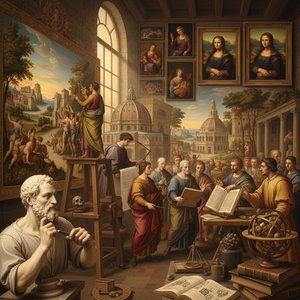
The greatness of the Italian Renaissance was not the result of isolated geniuses working in vacuums, but rather the product of the bottega, or workshop. These were collaborative environments where masters oversaw apprentices, passing down technical secrets from one generation to the next. From the textile weavers of Florence to the glassmakers of Venice, the culture of meticulous, handcrafted excellence was a shared standard across the peninsula.
In these workshops, an artist might begin by grinding pigments or preparing canvases, slowly learning how to manipulate the chemistry of oil and resin. This tradition of Italian Manufacture ensured that even as styles shifted from the Early Renaissance to Mannerism, the fundamental technical proficiency remained constant. The workshop was a living laboratory where the boundary between artisan and master was perpetually blurred.
Today, this dedication to the handmade survives in the way we value true artistry. At TopImpressionists.com, we honor this lineage by offering hand-painted oil reproductions that retain the visible brushstrokes and textural depth of the originals. Our artists, trained in the academic tradition, use the same layering techniques and materials—such as 100% cotton canvas and Damar varnish—to ensure that the soul of the Renaissance is not lost in translation, but preserved for the modern collector.
Explore the enduring legacy of Renaissance art! Discover its historical context, humanist ideals, iconic masterpieces, and lasting influence on Western art with .
Explore the profound drama of chiaroscuro and tenebrism. Discover how masters like Caravaggio used light and shadow to sculpt emotion and volume, creating timeless masterpieces for the discerning collector.
Discover the enduring elegance of Florence. Explore how Renaissance masterpieces and Italian craftsmanship inspire timeless art collections through museum-quality, hand-painted oil reproductions and bespoke commissions for the discerning collector.
Embark on a journey through Venice's soul with 25 iconic masterpieces from Gallerie dell'Accademia. From Titian to Tintoretto, explore the legends of Venetian Renaissance art and find inspiration for museum-quality decor. Discover all masterpieces on TopImpressionists.com.


 Chiaroscuro
 Capriccio with the Archway of the Torre dell'Orologio
 Renaissance architecture
 Italian Workshop