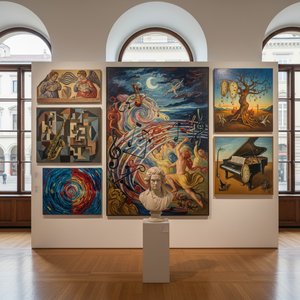
The Divine Vibration: Music as an Ethereal Force in Ancient Iconography Harmonies on Canvas: Exploring the Visual Representation of Music in Art History The Ancient Roots: Music's Divine Origins in Early Art Wikipedia: Hindu iconography Over the mill...
Before the first notes were ever etched into musical notation, sound existed as a fundamental vibration, a frequency woven into the very fabric of existence. In the earliest stages of human expression, art did not merely seek to represent sound; it sought to embody its divine essence. To look upon ancient iconography is to witness a period where the boundary between the audible and the and visible was intentionally blurred.
In the sacred traditions of Hindu iconography, music is inseparable from the spiritual architecture of the universe. The Om symbol serves as more than a visual emblem; it is a sonic blueprint of creation itself, a mantra that resonates through the silent halls of history. This pursuit of capturing the intangible was equally profound in other ancient cultures, where instruments were not merely tools for entertainment but vessels for the divine.
The oldest known paintings, found in the caves of Sulawesi and Borneo, date back tens of thousands of years. These early works, often depicting animals or human figures, share a common origin with the earliest flutes—simple bone instruments that suggest a time when art and music were unified in ritual. In these moments, the brushstroke and the breath were one, both serving to bridge the gap between the earthly and the eternal.
Harmonic Order: Classical Mythology and the Geometry of Form
A Symphony of Sound and Form: Exploring Oxford’s Bate Collection The Faculty of Music and Bate Collection of Musical Instruments stands as a singular testament to the enduring fascination with musical heritage—a place where instruments whisper tales ...
As civilizations matured, the representation of music shifted from the ethereal toward a structured, symbolic order. In the Hellenic world, the Muses presided over the creative arts with an authority that demanded both precision and passion. When we observe classical depictions of Apollo wielding his lyre, we are witnessing more than a god with an instrument; we see a visual testament to the power of harmony to impose order upon a chaotic world.
The myth of Orpheus, whose melodies could charm even the most untamed beasts, serves as a poignant reminder that music possesses a transformative capability—a power to transcend physical boundaries and touch the soul. This belief in music's ability to pacify and organize is mirrored in the geometric precision found in classical art. The strings of a lyre or the proportions of a harp reflect a mathematical beauty that aligns with the perceived laws of the cosmos.
This connection between structure and sound finds a modern echo in the preservation of history. Institutions such as the Faculty of Music and Bate Collection of Musical Instruments in Oxford house instruments that embody this very sense of scholarly order. Within its halls, the Reginald Morley-legge Memorial Collection of Horns showcases the technical excellence of wind instruments, much like the disciplined lines of a classical frieze, reminding us that true beauty relies upon a foundation of rigorous craft.
Tactile Resonance: The Materiality of Stringed Instruments and Pigment
Rikhi Ram Originals: Guardians of Indian Musical Tradition Rikhi Ram Originals stands as a testament to India’s enduring legacy in musical instrument craftsmanship. Established over a century ago, this Delhi-based company isn't merely a manufacturer;...
As the focus of artistic representation moved toward the tangible, painters began to celebrate the profound intersection of acoustic science and physical craftsmanship. The transition from ethereal concept to object allowed for an appreciation of the exquisite materiality found in instruments like the sitar, the lute, or the harp. Here, the artist’s eye meets the luthier’s hand.
Consider the meticulous construction of a Sitar by makers such as Rikhi Ram Originals. These instruments are a complex amalgamation of strings, resonators, and tuning pegs, often featuring intricate inlay work with precious stones like jasper or agate. The use of seasoned teakwood or sandalwood provides a tonal richness that is matched by the visual depth of the carving. This level of detail requires a painter to understand not just color, and tone, but the very texture of the wood and the way light catches a polished surface.
This reverence for material is echoed in the tradition of oil painting itself. Just as a luthier selects specific woods for their resonance, a painter chooses pigments and oils for their longevity and depth. The visible brushstrokes on a heavy cotton canvas provide a tactile dimension that mimics the physical presence of a well-crafted instrument. Whether it is the weight of a cello or the impasto of a thick oil layer, the sensation of substance remains central to the experience of both arts.
Atmospheric Breath: Woodwind Traditions and the Impressionist Air
A Legacy of Craftsmanship: Jérôme Thibouville-Lamy and the Parisian Instrument Tradition Jérôme Thibouville-Lamy & Cie, abbreviated as “J.T.L.,” stands as a testament to enduring musical heritage—a French instrument making company that flourished for...
The evolution of woodwind instruments, from the simple recorders in the Edgar Hunt Collection to the complex French woodwinds produced by Jérôme Thibouville-Lamy, mirrors a shift in how we perceive atmosphere. In the 19th century, the expansion of orchestral wind sections brought about new textures of sound—textures that were both breathy and piercing, much like the dappled light found in the works of the Impressionists.
The French tradition of instrument making, particularly through firms like J.T.L., emphasized a tonal quality characterized by exceptional projection and responsiveness. This technical precision allowed for the nuanced phrasing required by composers such as Debussy. There is a direct parallel here to the way painters like Monet or Renoir approached the canvas; they sought to capture the movement of air, the shimmer of heat, and the transient nature of light through broken brushstrokes and a luminous palette.
In the mid-1800s, the invention of portable paint tubes allowed artists to work en plein air, directly under the sky. This freedom to capture the immediate atmosphere mirrors the way a woodwind player responds to the acoustics of a space. Both the painter and the instrumentalist are engaged in a dialogue with the environment, attempting to catch a fleeting sensation before it dissolves into the stillness of history.
The Transient Note: Light and Sound within the Fleeting Moment
The Luminous Revolution: How Impressionism Redefined the Art of Seeing Impressionistic Landscapes: 10 Masterpieces That Changed Art & Decor Introduction To gaze upon these ten canvases is to step directly into a world transformed by light, color, and...
In the final analysis, both fine art and music find their most profound expression in the embrace of the ephemeral. The Impressionist revolution was a bold declaration that reality is not a fixed entity, but a shimmering, subjective experience. This movement moved away from the heavy, somber shadows of academic tradition to enter a realm bathed in sunlight, much like a sudden crescendo in a musical composition breaks through a period of quietude.
The works of Pierre-Auguste Renoir, such as La Poste at Cagnes, capture a distillation of life that feels as fresh as a morning mist. There is a pulse beneath the surface of these canvases—a quiet rhythm that resonates with the transient nature of existence. This mirrors the experience of listening to a live performance, where a note exists only for a moment before it vanishes, leaving behind only its emotional imprint on the listener.
We find this continuity in the way we approach art today. Whether through the preservation of ancient musical legacies in the Hamamatsu Museum of Musical Instruments or the creation of new, custom oil reproductions that reimagine historical styles, the goal remains the same: to hold a question open and to honor the beauty of the passing moment. At TopImpressionists.com, we remain dedicated to this enduring resonance, celebrating the craftsmanship that allows both sound and color to endure.
Journey through Impressionism's golden age! Explore 10 masterpieces by Monet, Renoir & Degas that redefined art. Discover the stories behind these iconic paintings and find museum-quality reproductions to elevate your home decor on TopImpressionists.com.
Explore the fascinating history of music's visual representation in art! From ancient symbolism to modern abstraction, discover how artists have captured sound and emotion on canvas. Expert insights & stunning examples.
Discover the profound connection between music and art history. Explore how iconic composers inspired visual masterpieces through our expert-led guide to the melodies captured in paint.


 The Symphony of Canvas: Capturing the Timeless Resonance of Musical Instruments in Fine Art Masterpieces
 Faculty of Music And Bate Collection of Musical Instruments
 Rikhi Ram Originals
 Jerome Thibouville-Lamy
 Capturing the Soul: The Most Emotionally Moving Impressionist and Post-Impressionist Masterpieces