

The Genesis of Order: Neoplasticism and the Search for Universal Truth
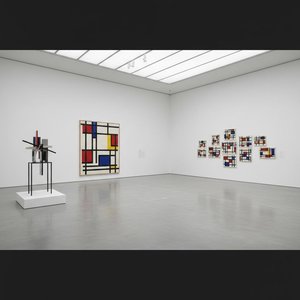 Neoplasticism Unveiled: The Power of Pure Color and Geometric Form in Modern Abstract Art
The Genesis of Neoplasticism: Piet Mondrian and the Pursuit of Universal Order In the turbulent dawn of the twentieth century, as the world grappled with the fragmentation of old empires and the industrialization of human existence, a profound moveme...
In the turbulent dawn of the twentieth century, as the world grappled with the fragmentation of old empires and the rapid industrialization of human existence, a profound movement emerged from the heart of Europe to seek something more permanent. This was the birth of Neoplasticism, a radical departure from the representational traditions that had dominated Western art for centuries. While many of us find solace in the soft, light-drenched landscapes of Monet or the emotive textures of Van Gogh, Neoplasticism offered a different kind of sanctuary—not one found in the imitation of nature, but in the discovery of an underlying, immutable order.
At its epicenter stood Piet Mondrian, a visionary whose artistic journey began within the lush, descriptive landscapes of the Dutch tradition. Yet, his evolution was not merely stylistic; it represented a profound philosophical shift. He sought to move beyond the particularities of appearance to find a deeper, spiritual truth. For Mondrian, art was not a mirror held up to nature, but a tool to uncover the mathematical and spiritual equilibrium that governs the cosmos. This quest for universal harmony required a stripping away of the superfluous, an abandonment of the curve, the shadow, and the organic irregularity of the natural world in favor of something far more fundamental: the very structure of reality itself.
The Grammar of Abstraction: Primary Colors and Orthogonal Lines
 Composition with red blue and yellow
Piet Mondrian: Architect of Geometric Harmony Piet Mondrian’s *Composition with Red, Blue and Yellow*, completed in 1937–42 during his time in New York City, stands as a cornerstone of abstract art. Born Pieter Cornelis Mondriaan in Amersfoort, Nethe...
To understand Neoplasticism is to master its strict yet breathtakingly potent grammar. The movement operates through a highly disciplined vocabulary, a visual language of absolute clarity that rejects the chaos of human emotion in favor of rational order. This language is composed of only three primary colors—red, yellow, and blue—complemented by the achromatic power of white, black, and grey. These pigments are not used for their descriptive qualities but as pure energetic forces. When a vibrant block of red meets a stark field of white, it creates a tension that is both visually striking and philosophically significant.
This chromatic simplicity is anchored by the use of orthogonal lines—the intersection of horizontal and vertical planes. In works such as Composition with Grid #1, we see how these lines serve as a resolution to the opposing demands of the material and spiritual worlds. The grid is not merely a decorative element; it is a scaffolding for balance. Even in more complex compositions, like Mondrian’s later works in New York, the meticulous application of thin layers of oil paint ensures a smooth, precise surface that accentuiates the clarity of these shapes. There is no room for the spontaneous or the accidental here; every line and every color block is a deliberate step toward achieving a state of pure, geometric revelation.
Beyond the Canvas: The Philosophical Soul of De Stijl
 De Stijl
De Stijl (, Dutch: [də ˈstɛil]; 'The Style') was a Dutch art movement founded in 1917 by a group of artists and architects based in Leiden (Theo van Doesburg, J. J. P. Oud), Voorburg (Vilmos Huszár, Jan Wils) and Laren (Piet Mondrian, Bart van der Le...
The movement was more than an aesthetic experiment; it was a lived philosophy embodied by the De Stijl group, founded in 1917. Led by figures such as Theo van Doesburg and Mondrian, this collective aimed to unite the material and spiritual worlds through an art of pure geometry. The name itself, meaning "The Style," suggests a pursuit of a singular, perfected way of seeing. This was a utopian endeavor, driven by a belief that by reducing art to its most essential elements, one could communicate a sense of cosmic balance that remains untouched by temporal decay.
This intellectual rigor was deeply influenced by the currents of the era, including the mathematical precision championed by figures like László Moholy-Nagy and the burgeoning interest in Jungian archetypes. The artists sought to find the rhythm that resonates with the very structure of the universe. While some members eventually drifted toward "Elementarism," introducing dynamic diagonals to inject more energy into the work, the core mission remained: to create an art that was objective and universal. It was a search for beauty that did not rely on the fleeting beauty of a flower or a sunset, but on the eternal beauty of proportion and logic.
Architectural Echoes: From Mondrian’s Grid to Modern Living Spaces
 Mondrian Collection
The Mondrian Collection was designed by French fashion designer Yves Saint Laurent (1936–2008) in 1965. This collection was a homage to the work of several modernistic artists. Part of this collection were six cocktail dresses that were inspired by t...
The influence of Neoplasticism extends far beyond the confines of a gilded frame, bleeding into the very fabric of our modern environments. The principles of De Stijl found their way into architecture and design, influencing the works of Gerrit Rietveld and the broader Bauhaus movement. We see the echoes of Mondrian’s grid in the clean lines of modern furniture, the functionalist beauty of urban planning, and even the structural clarity of contemporary skyscrapers. The movement's emphasis on balance and primary forms helped shape the aesthetic of the 20th century, turning the world itself into a canvas for geometric experimentation.
This legacy is perhaps most famously felt in the intersection of fine art and high fashion, such as the iconic 1965 Mondrian Collection by Yves Saint Laurent. By translating the rigid geometry of the canvas into the fluid movement of fabric, Saint Laurent demonstrated that the principles of Neoplasticism possess a timeless elegance that transcends medium. Whether through the massive scale of architectural murals or the subtle arrangement of a modern interior, the pursuit of order and clarity continues to provide a sense of sophisticated calm in an increasingly complex world.
Legacy of the Line: How Geometric Precision Redefined Modern Aesthetics
 Ilya Bolotowsky
Ilya Bolotowsky: Pioneer of Geometric Abstraction Ilya Bolotowsky (1907-1981) stands as a pivotal figure in the history of 20th-century abstract art, particularly within the influential De Stijl movement. Born in Saint Petersburg, Russia, amidst the ...
As we reflect on the enduring impact of Neoplasticism, we recognize it as a cornerstone of modern abstract art. It challenged the viewer to find meaning not in what is recognizable, but in what is felt through pure form and color. The movement paved the way for subsequent generations of geometric abstractionists, such as Ilya Bolotowsky, who brought these European ideals to the American landscape, fostering a new dialogue between abstraction and the public.
Today, the legacy of this movement lives on in our appreciation for minimalism and the power of the essential. While we may still cherish the emotional warmth of an Impressionist masterpiece, there is a unique, profound satisfaction found in the precision of a well-balanced geometric composition. Neoplasticism taught us that even in a world of fragmentation, there is a possibility for harmony—a truth written in the eternal language of the straight line and the primary hue.
At TopImpressionists.com, we celebrate the full spectrum of art history. While our hearts beat most strongly for the luminous textures of the Impressionists, we hold a deep reverence for the structural brilliance of the modern masters. Whether you are seeking a hand-painted oil reproduction of a classic landscape or a custom commission that reimagines your own memories through a historical lens, our mission is to bring the soul of fine art into your home.


