

The Shattered Mirror: Post-War Germany and the Rejection of Expressionist Emotion
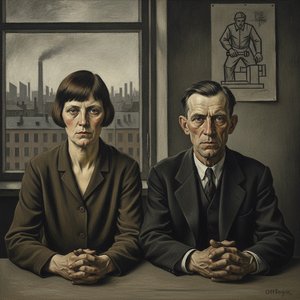 Neue Sachlichkeit: The Raw Realism and Social Critique of German New Objectivity
The Aftermath of War: Rejection of Expressionism and the Rise of New Objectivity To understand the emergence of Neue Sachlichkeit , one must first walk through the scarred landscapes of post-World War I Germany. The Great War had left the nation in a...
To understand the emergence of Neue Sachlichkeit, one must first walk through the scarred and psychologically fragmented landscapes of post-World War I Germany. The Great War had left the nation in a state of profound fragmentation, not merely redrawing borders but shattering the very foundations of European idealism. Before this era of stark clarity took hold, the German art world was vibrantly dominated by German Expressionism—a movement that functioned as a visceral, often agonizing scream against the horrors of conflict. It was an era of swirling, distorted forms and intense, subjective emotionality, where the internal storm of the soul was rendered through feverish, dreamlike palettes.
However, as the dust of the trenches settled and the 1920s unfolded, a new generation of artists began to feel that such emotional abstraction had become insufficient. The feverish dreams of the subconscious could no longer adequately document the tangible decay of a nation grappling with hyperinflation, political assassinations, and profound social upheaval. There was a growing, desperate need to move away from the internal psyche and toward an external, unblinking observation of the present moment. This transition was not merely stylistic but existential; it was a movement from the romanticized longing of the past toward a cold, much-needed confrontation with the reality of a broken society.
Defining Neue Sachlichkeit: The Pursuit of Clinical Realism and Social Order
 New Objectivity
The New Objectivity (in German: Neue Sachlichkeit) was a movement in German art that arose during the 1920s as a reaction against expressionism. The term was coined by Gustav Friedrich Hartlaub, the director of the Kunsthalle in Mannheim, who used it...
The term Neue Sachlichkeit, or New Objectivity, was famously coined by Gustav Friedrich Hartlaub, the director of the Kunsthalle Mannheim, to describe an art that sought a more disciplined engagement with the world. While some translations suggest "New Resignation" or "New Sobriety," the essence of the movement lay in its Sachlichkeit—a matter-of-factness, a precision, and a practical focus on the "thing" itself. This was an era that rejected the self-involvement of the Expressionists in favor of a clinical, almost detached realism that sought to strip away the romanticized layers of history to reveal the unvarnished truth of the Weimar Republic.
This pursuit of order amidst chaos manifested as a sharp, precise technique that emphasized clarity and definition. The artists utilized a style that was often described as an "all-business" attitude, much like the burgeoning industrial efficiency of the age. By focusing on the tangible—the texture of a soldier's uniform, the gleam of a decadent ballroom, or the weary eyes of a street vendor—they created a visual archive of a civilization in flux. It was art as a mirror, reflecting both the structural stability they craved and the profound instability they inhabited, capturing the very essence of an era caught between the wreckage of the old world and the uncertain promise of the new.
Masters of the Unblinking Eye: The Portraits and Urban Landscapes of Otto Dix and George Grosz
 Portrait of the Journalist Sylvia Von Harden
The Enigmatic Allure of Sylvia von Harden Otto Dix's "Portrait of the Journalist Sylvia Von Harden" is an iconic masterpiece that captures the essence of the Weimar Republic era. This striking portrait, created in 1926, features Sylvia von Harden, a ...
Among the titans of this movement, few captured the duality of the Weimar era as powerfully as Otto Dix and George Grosz. Dix, a key figure whose work often bridged the gap between the visceral and the clinical, produced masterpieces like the Portrait of the Modern Journalist Sylvia von Harden. In this iconic 1926 work, Dix employs an unflinching realism to bring the "New Woman" archetype to life. Through his attention to detail—the bobbed hair, the monocle, and the modern attire—he captures the enigmatic allure and the social shifts of the time. His use of both soft and sharp lines creates a dynamic interplay that reflects the psychological depth and the unsettling atmosphere of a society undergoing radical transformation.
In contrast, George Grosz utilized his brush and charcoal to launch scathing critiques against the moral bankruptcy of German society. His work, such as the striking Attack, plunges the viewer into the chaotic, nighttime urban environments of Berlin. Through monochromatic visions and a dynamic composition that guides the eye through scenes of struggle and decay, Grosz exposed the hypocrisy and corruption of the era. Whether through the biting satire of his social landscapes or the heavy, textured realism of his portraits, these masters ensured that the true face of Germany—no matter how grim—would never be forgotten by history.
Beyond the Canvas: Photography, Precision, and the Legacy of Aenne Biermann
 anna sibilla sternfeld
A Pioneer of New Objectivity: The Life and Legacy of Anna Sibilla Sternfeld Anna Sibilla Sternfeld, known professionally as Aenne Biermann, was a quietly revolutionary figure in the landscape of early 20th-century photography. Born on March 8, 1898, ...
While much of our reverence for New Objectivity is directed toward painting, the movement’s soul was equally present in the burgeoning field of photography. The movement sought to capture reality with uncompromising clarity and precision, a goal perfectly embodied by figures such as Aenne Biermann (known professionally as Anna Sibilla Sternfeld). A pioneer of the movement, Biermann brought an acute observational eye to her work, moving beyond mere documentation toward a deeper exploration of light, shadow, and form.
Her journey from capturing intimate family moments to becoming an internationally recognized artist mirrors the broader shift within German culture toward a more disciplined, objective view of the world. In photography, the New Objectivity found its most literal expression; the camera lens offered a way to strip away the subjective distortions of the painterly hand and present the subject with a clinical, unmediated truth. This photographic precision complemented the paintings of the era, creating a cohesive cultural aesthetic that valued the sharp edge of reality over the soft blur of romanticism.
The Weight of Truth: How New Objectivity Captured a Civilization in Flux
 Neue Sachlichkeit: The Sharp, Gritty Edge of Modern Realism and the Power of Unflinching Truth
The Death of the Dream: Moving Beyond Expressionist Chaos Neue Sachlichkeit: Objectivity, Realism & Social Commentary in Interwar German Art Introduction: The Rise of Neue Sachlichkeit – A Reaction to Expressionism Wikipedia: Expressionism Expression...
Ultimately, the legacy of Neue Sachlichkeit lies in its refusal to look away. It was an art movement that stood at the intersection of profound tragedy and vibrant modernism. By embracing a style that was often cold, detached, and even satirical, the artists of the 1920s provided a vital service: they documented the pulse of a nation during its most turbulent years. They captured the decadence of the café culture, the grit of the urban streets, and the psychological weight of a post-war identity.
Though the movement essentially ended with the rise of the Nazi dictatorship in 1933, its impact on the trajectory of modern art remains indelible. It taught us that there is a profound power in the unblinking gaze—that by confronting the most uncomfortable aspects of our reality with precision and clarity, we can achieve a deeper understanding of the human condition. The sharp, gritty edge of New Objectivity continues to resonate today, serving as a timeless reminder of the strength found in facing the truth, no matter how stark it may appear.


