

The Fracture of Harmony: Transitioning from Renaissance Stability to Mannerist Tension
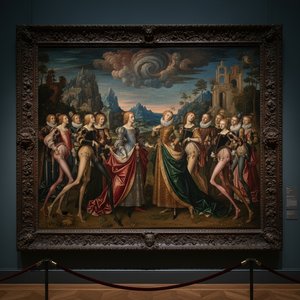 Northern Mannerism: The Dramatic Evolution of Renaissance Art and the Mastery of Elegant Distortion
The Transition from Renaissance Harmony to Mannerist Tension To understand the profound shift of Northern Mannerism, one must first contemplate the serene equilibrium of the High Renaissance. For decades, the artistic landscape was defined by a pursu...
To truly appreciate the breathtaking complexity of Northern Mannerism, one must first pause to contemplate the serene equilibrium that preceded it. For decades, the European artistic landscape was anchored by the profound pursuit of mathematical perfection. During the High Renaissance, masters like Leonardo da Vinci and Raphael sought to mirror the very order of the cosmos through stable pyramidal compositions, anatomical accuracy, and a light that converged to create a window into a divine, harmonious reality. There was a predictable, comforting beauty in this classical stability—a belief that art could capture the essence of a rational and balanced universe.
However, as the sixteenth century dawned, this sense of certainty began to fracture under the weight of profound social, religious, and political upheaval. The clarity of the Renaissance gave way to an era defined by ambiguity. Events such as the Sack of Rome in 1527 fostered a pervasive sense of instability and disillusionment across the continent. This was not a sudden rupture but a gradual, deliberate departure from the predictable. The mathematical certainty of the past felt increasingly inadequate to capture the spiritual anxieties and intellectual shifts of a changing Europe. In its place emerged a fascination with tension, where the pursuit of perfection was abandoned in favor of the pursuit of expression.
The Aesthetic of Elegance: Exploring Elongated Forms and Graceful Distortion
--- title: Mannerist | Tate url: https://www.tate.org.uk/art/art-terms/m/mannerist hostname: tate.org.uk description: Tate glossary definition for mannerist: Sixteenth century style characterised by artificiality, elegance and sensuous distortion of ...
As the stability of the Renaissance dissolved, a new visual language began to emerge—one that celebrated maniera, or individual style. This was the birth of an aesthetic characterized by what we now call elegant distortion. Rather than adhering to the strict proportions of nature, Mannerist artists embraced the artificial and the exaggerated. We see this in the deliberate manipulation of form, where limbs are stretched into impossible lengths and bodies are twisted into the figura serpentinata—a serpentine grace that is simultaneously beautiful and unsettling.
This movement privileged compositional tension over balance. Where a Renaissance master would seek symmetry, the Mannerist sought an asymmetrical, often crowded arrangement that keeps the viewer’s eye in constant motion. This was not a failure of skill, but a masterful demonstration of virtuosity. The goal was to move beyond mere imitation of the physical world toward an expression of internal, often turbulent, human experience. It is a style that demands much from the observer, rewarding those who look past the surface to find the intentionality within the distortion.
Northern Sensibilities: The Unique Spirit of the Netherlands and France
 Antwerp Mannerism
 refers to the style of a group of largely anonymous painters active in the southern Netherlands, principally in Antwerp, in roughly the first three decades of the 16th century. The movement marks the tail end of Early Netherlandish ...
While Italian Mannerism flourished under royal patronage in centers like Florence and Rome, Northern Mannerism developed its own distinct, often more original, character north of the Alps. In the Netherlands, particularly in Antwerp, a unique phenomenon known as Antwerp Mannerism emerged during the early sixteenth century. This style was less a direct imitation of Italian trends and certainly predated many of them; instead, it acted as a reaction to the "classic" style of earlier Flemish painters. These artists utilized a repertoire of stock motifs and ornate, crowded compositions that evoked a sense of exoticism and luxury.
The movement found significant strength in France and Prague as well, often driven by the sophisticated tastes of the courts. In the Netherlands, the rise of international trade brought an influx of wealth and foreign merchants, creating a demand for art that celebrated rich commodities and far-reaching exploration. This Northern variation blended the decorative elegance of the Italian style with a lingering Gothic sensibility, resulting in works that were both intellectually sophisticated and visually opulent, characterized by fluttering drapery and intricate, grotesque ornamentation.
Psychological Depth and Intimacy: Beyond the Surface of the Human Figure
 Hurdy-Gurdy Player
A Portrait of Wandering Sound: Jacques Bellange’s “Hurdy-Gurdy Player” Jacques Bellange's "Hurdy-Gurdy Player," etched in the early 17th century, is more than a simple depiction of a street musician; it’s a hauntingly intimate study of human characte...
Beyond the striking visual distortions lies the true soul of Northern Mannerism: a profound psychological intensity. One of the most hauntingly beautiful examples of this can be found in the works of Jacques Bellange. His etching, The Hurdy-Gurdy Player, serves as a masterful study of human character. In this work, we move away from idealized beauty and into a world of shadowed streets and solitary figures that reflect the complexities of early modern life.
Bellange’s ability to use the technical mastery of etching—utilizing meticulous hatching and cross-hatching—to create volume and texture allows for a palpable sense of unease and vulnerability. The subject is positioned off-center, creating an immediate sense of dynamic tension and melancholy. This focus on psychological realism, even through distorted forms, distinguishes Northern Mannerism from its predecessors. It invites us to contemplate the inner life of the subject, finding beauty not in perfection, but in the raw, often unsettling, truth of the human condition.
A Legacy of Complexity: How Northern Mannerism Shaped the Path to the Baroque
 Drama & Distortion: A Journey Through the Captivating World of Baroque Mannerism
The Renaissance Departure: From Serene Harmony to Mannerist Tension Drama and Distortion: A Definitive Guide to the Mastery of Mannerism and Baroque Art The Renaissance Departure: Understanding the Rise of Mannerism Mannerism Mannerism is a style in ...
As we look back through the lens of art history, we see that Northern Mannerism was a vital bridge between two eras. While it eventually receded in the early seventeenth century, making way for the dramatic, light-drenched intensity of Caravaggio and the early Baroque, its influence remained deeply embedded in the European consciousness. The movement’s fascination with drama, tension, and emotional complexity paved the way for the grand theatricality of the Baroque era.
For the modern collector and lover of art, Northern Mannerism offers a captivating window into a period of transition. It reminds us that art is not merely a mirror of reality, but a tool for exploring the fractures and complexities of our existence. Whether through the intricate lines of an etching or the sweeping, distorted grace of a painting, this era continues to inspire awe, challenging us to find elegance within the unexpected and beauty within the distorted.
At TopImpressionists.com, we share this lifelong passion for the transformative power of art. While our heart beats most strongly for the luminous light of Monet and the emotive textures of Van Gogh, we hold a profound respect for the historical movements that shaped the evolution of European creativity. We invite you to explore our curated collections of hand-painted oil reproductions, where every brushstroke is a tribute to the masters of the past. Whether you seek to bring the tension of a Mannerist masterpiece or the soft glow of an Impressionist landscape into your home, our dedicated artists are here to bring history to life on canvas.


