--- title: Impressionism, an introduction – Smarthistory author: Dr Beth Gersh-Nesic url: https://smarthistory.org/a-beginners-guide-to-impressionism/ hostname: smarthistory.org description: Rebelling against tradition, the Impressionists exhibited t...
There is a specific kind of magic that occurs when we stop looking at objects and begin looking at the light that defines them. In the works of the Impressionists, color does not sit heavily upon the canvas; instead, it dances. This was achieved through a technique of placing small commas of pure, unmixed color side by side. When viewed from a distance, these individual marks undergo an optical blending within the eye of the observer, creating a luminosity that physical mixing on a palette often lacks.
Long before the Impressionists experimented with this flickering brilliance, the masters of the Renaissance sought clarity through precise edges and smooth transitions. They relied on the stability of form and the permanence of shadow. The Impressionists, however, chose to break that stability. They replaced the solid line with a vibration of light, allowing the eye to participate in the creation of the image. It is a subtle shift from observing a finished object to experiencing a living sensation.
A Lineage of Landscapes: From Barbizon Roots to Impressionist Skies
Discover Jules Dupre’s ‘Landscape with Cattle at Limousin’ (1837). A dramatic Barbizon painting showcasing dynamic movement & light, capturing rural France's sublime beauty. Oil on canvas.
The pastoral scenes we admire today did not emerge from a vacuum. They are the direct descendants of the Barbizon School, a group of painters who sought refuge in the forests of Fontainebleau. These artists looked away from the growing noise of urbanization, choosing instead to paint poetic, romanticized versions of nature. Their work possessed a certain weight and a quiet, somative dignity that anchored the landscape in tradition.
The Impressionists inherited this love for the countryside but altered its very pulse. While the Barbizon painters sought the eternal, the Impressionists sought the ephemeral. They took the foundation of the landscape and infused it with the movement of the present moment. Where the older school found a permanent sanctuary, the newer generation found a shifting stage of light and air.
Capturing the Fleeting: The Practice of En Plein Air
To paint outdoors, or en plein air, was more than a stylistic choice; it was an act of devotion to the truth of the moment. Artists like Claude Monet and Pierre-Auguste Renoir moved their easels into the open air to witness the precise second when sunlight hits a haystacks or ripples across a river. This method required speed and a certain bravery, as the light they sought to record would inevitably fade or change before the paint could even dry.
This practice finds an echo in the earlier traditions of studio-bound composition, where landscapes were meticulously constructed from sketches and memories. Those works were carefully planned, much like a stage set designed for permanence. The Impressionists rejected this controlled environment. They embraced the unpredictability of the weather, finding that the true character of a landscape is revealed only when one is subject to its winds and its sudden, passing clouds.
Nature and Industry: The Evolution of the Pastoral Subject
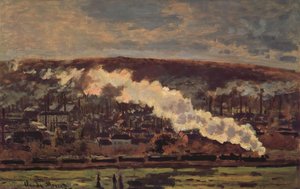
The definition of the pastoral underwent a profound transformation during the late nineteenth century. For some, like Camille Pissarro, the landscape was not merely an escape from modernity but a way to document it. In his depictions of the village of Pontoise, one might see the peaceful riverbanks of the Oise alongside the encroaching presence of factories. He did not shy away from the industrial reality; he integrated it into the greenery.
This tension mirrors the earlier Romantic era, which often viewed nature as a pristine, untouched force, separate from human interference. The Impressionists, however, accepted the modern world. They painted the train cutting through verdant fields and the leisure of suburban life at La Grenouillère. They understood that the landscape is not a static relic of the past, but a living entity shaped by the hands of progress.
The Texture of Atmosphere: Recording Shifting Weather
There is a tactile quality to an Impressionist sky. Through visible brushstrokes and a delicate handling of surface, these artists captured the very weight of the atmosphere. One can almost feel the humidity of a summer afternoon or the crispness of a gray, overcast morning. They recorded the trembling of leaves and the shimmer of water, using texture to represent the movement of air itself.
This focus on atmospheric texture stands in contrast to the Neoclassical tradition, where the sky often served as a smooth, idealized backdrop for historical drama. In those works, the atmosphere was secondary to the narrative. For the Impressionists, the atmosphere was the subject. The goal was not to tell a story of heroes, but to tell the story of a single, breathing moment in time.
The Enduring Glow: Finding Stillness in a Moving World
As we look upon these works decades or even centuries later, we find something that transcends the era of their creation. Despite the rapid pace of the brushwork and the focus on the fleeting, there is a profound sense of stillness to be found in an Impressionist landscape. It is the stillness of a moment caught before it vanishes forever.
We see this same search for permanence in the great works of history that preceded them—works that sought to freeze time through monumental scale and rigid composition. The Impressionists achieved a different kind of permanence. They did not freeze time; they honored its passing. In doing so, they created an art that remains deeply resonant with our own experience of a world that never stops moving.
At TopImpressionists.com, we invite you to bring this light into your own home. Whether through a hand-painted oil reproduction on cotton canvas or a custom commission that transforms a personal memory into the style of Monet, our mission is to preserve the luminous spirit of the Impressionist era for generations to come.
Explore the profound serenity of monastic life through Impressionist art. Discover how masters captured spiritual light and solitude, and learn how to bring these soulful, hand-painted oil reproductions into your home with TopImpressionists.com.
Explore the life & art of Charles-François Daubigny, a pivotal Barbizon School painter. Discover his innovative landscapes, mastery of light, and influence on Impressionism. High-quality reproductions available.
Explore the captivating world of Impressionism! Discover techniques, key artists like Monet & Renoir, and its lasting influence on art history. A comprehensive guide for enthusiasts.
Discover the ethereal beauty of Impressionism. Explore how masters like Monet and Renoir captured light and motion through exquisite, hand-painted oil reproductions and bespoke commissions designed for true art lovers.



 Landscape with Cattle at Limousin


