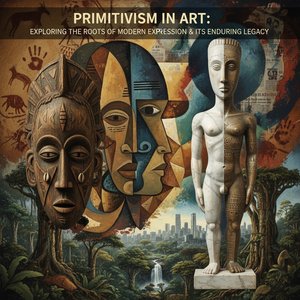
The Aesthetic of the Untamed: Defining Primitivism in the Western Canon
 Primitivism Unveiled: How Raw Expression and Aesthetic Idealization Redefined Modern Art History
The Aesthetic of the Untamed: Defining Primitivism in Western Art Primitivism In the arts of the Western world, Primitivism is a mode of aesthetic idealization that means to recreate the experience of the primitive time, place, and person, either by ...
To step into the world of art history is to witness a grand, sweeping dialogue between the polished and the profound. For those of us who have spent decades finding solace in the soft, dappled light of an Impressionist landscape, the concept of Primitivism may initially feel like a startling departure. Yet, beneath its complex and often debated terminology lies a deeply human yearning—a desire to reconnect with something elemental. In the Western tradition, Primitivism emerged not merely as a stylistic choice, but as a profound mode of aesthetic idealization. It was an attempt to recreate the experience of a perceived primitive time, place, and person, seeking to bypass the increasingly cluttered and industrial urban values of Europe in favor of a lost, sacred simplicity.
This movement was characterized by a search for the untamed. It sought to find beauty in the unrefined, looking toward what were perceived as more direct and spiritually pure ways of being. For the discerning eye, Primitivism represents a moment where the artist stops trying to mirror the world with photographic precision and begins to capture its pulse. It is an aesthetic that values the essence over the ornament, inviting us to look past the surface of things to find the raw vitality that resides within the soul of the subject.
Breaking the Academy: The Rejection of Mimesis and the Rise of Raw Expression
 Primitivism Unveished: How Raw Emotion and Non-Western Aesthetics Redefined the Course of Modern Art
The Essence of Primitivism: Breaking from Academic Tradition To understand the seismic shift that occurred at the dawn of the twentieth century, one must first envision the rigid, polished world of the European Academies. For generations, the pinnacl...
For generations, the pinnacle of artistic achievement was dictated by the rigid, almost suffocating standards of the European Academies. The goal was mimesis—the meticulous, near-perfect imitation of reality through smooth brushwork, anatomical perfection, and a strict adherence to perspective. The masters sought to hide the very hand that held the brush, presenting a window into a perfected world where every shadow served a calculated illusion. However, as the nineteenth century gave way to the twentieth, a seismic shift began to occur. A new generation of artists felt a growing alienation from these established conventions, sensing that the "perfected" world was, in fact, losing its heartbeat.
This rebellion against the academic tradition paved the way for a revolution of expression. Artists began to embrace the jagged, the asymmetrical, and the unrefined. They found power in the visible brushstroke and the bold, heavy outline. This was an era where perfection was being traded for authenticity. By rejecting the polished finish of the Academy, these creators allowed the texture of the paint and the energy of the movement to become part of the narrative itself. It was a liberation of the medium, allowing art to breathe with a new, unfiltered intensity that spoke directly to the human condition, far removed from the sterile precision of academic realism.
Echoes of the Elemental: How Non-Western Motifs Reshaped Modernist Vision
Primitivism in art involves the appreciation and imitation of cultural products and practices perceived to be “primitive,” or at an earlier stage of a supposed ...
The true transformative power of Primitivism lay in its gaze outward. To find the spiritual purity they craved, Western artists turned their attention to the cultural products and practices of Asian, African, and Australasian peoples. They were captivated by the motifs, techniques, and symbolic languages found in these "exotic" arts—elements that felt far removed from the industrializing West. This was not an attempt at ethnographic accuracy, but rather a pursuit of a certain aesthetic truth. By integrating these non-Western influences, artists could inject a sense of raw, unmediated energy into their canvases.
We see this influence in the way perspectives began to flatten and forms became more geometric and symbolic. The introduction of bold, non-naturalistic colors and simplified shapes challenged the very definition of "refined" art. This cross-cultural dialogue, while complex in its historical context, fundamentally expanded the vocabulary of Modernism. It provided the tools for artists to dismantle long-standing traditions and build a new visual language—one that was capable of expressing the fragmented, multifaceted experience of a modernizing world through the lens of ancient, elemental strength.
From Gauguin to Picasso: A Lineage of Spiritual and Aesthetic Purity
 Woman with yellow shirt
Pablo Picasso’s “Woman with Yellow Shirt”: A Window into Primitivism and Inner Turmoil Pablo Picasso's "Woman with Yellow Shirt," painted in 1907, stands as a pivotal work within the artist’s burgeoning exploration of Naive Art – or Primitivism – a m...
The lineage of this movement is beautifully traced through the works of titans who dared to dream in bolder strokes. One cannot discuss this era without reflecting on the spirit of Paul Gauguin, whose work often sought to capture a sense of primordial energy and a departure from the civilized world. His use of color and simplified form served as a bridge toward a more symbolic, spiritual way of seeing. This path was later paved by the monumental innovations of Pablo Picasso. In works such as "Woman with Yellow Shirt," we witness Picasso’s profound fascination with Naive Art and Primitivism. He moved away from traditional academic styles to embrace a concentrated distillation of emotion, using vibrant hues and simplified anatomy to tap into a more primal core.
Even within the realms of Cubism, the echoes of this raw expression remain. In pieces like "Bust of a Woman and Self-Portrait," Picasso blends the fragmented perspective of Cubism with the directness of Naive Art, creating a visual dialogue that is both deeply personal and structurally revolutionary. This lineage shows us that Primitivism was not a single moment in time, but a continuous thread of exploration—a relentless pursuit of an aesthetic that could capture the complexity of identity and the enduring power of the human spirit through simplified, yet profoundly expressive, forms.
The Enduring Allure of the Unfiltered: Why Primitivism Still Resonates Today
 Raw & Unfiltered: Why Naive Art and Primitivism are Dominating Modern Street Style
The Anti-Aesthetic Revolution: Why Perfection is Out and Rawness is In Raw, Bold, Unfiltered: Why Naive Art is the Ultimate Vibe for Your Space The Anti-Aesthetic Revolution: Why Perfection is Out and Rawness is In Naive Art Unveiled: The Charming Be...
In our contemporary era, where our digital existence is hyper-curated and polished to a mirror finish by algorithms and high-definition filters, we find ourselves experiencing a profound cultural fatigue. There is a growing, quiet rebellion against this sterile precision. We are witnessing a return to the anti-aesthetic—a craving for something that feels humanly flawed, authentic, and real. The allure of the raw and the unfiltered provides a necessary anchor to reality in an increasingly synthetic world.
This is why the spirit of Primitivism continues to resonate within our modern sensibilities. We find beauty in the grit, the grain, and the unexpected. Whether it is through the bold textures of a hand-painted oil reproduction or the deliberate use of distressed elements in modern design, we are all searching for that sense of presence that high-gloss perfection cannot provide. The legacy of Primitivism teaches us that true beauty does not always lie in the smooth or the symmetrical, but often in the raw, unmediated expression of the soul—a truth that remains as vital today as it was at the dawn of the twentieth century.
At TopImpressionists.com, we celebrate this enduring passion for the authentic. Our mission is to make the profound beauty of fine art accessible to all, specializing in exquisite, hand-painted oil reproductions that honor the texture and soul of the masters. Whether you wish to transform a personal memory into a masterpiece through our Custom Paintings from Photos service, or explore the vibrant energy of historical movements, our master artists bring the weight of history to your walls with every visible brushstroke. We invite you to rediscover the power of the unfiltered.