The Humanist Pulse: Reclaiming Classical Wisdom
Renaissance art | Definition, Characteristics, Style ...
The transition from the medieval period to the Italian Renaissance was never a sudden rupture, but rather a slow, deliberate awakening. It began with a quiet shift in how we perceived our place within the natural world, moving away from the rigid dogmas of scholasticism toward a renewed fascination with the intellect and the individual. This movement, known as humanism, sought to revive the rhetoric, history, and moral philosophy of Roman antiquity. In the streets of Florence, this was not merely an academic pursuit; it was a way of seeing. The scholars looked backward to find the tools to move forward, finding in ancient texts a framework for understanding human dignity and the beauty of the physical realm.
This intellectual revival finds its echo in the very structure of our modern appreciation for the arts. Just as the humanists sought to integrate classical learning with contemporary life, we look to these old masters not as relics of a dead era, but as living instructors in the art of observation. To study the works of this period is to participate in that same reclamation of wisdom, finding relevance in their pursuit of truth through the lens of antiquity.
--- title: Renaissance art | Definition, Characteristics, Style, Examples, & Facts | Britannica author: Britannica Editors url: https://www.britannica.com/art/Renaissance-art hostname: britannica.com description: Renaissance art, painting, sculpture,...
Mathematical Grace: The Invention of Linear Perspective
If humanism provided the soul of the Renaissance, then mathematics provided its skeleton. One of the most profound shifts in visual language occurred when artists began to treat the flat surface of a painting not as a decorative plane, but as a window into a measurable, three-dimensional world. Masaccio, a pioneer of this era, utilized one-point linear perspective to ground his figures within a coherent, rational space. In works such as the Trinity in Santa Maria Novella, the architecture does not merely surround the subjects; it recedes with a scientific precision that pulls the viewer into the sacred scene. This was the birth of an illusionism so potent it changed the very nature of sight. We see this same impulse toward order and clarity in the way we approach the curation of beauty today. The discipline required to master such geometry mirrors the careful composition found in a well-ordered home or a thoughtfully arranged gallery. There is a profound comfort in the recognition of structure, a sense that even within the vastness of art, there exists a logic that can be understood and embraced.The Living Marble: Contrapposto and the Human Form
The Renaissance obsession with the human body was far more than an interest in anatomy; it was a celebration of weight, balance, and movement. Sculptors like Donatello looked to the classical past to rediscover contrapposto—that subtle, asymmetrical shift of weight where one leg bears the load while the even hips and shoulders respond. His bronze David possesses a lithe, sensual vitality that breaks free from the stiff, frontal poses of previous centuries. By capturing the body in a state of potential motion, these artists breathed life into stone and metal, honoring the physical reality of the human condition. This reverence for the organic form finds its parallel in our dedication to the tactile nature of oil painting. Just as Donatello manipulated bronze to suggest the softness of skin, our artists use thick, visible brushstrokes and heavy impasto to ensure that a painting possesses a physical presence. We reject the flat, characterless surface of a digital print in favor of a medium that, much like a sculpted figure, occupies space with texture and weight.Atmospheric Mystery: Leonardo’s Sfumato Technique
As the High Renaissance reached its zenith, the clarity of early mathematical perspective gave way to something more elusive and profound. Leonardo da Vinci introduced sfumato, a technique of layering incredibly fine, translucent glazes to create smoky, seamless transitions between light and shadow. In the Mona Lisa, there are no harsh outlines; the corners of the eyes and the edges of the mouth dissolve into the surrounding atmosphere. This soft, blurred effect does not obscure the subject but rather imbes it with a psychological depth, suggesting thoughts and emotions that remain just out of reach. This pursuit of subtlety is a principle we hold dear in our custom commissions. When a client asks to see a modern portrait reimagined through a historical lens, we do not seek mere imitation, but the capture of that same atmospheric soul. The goal is to move beyond the literal, using the softness of light and the depth of tone to create an image that feels as though it possesses its own breath and mystery.Venetian Luminosity: The Mastery of Color and Light
 Robusti jacopo portrait of a bearded venetian nobleman
Experience Tintoretto’s masterful Venetian portrait! This black & white masterpiece showcases dramatic chiaroscuro and bold brushstrokes depicting a noble Venetian gentleman – explore its symbolism and artistic legacy.
The Patron's Hand: Art as a Declaration of Virtue
Art in the Italian Renaissance Republics, c. 1400–1600
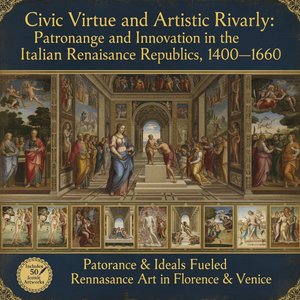
It is an uncomfortable truth that the greatest achievements of the Renaissance were often fueled by the ambitions of the powerful. The Medici family, the bankers and rulers of Florence, did not commission art merely for aesthetic pleasure; they used it to signal their piety, their wealth, and their civic virtue. Art was a tool of diplomacy and a declaration of status. From the bronze Gates of Paradise by Ghiberti to the monumental frescoes of Michelangelo, every stroke was an investment in the cultural capital of the city-state. The artist and the patron were bound together in a shared pursuit of glory.
This tradition of meaningful patronage continues in our relationship with those who collect art. We do not view ourselves as mere vendors, but as partners in the creation of a lasting legacy. Whether it is a custom portrait that commemorates a family milestone or a large-scale mural designed to define an architectural space, we understand that art is an investment in memory and identity. At TopImpressionists.com, we honor this ancient bond between the creator and the collector, ensuring that every piece serves as a profound expression of the owner's discerning taste.
--- title: Art in the Italian Renaissance Republics, c. 1400–1600 – Smarthistory author: Dr Heather Graham url: https://smarthistory.org/reframing-art-history/art-italian-renaissance-republics/ hostname: smarthistory.org sitename: Smarthistory date: ...