The Foundations of Royal Portraiture: Ancient Origins & Early Dynasties The Embodiment of Power: Exploring Representations of Status in Art History Explore the fascinating history of status symbols in art! Discover how Renaissance portraits conveyed ...
To look upon a royal portrait is to witness a deliberate construction of truth. Long before the advent of the camera, monarchs understood that their physical presence could be engineered through the tip of a brush or the chisel of a sculptor. This impulse finds its most rigid expression in ancient Egypt, where portraiture functioned as a religious tool to maintain Ma'at, or cosmic order. The pharaohs were rarely depicted with the messy idiosyncrasies of human flesh; instead, they were rendered through idealized, stylized forms that emphasized their connection to the divine. These stone carvings and tomb paintings were not meant to be photographic, but rather a permanent abode for the spirit, ensuring an eternal, sinless existence.
This ancient drive toward perfection finds a sophisticated echo in the Renaissance and Baroque eras. While the Egyptian artist sought to exclude imperfection to preserve cosmic order, the painters of European courts began to use realism to command respect. The focus shifted from the purely symbolic to the psychological, yet the underlying goal remained unchanged: the creation of an immutable identity that could withstand the volatility of politics. When we view these works today, we see the foundation of how leaders attempt to project an enduring authority that transcends their biological lifespan.
Threads of Authority: Decoding Textiles and Regalia
The portraiture of Queen Elizabeth I (1533–1603) spans the evolution of English royal portraits in the early modern period (1400/1500–1800), from the earliest representations of simple likenesses to the later complex imagery used to convey the power ...
A royal portrait is a carefully constructed language of status, where every texture serves as a signal of power. For the aristocracy, wealth was not merely possessed; it was worn. The heavy drape of velvet, the shimmer of silk, and the cold glint of pearls were never accidental details. Consider the portraits of Queen Elizabeth I, where layers of iconography—globes, crowns, swords, and columns—intertwine with representations of purity, such as moons and pearls. In her later works, the focus moved toward a decorative pattern that achieved an effect of splendid majesty through sheer material opulence.
This reliance on material to communicate rank finds a historical echo in the 19th-century portrait of Ferdinand I by Josef Kriehuber. In this work, the sitter is presented in full regal attire, emphasizing his status as a sovereign within the Habsburg Empire. Dressed in elaborate armor and richly embroidered garments, he wears a majestic crown and holds a scepter—traditional symbols of sovereignty. The use of light and shadow captures the textures of metallic armor and soft fabrics with precision, much like the way Louis XIV’s portraits by Hyacinthe Rigaud utilized ermine and the fleur-de-lis to emphasize absolute power. In both eras, the clothing does not merely cover the body; it announces the office.
The Architect of Identity: Establishing the Sovereign Image
William Alan Menzies: The Architect of Regal Portraits William Alan Menzies, a British artist working primarily during the late 19th and early 20th centuries, remains an enigmatic yet profoundly influential figure in the history of portraiture. More ...
Beyond mere physical resemblance, royal portraits have always been laden with iconography—a complex visual language designed to communicate legitimacy. The transition from the medieval period, where faces were secondary to theological messages, to an era where the individual became a monumental force, required artists to become architects of identity. In Tudor England, this was achieved through a controlled use of "face patterns" or approved drawings, ensuring that the monarch's image remained consistent and recognizable across various media, from large oil panels to small portrait miniatures on vellum.
This construction of a stable image finds its parallel in the work of William Alan Menzies. Working during the late 19th and early 20th centuries, Menzies was more than a painter; he was a meticulous craftsman who used staged grandeur to evoke specific historical roles. His ability to capture the very essence of dignity and gravitas mirrors the way Hans Holbein the Younger established the visual authority of Henry VIII. Just as Holbein used the cloth of honor to highlight royal authority, Menzies utilized composition and dramatic lighting to create a deliberate construction of visual authority, proving that the creation of a ruler's image is an exercise in controlled elegance.
The Politics of Presence: Portraits as Dynastic Propaganda
--- title: Coronation portraits of the United Kingdom - Wikipedia url: https://en.wikipedia.org/wiki/Coronation_portraits_of_the_United_Kingdom hostname: wikipedia.org sitename: Wikimedia Foundation, Inc. date: 2025-05-08 --- # Coronation portraits o...
Portraiture has frequently been used as a political act, an assertion of privilege and status designed to secure loyalty. In 1544, Kateryn Parr, the sixth wife of Henry VIII, was instrumental in commissioning a campaign of portraits for her stepchildren, Mary and Elizabeth. These works were intended to be visual affirmations of their enhanced status following the Act of Serccession, serving as icons of imperial monarchy to ambassadors and courtiers alike. The portrait was not merely a likeness; it was a declaration of dynastic right.
This use of art to stabilize a lineage is echoed in the coronation portraits of the United Kingdom. These large-scale oil paintings often depict monarchs in their coronation robes, surrounded by the crown, orb, and scepter. From the 1620 portrait of James VI and I by Paul van Somer to the more recent works for Charles III, these images function as a reaffirmation of ritual and national unity. Whether through the strategic commissioning of Tudor heirs or the formal state portraits of the House of Windsor, the goal remains the same: to use the painted image to project the stability of the institution itself.
From Courtly Grandeur to Private Intimacy: The Evolution of the Gaze
--- title: Tudors to Windsors: British Royal Portraits from Holbein to Warhol (October 7, 2018–January 27, 2019) url: https://www.mfah.org/art/exhibitions/tudors-to-windsors-british-royal-portraits-holbein-warhol hostname: mfah.org description: This ...
As time progressed, the nature of the royal gaze shifted from the untouchable icon to a more humanized figure. While early state portraits emphasized a sense of distance and divine right, later traditions began to explore more intimate settings. Elisabeth Vigée Le Brun’s portrait of Marie Antoinette, for instance, depicts her as a tender mother with her children, using a maternal image to counter political criticism. This move toward the personal allowed the monarchy to connect with the viewer on a more emotional, human level.
This evolution is reflected in the works of Winterhalter, whose portrait of Queen Victoria and Prince Albert presents the royal couple in a domestic setting. By blending opulent attire with images of their children, the painting emphasizes both family life and dynastic continuity. This shift from the rigid, formal poses of the Renaissance to the more relatable, domestic scenes of the 19th century demonstrates how the monarchy adapted its visual strategy to meet the changing expectations of the public, moving from a position of distant authority to one of shared human experience.
The Enduring Legacy: How Historical Iconography Shapes Modern Perception
The Genesis of Likeness: Portraiture in Antiquity and the Renaissance Wikipedia: Portrait painting Portrait painting is a genre in painting, where the intent is to represent a specific human subject. The term 'portrait painting' can also describe the...
The impulse to capture and manipulate the image of power remains a fundamental aspect of our visual culture. We see the foundations of ancient royal portraiture in how modern leaders attempt to manage their public personas through photography and digital media. The techniques developed by court painters—the careful selection of props, the strategic use of lighting, and the manipulation of setting—continue to inform how authority is projected in the contemporary age.
We can still observe these historical echoes when we examine the way modern commemorations are staged. Just as the coronation portraits of the United Kingdom utilize the regalia of the past to assert continuity, modern portraiture seeks to link current figures to a long lineage of leadership. The study of these works allows us to look past the surface and understand the deeper narratives of power, identity, and permanence that have been woven into the fabric of art for centuries. Through the lens of history, we learn that every brushstroke in a royal portrait is a deliberate step toward immortality.
Explore the captivating history of royal portraiture with TopImpressionists. Discover the symbolism, artistry, and enduring legacy of regal imagery in art. Expert insights for collectors & enthusiasts.
Explore the rich history of formal portraiture & its enduring power to capture identity and shape perception. Discover investment-worthy artworks, expert appraisals, and custom reproduction services at TopImpressionists.


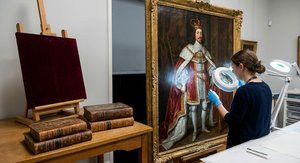 The Majesty of Representation: Exploring Regal Imagery in Art History
 Portraiture of Elizabeth I
 William Alan Menzies
 The Enduring Legacy of Formal Portraiture: Power, Identity & Artistic Exploration


