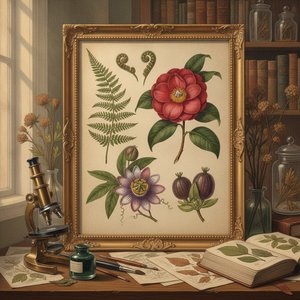
The Convergence of Science and Soul: An Introduction to Botanical Realism
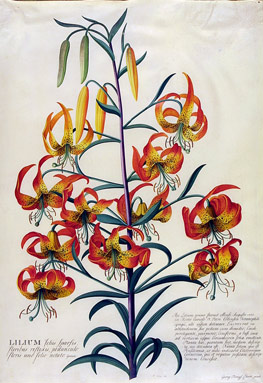 Botanical illustration
Botanical illustration is the art of depicting the form, color, and details of plant species. They are generally meant to be scientifically descriptive about subjects depicted and are often found printed alongside a botanical description in books, ma...
To wander through the annals of art history is to witness a profound, ancient dialogue between humanity and the verdant world. Long before the advent of sophisticated scientific tools or the clarity of the camera lens, our understanding of the plant kingdom was inextricably linked to the skill and patience of the artist. There exists a unique, almost sacred space where the rigorous demands of scientific inquiry dissolve into profound aesthetic grace. This is the realm of botanical realism, a genre that does not merely depict flora but seeks to capture its very essence through a harmonious blend of accuracy and understated beauty.
For the discerning collector, these works offer more than mere decoration; they are windows into a period when the artist's eye was the primary instrument of discovery. In this delicate intersection, the specimen is treated with both the scrutiny of a naturalist and the reverence of a poet. The result is an art form that transcends the boundaries of biology, transforming a simple study of a leaf or petal into a meditative experience of nature’s enduring majesty.
Masters of the Meticulous: The Legacy of Kerner, Havell, and the Pioneers of Precision
 johann simon von kerner
Johann Simon von Kerner: A Pioneer of Botanical Illustration Born in Kirchheim bei Teck, Germany, in 1755, Johann Simon von Kerner’s life was inextricably linked to the burgeoning world of botany and scientific illustration. His legacy rests primaril...
The history of botanical illustration is written by hands that possessed an almost obsessive attention to detail. We look back with admiration at figures like Johann Simon von Kerner, a pioneer whose life was inextricably linked to the burgeoning world of botany. His monumental twelve-volume work, Hortus Sempervirens, stands as a testament to his dedication to capturing the essence of plant life through meticulous observation. Such works were not merely artistic endeavors but scholarly pursuits, designed to bring the complexity of the natural world within reach of a wider audience.
Similarly, the 19th-century artistry of Robert Havell Jr. offers us captivating glimpses into a world of exquisite precision. His study of Lilium candidum exemplifies the technical mastery of his era, utilizing fine, precise lines to define delicate forms and expert hatching to suggest subtle textures. In these works, we see the transition from art as myth to art as a tool for human advancement. Even the more atmospheric contributions, such as those by Maud H. Purdy or the early scientific documentation of Claude Aubriet, remind us that behind every stroke lies a commitment to documenting the truth of the natural form.
From Herbals to Masterpieces: The Historical Evolution of Scientific Observation
 Botanical Realism: The Art of Capturing Nature's Precise Detail through Scientific Mastery
The Evolution of Observation: From Ancient Herbals to Scientific Realism The Art of Precision: A Definitive Guide to Scientific Illustration and Botanical Mastery The Roots of Observation: From Ancient Herbals to Scientific Realism The Flourishing Ca...
The roots of this tradition reach deep into the medieval period, where monasteries served as vital centers for preserving botanical knowledge. Within these cloistered gardens, monks cultivated plants for their medicinal properties, creating illustrated compendiums known as herbals. While these early works often relied on artistic conventions that prioritized symbolic meaning over strict realism, they laid the essential groundwork for a more disciplined approach to observation. This era marked a pivotal shift from art serving purely cosmological or symbolic purposes toward a burgeoning need for utility and survival.
As centuries progressed, this impulse evolved into a sophisticated scientific realism. The Renaissance brought a renewed interest in anatomical accuracy, fueled by the patronage of families like the Medici, whose influence can still be felt in historic institutions like the Museo Botanico in Florence. This evolution turned the botanical plate from a simple medicinal guide into a high art form, where the artist's ability to render the life cycle, habitat, and morphology of a species became a celebrated skill, bridging the gap between the laboratory and the gallery.
The Art of the Detail: Technical Mastery in Watercolor and Ink
 Illustration: Trumpet Creeper
Exquisite 1932 botanical illustration by Maud H. Purdy: 'Trumpet Creeper'. Detailed watercolor study of a *Campis radicans* plant, showcasing scientific precision & natural beauty.
The true magic of scientific illustration lies in its technical execution. To achieve such profound realism, illustrators often employed a delicate dance of media, frequently utilizing watercolour for its luminous transparency, layered with precise ink outlines to define structure. This technique allows for a breathtaking range of textures—the smooth, waxy surface of a petal contrasting beautifully with the intricate veining of a leaf or the slightly rougher appearance of a stem.
Mastery is found in the subtle use of light and shadow. Through careful shading and a restrained yet effective color palette, artists create an illusion of three-dimensionality on a flat surface. The use of muted, naturalistic tones ensures that the scientific accuracy remains paramount, avoiding dramatic artistic expression in favor of a truthful representation. It is this very precision—the ability to capture the minute details visible only under close scrutiny—that gives these works their enduring, tactile quality.
Nature’s Living Canvas: The Enduring Aesthetic Appeal for the Modern Collector
 Cambridge University Botanic Garden
A Living Chronicle of Botanical Artistry Nestled within the historic heart of Cambridge, the Cambridge University Botanic Garden serves as much more than a mere horticultural display; it is a living, breathing masterpiece where scientific inquiry mee...
In our modern, fast-paced world, there is a profound longing for the stillness found within botanical art. For the contemporary collector, these pieces offer a sense of permanence and a connection to the slow, rhythmic cycles of the earth. There is an inherent elegance in a well-executed botanical study that complements any sophisticated interior, providing a touch of natural grace that is both intellectually stimulating and deeply soothing.
< …, as seen in the historic Cambridge University Botanic Garden, where every bloom acts as a brushstroke in a centuries-old portrait of nature. Whether it is the vibrant energy of a tropical scene or the quiet dignity of a single white lily, these works invite us to slow down and appreciate the intricate interconnectedness of life. They serve as a reminder that true beauty often resides in the smallest, most precisely rendered details.Preserving the Natural Record: The Intersection of Botanical Art and Scientific Discovery
 Natural history
Natural history is a domain of inquiry involving organisms, including animals, fungi, and plants, in their natural environment, leaning more towards observational than experimental methods of study. A person who studies natural history is called a na...
Ultimately, botanical illustration serves as a vital visual archive. Before the era of photography, these illustrations were essential for documenting new species discovered during global explorations. They functioned as indispensable references for taxonomists, providing a way to identify specimens that were too fragile or too distant to be transported. This legacy of documentation ensures that even as our understanding of science evolves, the artistic record remains a steadfast witness to the biodiversity of our planet.
As we continue to explore the boundaries between science and art, we find that the two are not opposing forces but rather complementary lenses through which we view the world. The botanical illustrator does not merely copy nature; they interpret it, preserving the fleeting beauty of a bloom within the enduring medium of art. For those who cherish the intersection of knowledge and beauty, these works remain an incomparable treasure.
This article was originally published on TopImpressionists.com.