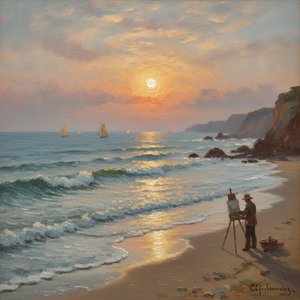
Introduction Close your eyes for a moment and imagine the world not as a collection of fixed lines and rigid shapes, but as a shimmering dance of light and atmosphere. Imagine the way a morning mist clings to the reeds of a pond, or how the setting s...
To stand before an Impressionist seascape is to experience a sudden, soft collision between the eye and the atmosphere. There is no harsh introduction here, only the gradual realization that the water and the sky are engaged in a continuous, shimmering dialogue. When we first approach these works, we do not see rigid boundaries or the heavy, dark outlines of earlier maritime traditions. Instead, we encounter a world where the edges of things have begun to dissolve. The light does not merely sit upon the surface; it seems to emanate from within the very pigment, a sensation achieved through the careful layering of color that mimics the way morning mist clings to the coastal air.
This initial encounter often brings a sense of quiet recognition. We remember our own moments by the shore, where the sun, low on the horizon, turns the spray into a fine, golden dust. The Impressionists understood this fleetingness. They stepped out of the controlled, dim environments of the studio to embrace en plein airpainting, seeking to record the precise sensation of a single moment before the light shifted forever. In doing so, they moved away from the somber, academic shadows of the past, replacing them with a palette that breathes.
Observing the Surface: The Alchemy of Color and Luminosity
A Glimpse of Modern Life: Edouard Manet’s “Seascape” Edouard Manet's 1873 oil on canvas, "Seascape," is more than just a depiction of the ocean; it’s a pivotal work reflecting the artist’s transition and contribution to the burgeoning Impressionist m...
As we move closer, the true complexity of the sea reveals itself through an intricate alchemy of color. What appeared from a distance to be a simple blue expanse reveals itself upon closer inspection as a mosaic of ultramarine, cobalt, teal, and even unexpected hints of violet or pale pink. The Impressionists studied light and color with a scientific devotion, realizing that shadows are rarely black or grey, but are instead composed of reflected hues from the sky and the surrounding landscape.
In works like those by Pierre-Auguste Renoir, we see how the surface of the water becomes a mirror for the heavens. By using light from behind or to the side of the subject, artists create a dramatic contrast between the deep, cool shadows of a swell and the sharp, brilliant highlights of the cresting foam. This technique adds a three-dimensional quality to the canvas, making the water feel heavy and real even as it appears translucent. The use of broken brushstrokes allows these colors to dance, preventing the eye from resting too long on any single point and instead encouraging a continuous movement across the liquid surface.
Discover Daubigny’s "Seascape" (1867): A dramatic oil painting of a stormy ocean & sky in an impressionistic style. Explore this evocative artwork's beauty and historical significance.
The eye is often drawn to a specific focal point within these compositions—a moment of kinetic energy where the sea asserts its power. Many seascape painters utilize an 'S' composition, where the direction of a breaking wave or the curve of a shoreline leads the viewer’s gaze through the painting. This structural choice creates a sense of naturalism and spontaneity, as if we have stumbled upon a wave in the very second it begins to collapse into white foam.
This motion is not merely about the movement of water, but about the movement of the brush itself. The texture of the paint plays a vital role. In some instances, a heavy impasto technique is used, where thick layers of oil paint catch the light in unpredictable ways, mirroring the physical turbulence of a storm-tossed sea. Conversely, other artists employ thin, luminous washes to recreate the heavy moisture of coastal air or the gentle, rhythmic pulse of a calm tide. Whether it is the dramatic surge of a wave hitting jagged rocks or the subtle ripple of a receding tide, the goal remains the same: to capture the kinetic soul of the ocean.
Tracing Maritime Legacies: Historical Echoes in the Landscape
Maritime history dates back thousands of years. The earliest watercraft used by humans were rafts, as they needed less sophisticated wood-working skills to make. The oldest archaeological survival of a prehistoric boat is a dugout canoe, the Pesse ca...
Beyond the immediate sensory experience, these paintings carry the weight of human history and the long memory of our relationship with the tides. The sea has always been a site of both profound connection and immense struggle. We see echoes of ancient trade routes, where vessels like the Egyptian papyrus boats or the slender, curved hulls of Indian Ocean dhows once moved spices, gold, and silk across vast distances. The maritime landscape is a record of human ambition and the technological leaps required to navigate it.
In the works of artists like Édouard Manet, we see a shift toward depicting modern, everyday life—the leisure craft and working boats that represent a contemporary era rather than a heroic naval battle. Yet, even in these more tranquil scenes, the presence of history is felt. We are reminded of the great explorers and the complex, often difficult, histories of trade and colonization that shaped our coastal boundaries. The sea serves as a silent narrator, connecting the prehistoric dugout canoes to the sophisticated sailing vessels of the 19th century, reminding us that we are part of a much longer, salt-etched story.
The Quietude of the Tide: Finding Solace in Atmospheric Depth
The Enigmatic Landscapes of Cornelis Brisé Cornelis Brisé remains a somewhat elusive figure in the landscape painting tradition, an artist whose work evokes a profound sense of tranquility and atmospheric depth yet receives comparatively little schol...
There is a profound stillness to be found in the more atmospheric works, where the horizon line is placed high or low to emphasize the vastness of the sky or the depth of the water. In these moments, the painting becomes less about a specific location and perhaps more about an emotional resonance. The use of atmospheric perspective—where distant features become paler, bluer, and less distinct—creates a sense of infinite space.
This depth offers a sanctuary for contemplation. As we gaze into the hazy, blue-grey distance, the noise of the modern world seems to recede. There is a soulful solace in returning to these landscapes, which remind us to pause and notice the subtle shift in a shadow or the way a sunset dissolves into twilight. The ability of an artist to distill complex meteorological conditions into a single, powerful composition allows us to experience the peace of a misty morning or the heavy, expectant air before a summer storm.
The Eternal Horizon: Reflecting on the Sea's Enduring Beauty
--- title: Seascapes | National Gallery of Art url: https://www.nga.gov/artworks/seascapes hostname: nga.gov description: Artists have long been fascinated by the sea—whether for its serenity or for the interplay of light with turbulent waves. Painte...
Ultimately, these paintings invite us to reflect on the enduring nature of the sea itself. While the light changes and the waves break and vanish in an instant, the horizon remains a constant. The Impressionist seascape captures the ephemeral, yet it points toward something eternal. It is a celebration of the transient beauty found in the natural world—a reminder that even in a world that feels hurried and disconnected, there are rhythms that persist, unchanged by time.
To look upon these works is to rediscover the poetry of the present moment. They teach us to find wonder in the everyday, in the way sunlight filters through a mist or how a single crest of foam catches the light. As we continue to explore the depths of this movement, we find that these paintings are not merely windows into the past, but mirrors reflecting our own human experience of time, change, and the enduring beauty of the earth beneath our feet and the sky above our heads.
For those seeking to bring this sense of light and atmosphere into their own homes, TopImpressionists.com offers a curated selection of hand-painted oil reproductions and fine art prints that honor the traditions of the Impressionist masters.
Experience the breathtaking luminosity of Impressionist coastal art. From Monet’s shores to Sorolla’s sun-drenched waves, discover our exquisite hand-painted oil reproductions and bespoke commissions. Bring the timeless beauty of maritime masters into your home with TopImpressionists.com.



 10 Iconic Impressionist Landscapes That Changed Art Forever
 Seascape
 Seascape
 Cornelis Brisé