A Pioneer of Spanish Realist Landscape Painting Carlos de Haes, born in Brussels in 1829 and later a defining figure in Spanish art, occupies a unique position as a bridge between Northern European landscape traditions and the burgeoning realist move...
To look upon a portrait by Diego Velázquez is to encounter more than a mere likeness; it is to witness the careful construction of presence. As court painter to Philip IV, Velázquez did not simply record faces; he captured the very air surrounding them. In works like Las Meninas, he achieved a technical feat that many still find difficult to parse—the ability to paint the atmosphere itself. Through a sophisticated use of light and shadow, he created a sense of depth where the viewer feels invited into the royal chamber, caught in a moment of quiet, breathing reality.
This mastery of space finds an echo in the meticulous approach of later realists. Consider the way Carlos de Haes approached his subjects; though his focus shifted toward the natural world, that same disciplined observation of light and form remained central to his practice. Just as Velázquez used the brush to define the weight of a royal garment or the subtle glance of an Infanta, de Haes brought a structured, academic precision to the Spanish landscape. Both artists understood that true representation requires an unwavering commitment to seeing what is actually there, rather than what we expect to see.
Spiritual Vertigo: El Greco’s Mannerist Influence
Before the balanced naturalism of the Golden Age took hold, the Spanish spirit was often expressed through a more restless, vertical energy. Domenikos Theotokopoulos, known to history as El Greco, brought a Byzantine intensity to Toledo that defied the burgeoning trends of his era. His figures are elongated, almost ethereal, reaching toward a divine plane that feels both physically distant and emotionally immediate. In The Burial of the Count of Orgaz, the sky is not merely a backdrop but a site of spiritual drama, where light serves as a conduit for the miraculous.
This rejection of standard proportions to achieve emotional truth prefigures the much later movements of the twentieth century. When we look at the fragmented, intellectual geometries of Picasso’s Cubism, we see a different kind of distortion, yet the impulse remains similar: a desire to move beyond surface-level imitation. El Greco manipulated form to express the soul; Picasso dismantled form to explore perception. Both artists challenged the viewer to find meaning in the tension between the recognizable world and the artist's internal vision.
Wilderness and Solitude: Iriarte’s Untamed Landscapes
Ignacio de Iriarte: The Painter of Wild Landscapes Ignacio de Iriarte, a name perhaps less familiar than those of his contemporaries Murillo or Zurbarán, stands as a pivotal figure in 17th-century Spanish art. Born in Azcoitia, Gipuzcoa, in 1620, he ...
While many of his contemporaries sought the structured elegance of religious or courtly subjects, Ignacio de Iriarte found a different calling in the rugged terrain of the Spanish countryside. Born in Azcoitia, Iriary moved away from the polished traditions of Seville to embrace a more raw, dramatic style. His landscapes are not serene escapes; they are imbued with a sense of solitude and the untamed power of nature, often drawing inspiration from the wilder elements of the mountains near Aracena.
This preference for the unadorned landscape finds a contemporary resonance in the works of Ovidio Murguía de Castro. In pieces like Landscape 1, one observes an Impressionistic sensitivity to the earth's textures and the shifting moods of the terrain. Much like Iriarte, who earned the title of the Spanish Claude Lorraine for his ability to capture the wildness of the land, Murguía de Castro uses light and color to ground the viewer in a specific, palpable moment of natural existence. The legacy of the landscape painter is found in this shared devotion to the quiet, often lonely beauty of the earth.
A Fragmented Vision of Toledo: Diego Rivera’s Cubist Landscape Diego Rivera's "Spanish Landscape, Toledo" stands as a testament to the transformative power of artistic exploration and the enduring influence of European avant-garde movements on Mexica...
The transition from the Enlightenment to the era of modern conflict is perhaps most poignantly recorded in the evolution of Francisco de Goya. His journey from a successful portraitist of the aristocracy to a chronicler of human darkness is one of the most profound shifts in art history. Following a mysterious illness in 1792, Goya’s work began to reflect the turbulence of his time, moving from the light-filled designs for royal tapestries to the harrowing, visceral depictions of war and social upheaval found in works like The Charge of the Mamluks.
This capacity to use art as a witness to historical trauma is a thread that runs through the much later works of the Mexican master Diego Rivera. In his 1932 work, Spanish Landscape, Toledo, Rivera utilizes the fractured language of Cubism to interpret a Spanish setting. While his technique is modern and geometric, the underlying gravity—the sense of a landscape shaped by historical and cultural layers—miremon the weight Goya placed upon his canvases. Both artists demonstrate that a landscape is never just earth and sky; it is a vessel for the memory of what has transpired upon it.
The Geometry of Perception: Picasso and the Fragmented Plane
Colección Mateu: A Singular Window into Modern Spanish Painting Colección Mateu stands as a testament to passionate dedication—a carefully curated collection that illuminates the vibrant tapestry of Spanish art, specifically focusing on the captivati...
As the twentieth century progressed, the Spanish tradition moved into the realm of radical deconstruction. Pablo Picasso, alongside Georges Braque, fundamentally altered the way we perceive space through the development of Cubism. By breaking objects into interlocking planes and multiple viewpoints, Picasso rejected the single-point perspective that had dominated Western art since the Renaissance. His work became an investigation into the mechanics of sight itself, stripping away the illusion of depth to reveal the structural essence of his subjects.
This intellectual rigor finds a surprising parallel in the way modern collectors approach the curation of their own spaces. Just as Picasso reassembled reality into new, complex configurations, contemporary institutions like the Colección Mateu in Barcelona focus on the depth of stylistic evolution rather than mere breadth. By highlighting the subtle shifts in modern and contemporary painting, such collections allow us to see how the fragmentation of form in the early 1900s paved the way for a more nuanced, layered understanding of the Spanish artistic identity.
Luminous Legacies: The Persistence of Spanish Light
Pilar Navamuel: A Tapestry of Light and Spanish Landscapes Born in Düsseldorf, Germany, in 1968, Pilar Navamuel’s artistic journey is deeply rooted in a childhood saturated with the tactile joy of painting and drawing. From an early age, she demonstr...
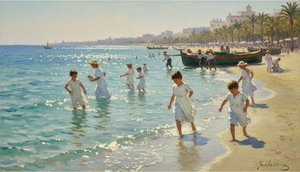
The enduring strength of Spanish art lies in its relationship with light—a light that can be as harsh and dramatic as a Baroque shadow or as soft and fleeting as an Impressionist dawn. From the sun-drenched canvases of John Phillip, who found his artistic rebirth in the brilliant atmosphere of Andalusia, to the contemporary explorations of Pilar Navamuel, the pursuit of "arreboles"—the fiery hues of sunset—remains a constant. This light does not merely illuminate; it defines the emotional temperature of the work.
This continuity is visible even in the most modern expressions. The works of artists like Julià Mateu, often referred to as the "Painter of the Wind," continue this meditation on atmosphere and light within the Catalan landscape. Whether through the heavy impasto of a classical reproduction or the delicate glazes of a contemporary oil, the fundamental goal remains unchanged: to capture the ephemeral quality of light before it vanishes. It is this shared pursuit of the luminous that binds the masters of the past to the creators of today, ensuring that the Spanish tradition remains a living, breathing dialogue with the world.
For those seeking to bring these profound historical echoes into their own homes, TopImpressionists.com offers a curated selection of hand-painted reproductions and original works that honor this deep-seated respect for technique and tradition.
Explore the revolutionary world of Cubism. Discover how Pablo Picasso and Georges Braque dismantled perspective to redefine modern art through geometric innovation and analytical mastery. An essential guide for art students, collectors, and history enthusiasts.
Explore the luminous world of Joaquín Sorolla, Spanish master of Impressionism. Discover his life, techniques & legacy – a guide for art collectors and enthusiasts. Invest in timeless beauty.
Embark on a sophisticated exploration of Spanish art history, from the chiaroscuro mastery of Velázquez to the profound shadows of Goya. Discover how the dramatic light and emotional depth of Spain's greatest masters continue to inspire collectors and connoisseurs today.


 Carlos de Haes
 Ignacio de Iriarte
![Spanish Landscape, Toledo [Paisaije español, Toledo]](/media/artworks/images-thumb/67/22/67223cfb67a3e879b8599832c8849094.jpg) Spanish Landscape, Toledo [Paisaije español, Toledo]
Spanish Landscape, Toledo [Paisaije español, Toledo] Colección Mateu
 Pilar Navamuel