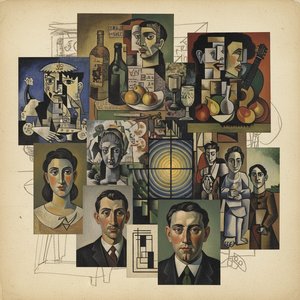
The Genesis of Reconstruction: Moving from Analytical Deconstruction to Synthetic Construction
 Synthetic Cubism Explained: How Picasso and Braque Redefined Reality Through Collage and Form
The Genesis of Fragmentation: From Analytical Deconstruction to Synthetic Construction Cubism Cubism is an early-20th-century avant-garde art movement which began in Paris. It revolutionized painting and the visual arts, and sparked artistic innovati...
To understand the breathtaking arrival of Synthetic Cubism, one must first wander through the somber, intellectual corridors of its predecessor, Analytical Cubism. In those earlier years, the great masters Pablo Picasso and Georges Braque acted as visual surgeons, meticulously dissecting the world. They approached a violin, a carafe, or a human face with a rigorous, almost austere discipline, breaking subjects down into a complex, monochromatic web of overlapping geometric planes. It was a period of profound deconstruction, where the distinction between object and background began to dissolve into a singular, fractured rhythm of muted earth tones and shadows.
Yet, as we move toward 1912, a palpable shift in energy began to stir within the studios of Paris. The artists felt the inherent limitations of pure dissection; there was a growing, restless desire not merely to pull the world apart, but to build something entirely new from the very fragments they had created. This transition marked the birth of Synthetic Cubism—a phase that moved away from the analytical destruction of form toward a more additive, constructive approach. It was no longer about how much an object could be broken down, but rather how many disparate, beautiful elements could be synthesized to represent its true essence.
The Alchemy of Collage: Integrating Everyday Reality into the Canvas
 Bottle of Vieux Marc, Glass, Guitar and Newspaper
A Revolutionary Still Life: Deconstructing Reality in 1913 Pablo Picasso’s ‘Bottle of Vieux Marc, Glass, Guitar and Newspaper’ (1913) is not merely a depiction of everyday objects; it's a pivotal statement within the evolution of modern art. This gro...
Perhaps the most profound disruption introduced during this era was the revolutionary birth of collage. The term itself, derived from the French coller, meaning to glue or stick together, perfectly encapsulates this new method of assembly. In works such as Picasso’s Bottle of Vieux Marc, Glass, Guitar and Newspaper, we witness a groundbreaking moment where the boundaries between fine art and the tangible world were irrevocently blurred. By incorporating real materials—newspaper clippings from Le Figaro, wallpaper, or fabric—directly onto the canvas, the artists invited the grit and texture of everyday life into the sacred space of the painting.
This technique was far more than a mere experiment in texture; it was a philosophical statement. The inclusion of actual printed matter challenged traditional notions of representation, questioning where the "art" ended and "reality" began. This approach emphasized flatness and a playful ambiguity, creating a visual puzzle that rewards the patient observer. As these disparate elements overlap and intersect, they create a dynamic interplay of forms that forces the viewer to actively participate in constructing meaning, rather than passively receiving a finished image.
A Symphony of Form and Color: Decoding the Vibrant Palette of the Synthetic Period
 Table in front of window
Table in Front of Window by Pablo Picasso – A Fragmented Symphony of Light and Life Pablo Picasso’s “Table in Front of Window,” painted in 1919, isn't merely a depiction of an interior scene; it’s a vibrant, almost frantic exploration of form, color,...
While the Analytical period was often characterized by its monochromatic austerity, the advent of Synthetic Cubism brought with it a much-needed infusion of light and vitality. The palette warmed considerably, embracing simpler shapes and brighter, more expressive colors. We see this transition beautifully captured in works like Table in Front of Window, where Picasso explores a vibrant, almost frantic exploration of color and life. The heavy, claustrophobic density of the previous years gave way to a sense of luminosity and movement.
This era allowed for a more rhythmic use of color to define space and emotion. Instead of using light to create traditional three-dimensional illusions, the artists used bold, flat planes of color to suggest depth and energy. This shift allowed the artwork to breathe, offering a more sensory experience that resonated with the burgeoning modern age. The colors were no longer just descriptive; they became structural components, working in harmony with geometric lines to compose a visual symphony that felt both modern and deeply rooted in the tactile reality of the human experience.
Mastering the Plane: The Architectural Precision of Picasso and Braque
 Crystal Cubism
Crystal Cubism (French: Cubisme cristal or Cubisme de cristal) is a distilled form of Cubism consistent with a shift, between 1915 and 1916, towards a strong emphasis on flat surface activity and large overlapping geometric planes. The primacy of the...
Beneath the vibrant surface of Synthetic Cubism lies a profound architectural precision. Both Picasso and Braque, though possessing distinct individual temperaments, shared an obsession with the underlying geometric structure of the world. This period saw a move toward simplification, where complex subjects were distilled into large, overlapping geometric planes. There is a certain mathematical elegance in how they managed to maintain the recognizable essence of a guitar or a bottle while simultaneously reducing them to essential angles and lines.
This mastery of the plane created a sense of "Crystal Cubism" in later years—a style characterized by a strong emphasis on flat surface activity. The primacy of the underlying structure controlled nearly every element of the artwork, creating a balanced, stable composition that felt both avant-garde and classically composed. It was an incredible feat of intellectual and technical skill: to strip away the superfluous and find the structural truth within the chaos of modern perception.
The Enduring Legacy: How Synthetic Cubism Redefined Modern Perception
 Pablo Picasso
The Enduring Legacy of Pablo Picasso Pablo Ruiz y Picasso, a name synonymous with artistic revolution, was born in Málaga, Spain, on October 25, 1881. His very existence seemed destined for creative expression; legend has it his first uttered words w...
The impact of Synthetic Cubism extends far beyond the edges of the canvas. It revolutionized not only painting but also sparked innovations in music, ballet, literature, and architecture. By teaching us to see the world as a collection of assembled fragments rather than a single, fixed perspective, it fundamentally altered the trajectory of twentieth-century art. The movement’s ability to synthesize reality through abstraction provided a new language for an era of rapid technological and social change.
Today, we continue to find inspiration in this radical reimagining of reality. Whether through the lens of a modern digital collage or the textured impasto of a contemporary oil reproduction, the spirit of Synthetic Cubism lives on. It remains a testament to the power of human creativity to take the broken pieces of our existence and reconstruct them into something unified, beautiful, and profoundly meaningful. For the true connoisseur, exploring this movement is not just an art history lesson; it is an invitation to rediscover the very nature of how we perceive the world around us.