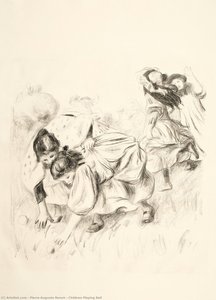
The Ephemeral Smile: Capturing Light and Laughter in Early Play
There is a specific quality to the light that falls upon a child at play, a clarity that seems to exist only for a heartbeat before the shadows lengthen. The Impressionists understood this fragility better than perhaps any other group of painters. They did not seek to freeze a subject in a static, heavy pose; instead, they chased the flicker of a smile or the way sunlight dances through a garden canopy. In works like Renoir’s Dance at Le moulin de la Galette, we see this pursuit of the momentary. The light filters through the trees, dappling the figures with patches of warmth and shade, much like the unpredictable energy of a summer afternoon.
This focus on the fleeting was born from a desire to move away from the rigid, dark compositions of the Academy. Where the Old Masters sought permanence, the Impressionists sought the pulse of life. They used short, rapid brushstrokes and unmixed colors to catch the eye before it could settle on a single detail. This technique allowed them to record the movement of a child’s hand or the sway of a dress in the breeze. To look at these paintings is to witness a struggle against time itself, an attempt to hold onto a joy that we all know, with a certain quiet ache, cannot stay.
The Intimate Circle: Family as the Foundation of the Impressionist Canvas
The subjects of these paintings were rarely strangers or distant historical figures; they were the people who shared the artists' breakfast tables and gardens. This intimacy gave the movement its warmth. For Claude Monet, the canvas was an extension of his domestic life, often featuring his young sons amidst the lush greenery of Giverny. Similarly, Mary Cassatt brought a profound tenderness to her depictions of the bond between mother and child. These were not staged portraits for posterity but observations of lived reality, captured en plein air where the atmosphere was as much a part of the family as the people themselves.
This reliance on the family circle also served a practical necessity. It was far more accessible to paint a sibling or a child than to secure a professional model from the city. Berthe Morisot, for instance, frequently turned her gaze toward her daughter, Julie Manet, painting her over seventy times throughout her life. In these works, we see the domestic sphere transformed into a landscape of light and emotion. The familiarity of the subjects allowed the artists to experiment with unusual visual angles and the study of natural movement, turning the private moments of a household into a shared experience of beauty.
A Delicate Threshold: Navictating the Transition of Adolescence
As the softness of early childhood begins to fade, there is a period of profound change—a threshold where the innocence of play meets the gravity of the adult world. The Impressionists were deeply attuned to this emotional transition. They captured the quiet melancholy that often accompanies adolescence, a time when a child begins to withdraw into their own inner landscape. In some works, we see a sense of solitude; in others, a budding independence.
This tension is visible in the paintings of Berthe Morisot, where her daughter Julie is seen reading in the Bois de Boulogne, physically present but mentally immersed in a world far from her mother’s reach. There is a subtle distance in these compositions, a recognition that the child is becoming an individual. We see this shift also in the works of Gustave Caillebotte, where a young boy might hold himself with an adult-like posture, his childhood already appearing as a receding memory. These paintings do not celebrate a static state of being; they document the bittersweet process of growing up, capturing the very moment when the light of youth begins to change its hue.
Inheriting the Brush: The Legacy of the Child Artist
In some of the most remarkable instances, the boundary between the observer and the observed dissolved entirely. For the children of the Impressionist circle, the studio was not a place of formal study but a playground of color and texture. They grew up surrounded by the scent of linseed oil and the sight of canvases drying in the sun. Julie Manet is perhaps the most poignant example; she learned to handle brushes at a very early age, receiving lessons from her mother, Morisot, and her uncle, Manet.
This inheritance went beyond mere technique. As an adult, Julie became a vital custodian of the movement, collecting works by these modern masters and fighting for their recognition in museums. Her life was a continuation of the very spirit she had witnessed in her cradle. When we look at the portraits of children painted by Renoir or Monet, we are looking at a lineage of creativity. The brushstrokes used to depict a child’s face were often the same ones that child would one day use to interpret the world, creating a cycle of artistic memory that ensures these fleeting moments remain part of our collective vision.
The Pulse of Movement: Preserving Life Through Rapid Brushstrokes
To capture a moment before it vanishes requires a certain decisiveness, a refusal to be slowed by the weight of tradition. The Impressionists utilized quick, sweeping strokes and often applied color directly from the tube to save time and maintain the vitality of the scene. This method was essential when painting outdoors, where the sun moves across the sky and the shadows shift with every passing cloud. They were not interested in the polished, porcelain skin of academic portraiture; they wanted the texture of life.
Even when faced with the challenge of a restless subject, the artists found ways to adapt. Renoir famously relied on the children’s nanny, Gabrielle, to keep his young subject, Jean, entertained with toys while he worked. This allowed him to focus on the interplay of light and movement rather than the struggle of posing. The result is a body of work that feels alive, where the paint itself seems to vibrate with the energy of the subject. Through these rapid marks, the artists achieved what they set out to do: they turned the ephemeral nature of existence into something we can hold in our gaze, long after the original moment has passed.
Explore the ethereal beauty of Impressionism through an expert guide on light, color, and technique. Discover how masters like Monet captured fleeting moments and learn to appreciate the profound legacy of this revolutionary art movement.
Explore the emotional revolution of Impressionist art. From Monet's light to Renoir's warmth, discover how these masters redefined perception through hand-painted beauty and timeless technique.