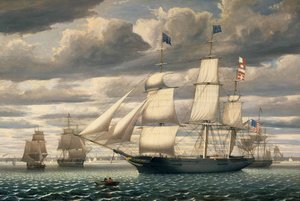
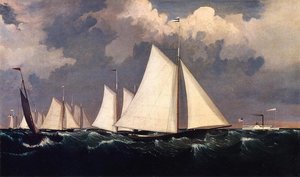
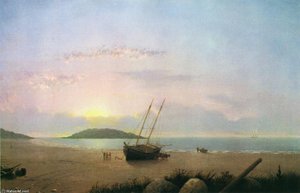
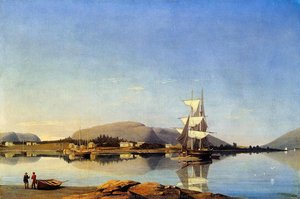
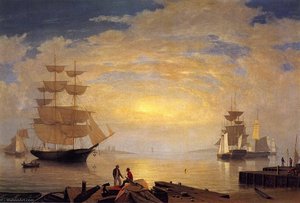
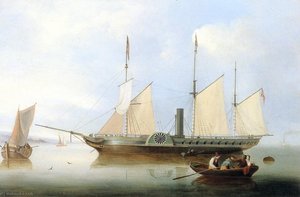
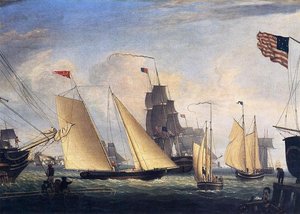
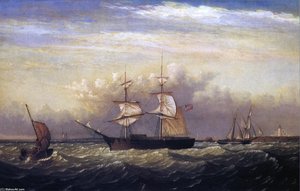
Lane’s early life was deeply intertwined with the maritime community of Gloucester. His father, Jonathan Dennison Lane, a sailmaker, immersed him in the world of ships and seafaring from an early age. A childhood illness, possibly caused by ingesting part of the peru-apple (jimsonweed), resulted in paralysis of his legs, requiring him to use crutches or a cane for mobility. This confinement may have fostered his artistic talent as he sought alternative forms of amusement and expression. Initially apprenticed in shoe-making, Lane’s passion for drawing led him to pursue art, demonstrating an early aptitude that would define his career. The change of name from Nathaniel Rogers Lane to Fitz Henry Lane in 1832 remains somewhat mysterious, though it may have been intended to distinguish himself from another artist, Nathaniel Rodgers.
Artistic Development and Training
Lithography Experience: Worked as a lithographer at Pendleton’s Lithography Shop in Boston from 1832 to 1847.
Early Works:Watercolor "Burning of the Packet Ship 'Boston'" demonstrates developing skill but less refined style than later works.
The years spent at Pendleton’s Lithography Shop were crucial for Lane's artistic development, allowing him to hone his skills and experiment with different techniques before focusing on oil painting. This experience provided him with valuable technical skills in drawing, engraving, and color reproduction.
Style and Major Works: The Luminist Master
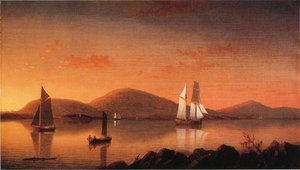
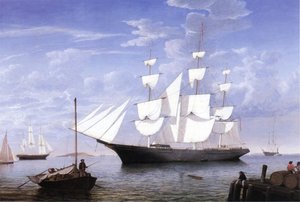
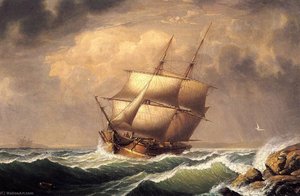
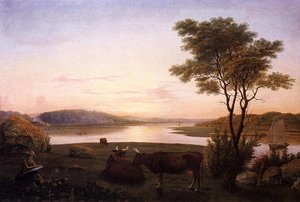
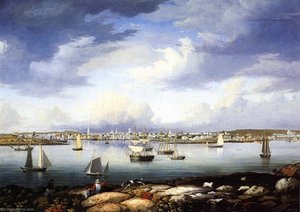
Lane is recognized as a leading figure in the Luminist movement, characterized by its emphasis on capturing atmospheric effects, particularly light reflecting on water. His paintings are known for their clarity, precision, and serene depiction of coastal scenes.
Key Characteristics of Lane's Style:
Atmospheric Perspective: Masterful use of aerial perspective to create a sense of depth and distance.
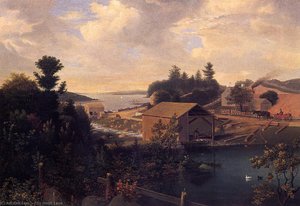
Detailed Observation: Meticulous attention to detail in depicting ships, buildings, and landscapes.
Luminous Light Effects: Capturing the subtle nuances of light and its reflection on water with remarkable accuracy.
Fitz Henry Lane’s work gained recognition during his lifetime, though his reputation has grown significantly in the 20th and 21st centuries. He is now considered one of the most important American Luminist painters, celebrated for his unique ability to capture the beauty and tranquility of New England's coastal landscapes. Lane’s paintings offer a valuable historical record of maritime life in 19th-century Gloucester and other coastal communities. His meticulous attention to detail and masterful use of light continue to inspire artists and captivate audiences today, solidifying his place as a significant figure in American art history.
By the TopImpressionists.com Editorial Team
A little quiz
There is only one correct answer for each question.
Question 1:
What artistic movement is Fitz Henry Lane most famously associated with?
Question 2:
Prior to focusing on oil painting, what skill did Lane develop during his time at Pendleton’s Lithography Shop?
Question 3:
What physical challenge impacted Fitz Henry Lane's early life?
Question 4:
Why did Nathaniel Rogers Lane legally change his name to Fitz Henry Lane?
Explore the captivating world of James Edward Buttersworth, a foremost Victorian marine painter. Discover his meticulous ship portraits, America's Cup chronicles & enduring legacy in museums worldwide. Learn about his technique and style.
Discover the ethereal beauty of Luminism. Explore the serene landscapes of the Hudson River School through an expert lens, celebrating the mastery of light, atmosphere, and the enduring legacy of American landscape painting.
Explore the luminous world of Fitz Henry Lane, a master of American maritime painting & Luminism. Discover his legacy, techniques, and investment potential for discerning art collectors. Expert insights at TopImpressionists.