Atelier — Complimentary worldwide shipping — Delivery 2–6 weeks
      Henry Ulke, 1821 – 1910

      Henry Ulke: The 9 Best-Known Paintings

      Of all Henry Ulke's paintings, Joseph Henry (1885) is the most famous; it hangs in the National Portrait Gallery, Washington, D.C.. Close behind come Spotted Tail (1877) and Ludwig Van Beethoven (1875). Among the 9 works by Henry Ulke in our catalogue, these 9 are the most celebrated, each shown with its date, its museum and its story.

      Ranked by our popularity score, which combines the searches, visits and orders for each work. Updated November 2026. Each painting on this page can be ordered as an oil reproduction painted by hand on linen canvas, or as a fine art print, made to the size you choose.

      Portrait of Henry Ulke
      Henry Ulke · 1821 – 1910
      Born · died
      1821 – 1910, Ząbkowice Śląskie
      Works in our catalogue
      9
      Most famous
      Joseph Henry (1885)
      Most works at
      National Portrait Gallery

      Henry Ulke's 10 most celebrated paintings

      Joseph Henry (1885) by Henry Ulke
      1

      Joseph Henry

      1885 · Oil On Canvas · National Portrait Gallery, Washington, D.C.

      A single light source strikes the subject from the upper left, carving deep shadows into the hollows of a weathered face. Joseph Henry sits in a quiet, dark space, his presence defined by the stark contrast of a black coat against a muted, ochre background. The skin around his jawline is mapped with the fine, delicate lines of age, each wrinkle a record of years spent in contemplation. He does…

      Hand-painted oil reproduction from $178 32 × 32 cm
      Spotted Tail (1877) by Henry Ulke
      2

      Spotted Tail

      1877 · Oil On Canvas · Smithsonian American Art Museum, Washington, D.C.

      The portrait by Henry Ulke depicts Spotted Tail, a Sichangu Lakota tribal chief. The subject, who was also known by the birth name Tȟatȟáŋka Napsíča, is presented in this work before 1881. He was a Lakota Brule Chief and the uncle of the warrior Crazy Horse.

      Hand-painted oil reproduction from $178 27 × 37 cm Same size as the original $446 85 × 116 cm Order at original size →
      Ludwig Van Beethoven (1875) by Henry Ulke
      3

      Ludwig Van Beethoven

      1875 · Oil On Canvas · Smithsonian American Art Museum, Washington, D.C.

      Henry Ulke captures the composer Ludwig Van Beethoven in this oil on canvas, a work dating to about 1875. The portrait presents the subject in a bust-length view, focusing on the weight of a furrowed brow and the wild, dark texture of hair. The scale of the piece is intimate, measuring 26 1/4 x 21 1/4 in. (66.7 x 54.0 cm.).

      Hand-painted oil reproduction from $178 29 × 35 cm Same size as the original $362 78 × 90 cm Order at original size →
      Major John Wesley Powell (1885) by Henry Ulke
      4

      Major John Wesley Powell

      1885 · Oil On Canvas · Smithsonian American Art Museum, Washington, D.C.

      In this medium close-up portrait of Major John Wesley Powell, Henry Ulke employs a deliberate, off-center positioning of the subject. By placing the figure slightly away from the central axis, the artist creates a subtle sense of depth within the frame. The perspective is set at eye-level, establishing a direct and steady connection between the subject and the viewer. This arrangement invites a quiet, intimate observation of the man's presence.

      Hand-painted oil reproduction from $178 29 × 34 cm Same size as the original $297 64 × 77 cm Order at original size →
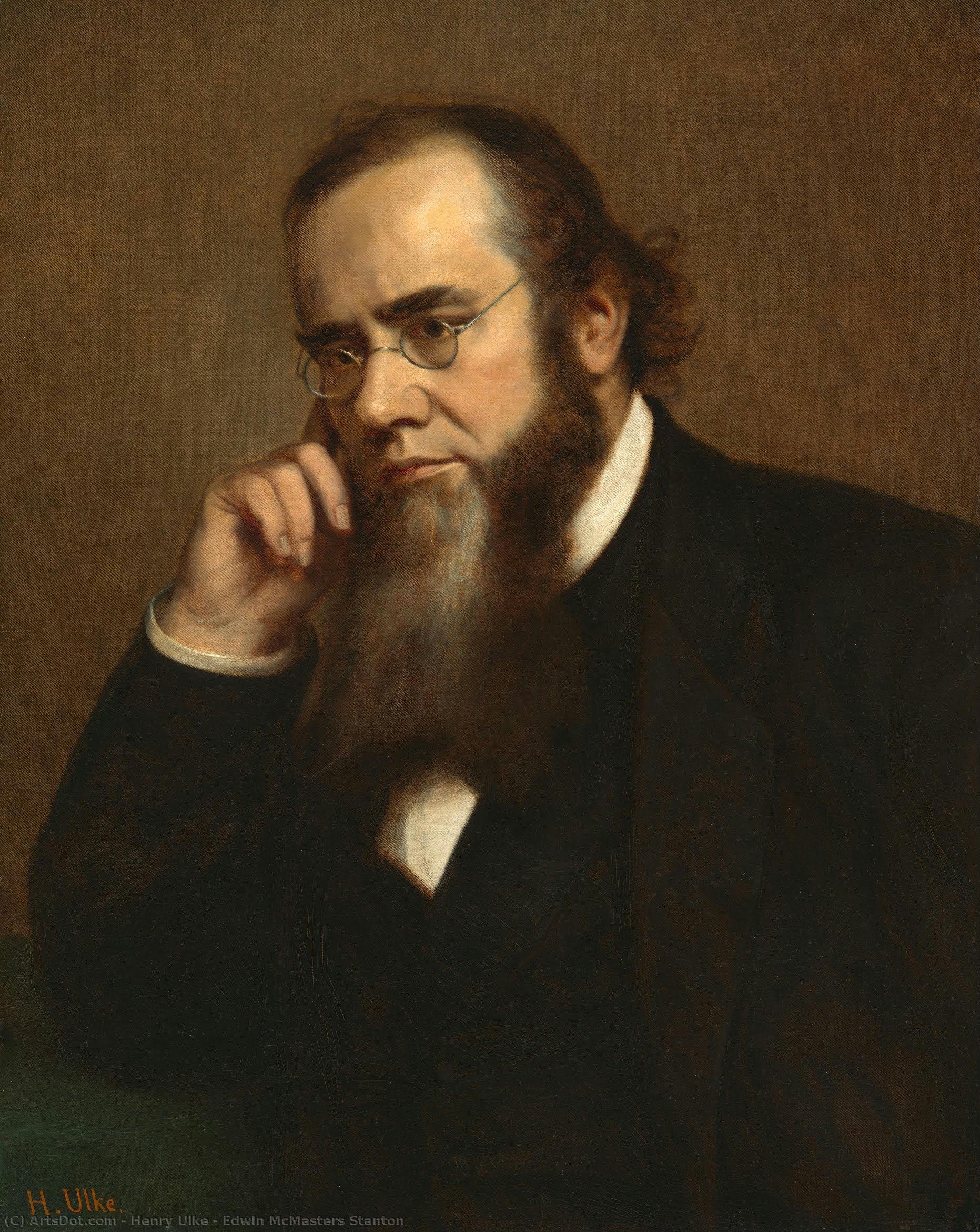
      Edwin McMasters Stanton (1872) by Henry Ulke
      5

      Edwin McMasters Stanton

      1872 · Oil · National Portrait Gallery, Washington, D.C.

      In the grand tapestry of American history, few figures loom as large or as formidable as Edwin McMasters Stanton. Captured in this 1872 masterpiece by the esteemed portraitist Henry Ulke, Stanton emerges not merely as a man, but as an institution of iron will and administrative brilliance. As the Secretary of War under President Abraham Lincoln, Stanton was the architect of Union logistics, a man whose rigorous reorganization of the…

      Hand-painted oil reproduction from $178 28 × 35 cm
      Joseph Henry (1885) by Henry Ulke
      6

      Joseph Henry

      1885 · Oil On Canvas · National Portrait Gallery, Washington, D.C.

      In this 1885 oil on canvas, Henry Ulke captures the quiet weight of a life spent in thought. The subject is Joseph Henry, an elderly man whose presence fills the frame with a heavy, contemplative stillness. He sits in a chair, his hands resting against his chin, caught in a moment of profound internal reflection. The portrait focuses on the gravity of his character, presenting a man whose intellect is…

      Hand-painted oil reproduction from $178 32 × 32 cm
      Spencer Fullerton Baird (1887) by Henry Ulke
      7

      Spencer Fullerton Baird

      1887 · National Portrait Gallery, Washington, D.C.

      The Spencer Fullerton Baird painting by Henry Ulke is a masterpiece that continues to fascinate art enthusiasts to this day. Created in 1887, this oil on canvas portrait is a testament to the artist's skill and attention to detail. The painting is currently housed at the Smithsonian American Art Museum in the United States. The Artist and His Subject Henry Ulke was a renowned German-American painter, known for his portraits…

      Hand-painted oil reproduction from $178 32 × 32 cm
      Edwin McMasters Stanton (1872) by Henry Ulke
      8

      Edwin McMasters Stanton

      1872 · National Portrait Gallery, Washington, D.C.

      The painting Edwin McMasters Stanton by Henry Ulke is a masterpiece that showcases the artist's skill in capturing the essence of his subject. Created in 1872, this oil on canvas portrait is housed at the Hirshhorn Museum and Sculpture Garden in the United States. The painting depicts Edwin McMasters Stanton, who was the Secretary of War during the Civil War era, as a thoughtful and contemplative individual. The Artist's Style…

      Hand-painted oil reproduction from $178 32 × 32 cm
      John Sherman (1880) by Henry Ulke
      9

      John Sherman

      1880 · National Portrait Gallery, Washington, D.C.

      The Hirshhorn Museum and Sculpture Garden in Washington D.C. is home to a remarkable oil on canvas painting, John Sherman, created by the skilled artist Henry Ulke in 1880. This captivating portrait showcases Ulke's mastery of capturing the essence of his subjects with precision and detail. A Glimpse into the Artist's Style Henry Ulke's work is characterized by his ability to convey the personality and spirit of his sitters through…

      Hand-painted oil reproduction from $178 32 × 32 cm

      What Henry Ulke painted most

      The four subjects that return most often on these canvases, each with its best-loved example.

      Where Henry Ulke's canvases hang

      The 2 museums that hold the most of the paintings on this page.

      Museum City Works by Henry Ulke Paintings from this list
      National Portrait Gallery, Washington, D.C.National Portrait Gallery Washington, D.C. 6 Joseph Henry, Edwin McMasters Stanton, Joseph Henry
      Smithsonian American Art Museum, Washington, D.C.Smithsonian American Art Museum Washington, D.C. 3 Spotted Tail, Ludwig Van Beethoven, Major John Wesley Powell

      Year by year: Henry Ulke's most celebrated canvases

      A long career in colour: 16 years, 1872 to 1887, and Henry Ulke's most celebrated canvases of each year.

      1. 1872
        Edwin McMasters Stanton (1872) by Henry Ulke
        Ranked 5 of 9

        Edwin McMasters Stanton

        Age 51 · National Portrait Gallery

        In the grand tapestry of American history, few figures loom as large or as formidable as Edwin McMasters Stanton. Captured in this 1872 masterpiece by the esteemed portraitist…

      2. 1872
        Edwin McMasters Stanton (1872) by Henry Ulke
        Ranked 8 of 9

        Edwin McMasters Stanton

        Age 51 · National Portrait Gallery

        The painting Edwin McMasters Stanton by Henry Ulke is a masterpiece that showcases the artist's skill in capturing the essence of his subject. Created in 1872, this oil…

      3. 1875
        Ludwig Van Beethoven (1875) by Henry Ulke
        Canvas 3 of 9

        Ludwig Van Beethoven

        Age 54 · Smithsonian American Art Museum

        Henry Ulke captures the composer Ludwig Van Beethoven in this oil on canvas, a work dating to about 1875. The portrait presents the subject in a bust-length view,…

      4. 1877
        Spotted Tail (1877) by Henry Ulke
        2 of 9

        Spotted Tail

        Age 56 · Smithsonian American Art Museum

        The portrait by Henry Ulke depicts Spotted Tail, a Sichangu Lakota tribal chief. The subject, who was also known by the birth name Tȟatȟáŋka Napsíča, is presented in…

      5. 1880
        John Sherman (1880) by Henry Ulke
        Ranked 9 of 9

        John Sherman

        Age 59 · National Portrait Gallery

        The Hirshhorn Museum and Sculpture Garden in Washington D.C. is home to a remarkable oil on canvas painting, John Sherman, created by the skilled artist Henry Ulke in…

      6. 1885
        Joseph Henry (1885) by Henry Ulke
        Ranked 1 of 9

        Joseph Henry

        Age 64 · National Portrait Gallery

        A single light source strikes the subject from the upper left, carving deep shadows into the hollows of a weathered face. Joseph Henry sits in a quiet, dark…

      7. 1885
        Major John Wesley Powell (1885) by Henry Ulke
        4 of 9

        Major John Wesley Powell

        Age 64 · Smithsonian American Art Museum

        In this medium close-up portrait of Major John Wesley Powell, Henry Ulke employs a deliberate, off-center positioning of the subject. By placing the figure slightly away from the…

      8. 1885
        Joseph Henry (1885) by Henry Ulke
        Ranked 6 of 9

        Joseph Henry

        Age 64 · National Portrait Gallery

        In this 1885 oil on canvas, Henry Ulke captures the quiet weight of a life spent in thought. The subject is Joseph Henry, an elderly man whose presence…

      9. 1887
        Spencer Fullerton Baird (1887) by Henry Ulke
        Canvas 7 of 9

        Spencer Fullerton Baird

        Age 66 · National Portrait Gallery

        The Spencer Fullerton Baird painting by Henry Ulke is a masterpiece that continues to fascinate art enthusiasts to this day. Created in 1887, this oil on canvas portrait…

      Your questions on Henry Ulke's paintings, answered

      Which is the most celebrated painting by Henry Ulke?Read the answer

      Joseph Henry (1885), National Portrait Gallery, Washington, D.C.. Spotted Tail (1877) and Ludwig Van Beethoven (1875) follow.

      How old was Henry Ulke at the time of Joseph Henry?Read the answer

      Henry Ulke, born in 1821, was 64 years old: Joseph Henry dates from 1885.

      How many paintings by Henry Ulke are known?Read the answer

      9 works by Henry Ulke are in our catalogue, dated 1872 to 1887.

      Which museums hold Henry Ulke's best-known canvases?Read the answer

      Mostly in National Portrait Gallery (Washington, D.C.) and Smithsonian American Art Museum (Washington, D.C.); the list above names each museum and its canvases.

      In which years did Henry Ulke paint the most celebrated canvases?Read the answer

      In 1885, which gave 3 of the 9 works on this page, Joseph Henry among them.

      What are the first and the last of Henry Ulke's famous canvases?Read the answer

      The earliest canvas here is Edwin McMasters Stanton (1872); the latest is Spencer Fullerton Baird (1887).

      Which subjects return most often in Henry Ulke's paintings?Read the answer

      Man (5), Portrait (5) and Ochre background (3), across the 9 works on this page.

      What did Henry Ulke usually paint with?Read the answer

      Oil On Canvas, used in 5 of the 9 works on this page.

      What can I see by Henry Ulke at the National Portrait Gallery?Read the answer

      The National Portrait Gallery, Washington, D.C. holds 6 of the works on this page, among them Joseph Henry, Edwin McMasters Stanton and Joseph Henry.

      Can I order a hand-painted copy of a painting by Henry Ulke?Read the answer

      Yes. Every painting on this page can be ordered from its own page as an oil reproduction painted by hand, or as a fine art print, in the size you choose.

      Henry Ulke: the painter's story

      A Life Etched in Likeness: The Story of Henry Ulke

      Henry Ulke, a name often whispered alongside the great figures he immortalized on canvas, was more than just “The Painter of Presidents.” Born Titus Ulke in 1821, his journey from German origins to becoming a celebrated portraitist in Washington D.C. is a compelling narrative of artistic dedication interwoven with an unexpected passion for the natural world. While history remembers him primarily for capturing the visages of Abraham Lincoln and Edwin Stanton, a deeper exploration reveals a man whose life was as richly detailed as the brushstrokes that defined his legacy. Ulke’s early life remains somewhat shrouded in mystery; details are scarce regarding his initial artistic training. However, it is known he immigrated to the United States, settling initially in New York before gravitating towards the political heart of the nation – Washington D.C. This move proved pivotal, placing him at the epicenter of a rapidly changing America and offering access to the very individuals who would become his most iconic subjects. He quickly established himself as a skilled portraitist, gaining favor amongst politicians and dignitaries seeking to preserve their image for posterity.

      The Brushstrokes of Power: Ulke’s Portraiture

      Ulke's artistic style can be characterized by a meticulous realism tempered with a subtle sensitivity. He wasn’t interested in flamboyant displays of technique or abstract interpretations; instead, he focused on capturing the *essence* of his sitters – their character, intellect, and the weight of their responsibilities. His portraits weren’t merely representations of physical appearance but psychological studies rendered in oil paint. This approach is particularly evident in his depictions of Abraham Lincoln. Ulke painted several versions of the 16th President, each offering a unique glimpse into Lincoln's evolving persona during the tumultuous years of the Civil War. These were not idealized images; they showed a man burdened by immense pressure, yet radiating an inner strength and profound empathy. The portrait commissioned for the Old Executive Office Building is perhaps his most famous, showcasing Lincoln with a quiet dignity that resonates even today. Beyond Lincoln, Ulke’s portrait of Edwin Stanton, Secretary of War during the Civil War, stands as another testament to his ability to convey power and authority through subtle nuances of expression and composition. He masterfully captured Stanton's stern demeanor and unwavering resolve, creating an image that perfectly embodies the man’s crucial role in securing Union victory.

      Beyond the Canvas: A Hidden World of Entomology

      What sets Ulke apart from many of his contemporaries is his remarkable dual life as a passionate entomologist – a collector and scholar of insects, particularly beetles. This seemingly disparate pursuit wasn't merely a hobby; it was a deeply ingrained fascination that consumed much of his free time and intellectual energy. He amassed an extraordinary collection, meticulously cataloging and studying thousands of specimens from around the globe.
      • A Dedicated Collector: Ulke’s home became a veritable museum of entomological wonders, attracting fellow enthusiasts and researchers.
      • Scientific Contributions: He published numerous papers on his findings, contributing significantly to the field of beetle taxonomy and distribution. His collection was highly regarded within scientific circles.
      • A Parallel Passion: The precision and attention to detail required in both portraiture and entomology suggest a common thread – a deep appreciation for observation and accurate representation.

      Legacy and Historical Significance

      Henry Ulke died in 1910, leaving behind a rich artistic legacy and an invaluable scientific collection. His portraits offer more than just historical documentation; they provide intimate glimpses into the lives of pivotal figures who shaped American history. He wasn’t simply recording appearances; he was capturing moments in time, preserving the spirit of an era on canvas. His work serves as a powerful reminder of the human cost of leadership and the enduring strength of the American ideal. The fact that his paintings continue to be studied and admired today is testament to their artistic merit and historical significance. Ulke’s story also highlights the often-overlooked passions that lie beneath the surface of public personas, revealing a man whose dedication extended far beyond the realm of art into the fascinating world of natural science. He remains a compelling figure – “The Painter of Presidents,” yes, but also a dedicated scholar, a meticulous observer, and a testament to the power of lifelong learning.