The Radiant Legacy of Jacopo Palma il Giovane
In the golden twilight of the Venetian Renaissance, a period defined by unparalleled mastery of color and light, there emerged a painter whose brush bridged the gap between the High Renaissance and the burgeoning drama of the Baroque. Jacopo Palma il Giovane, born Iacopo Negretti around 1548, was not merely a successor to the great masters but a vital link in the continuity of the Venetian School. As the great-nephew of the celebrated Palma Vecchio, he was born into a lineage of artistic excellence, inheriting a profound understanding of the chromatic richness that defines the Venetian tradition. His life and work represent a seamless transition, carrying the luminous elegance of his predecessors into a new era of emotional intensity and theatrical grandeur.
The foundations of Palma’s artistry were laid in the workshops of Venice, where the air was thick with the legacies of Titian and Tintoretto. While historical accounts suggest he may have polished his technique through the study of Titian’s breathtaking color palettes, it was the dynamic energy of Tintoretto that truly shaped his mature vision. Following the death of Tintoretto in 1594, Palma il Giovane ascended to a position of preeminence, becoming the dominant artistic force in Venice. He possessed a rare ability to synthesize these two disparate influences: from Titian, he drew a sophisticated command of light and skin tones; from Tintoretto, he adopted a sense of movement, dramatic chiaroscuro, and narrative urgency that resonated deeply with the religious fervor of the Counter-Reformation.
A Master of Narrative and Emotion
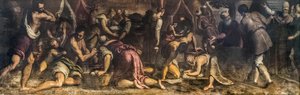
Palma il Giovane’s oeuvre is a testament to his ability to transform biblical and mythological themes into visceral human experiences. His paintings are rarely static; they pulse with a life force that draws the viewer into the heart of the drama. Whether depicting the solemnity of a religious martyrdom or the lively chaos of a tavern scene, his work utilizes light as a narrative tool, guiding the eye through complex compositions to find the emotional core of the story. His mastery is particularly evident in works such as Martyrdom of St Catherine of Alexandria, where the interplay of shadow and brilliance heightens the sense of divine struggle, and Apostles at the Virgin's Tomb, which captures a profound moment of collective grief through sweeping, energetic brushwork.
Beyond his religious commissions, Palma’s versatility allowed him to explore a wide spectrum of subject matter. His talent for capturing the human spirit is perhaps most intimately seen in his Self-Portrait, a work that reveals a soulful introspection and a technical prowess capable of rendering the subtle nuances of expression. Even in more secular or anecdotal scenes, such as the Amusements of the Prodigal Son, he maintains a vibrant, rhythmic quality that celebrates the textures and colors of Venetian life. This ability to oscillate between the profound and the playful ensured his relevance across various patronage circles, from the ecclesiastical authorities of Venice to the imperial courts of Central Europe.
Historical Significance and Enduring Influence
The historical importance of Jacopo Palma il Giovane extends far beyond the borders of the Venetian Republic. His influence radiated outward, reaching as far as Bergamo and the court of Emperor Rudolf II in Prague, marking him as an artist of international stature. He did not merely replicate the past; he evolved it, preparing the ground for the more emotive and dramatic styles that would define the 17th century. By mentoring subsequent generations, including figures who would further refine the Venetian aesthetic, he ensured that the traditions of his lineage remained vibrant and transformative.
Today, we recognize Palma il Giovane as a pivotal figure whose work serves as a bridge between eras. His legacy is found in:
- The Synthesis of Styles: The seamless integration of Titian’s coloristic brilliance with Tintoretto’s dramatic dynamism.
- Counter-Reformation Artistry: The use of powerful imagery to communicate the spiritual intensity required by the Catholic Church during a period of profound religious change.
- The Continuation of the Venetian School: Maintaining Venice's status as a global epicenter of art through his widespread commissions and pedagogical influence.
Through his expressive brush and masterful use of light, Palma il Giovane captured the very essence of a changing world, leaving behind a body of work that continues to enchant and move the modern observer.