Early Life, Family and Training
Jacques-Émile Blanche enters the scene on January 1, 1861, in the 16th arrondissement of Paris, France. His upbringing is defined by the high-society atmosphere of the Passy neighborhood. He grows up in a house with a storied past, once belonging to the Princesse de Lamballe. His father, Émile Blanche, operates a fashionable clinic on the heights of Montmartre, working as a successful psychiatrist. This environment places the young artist within a privileged Parisian milieu from the start.
Education for Jacques-Émile Blanche takes place at the prestigious Lycée Condorcet. While his formal academic path is set, his artistic development follows a more idiosyncratic trajectory. He receives instruction from Henri Gervex and Pierre-Auguste Renoir, yet the influence of these teachers is only part of the story. He also receives lessons from Ferdinand Humbert. Despite these structured encounters, Blanche remains largely self-taught, developing a technical approach that relies heavily on his own observation rather than strict academic doctrine.
Artistic Style and Technique
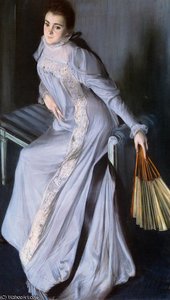
Blanche rejects the meticulous realism of academic tradition. Instead, he prioritizes the transmission of emotion and atmosphere over the pursuit of precise detail. His technique relies on loose brushwork where visible strokes define the form rather than blended, seamless surfaces. This approach creates a sense of immediacy, capturing the transient qualities of light and character through texture rather than rigid outlines.
The palette is deliberately restrained. He avoids the use of high-contrast, bright hues, opting instead for a muted scheme of ochres, browns, and greys. This tonal harmony allows him to focus on the subtle nuances of his subjects. Influenced by the aesthetics of Edouard Manet and James McNeill Whistler, his work balances a sense of modern spontaneity with a sophisticated control of color. His portraits achieve a specific sensitivity, using these subdued tones to reveal the inner personality and insight of the sitter.
- Mabel Beardsley, 1895
- Mrs Sickert, 1908
- Eton Bridge, Windsor and the Horse Guards, 1923
Activity in Paris and London
Blanche moves between two worlds with ease. He is as much at home in England as he is in France, navigating the social and artistic landscapes of both cities. In Paris, his presence is felt through regular exhibitions at the Salon and the Société Nationale des Beaux-Arts. These venues provide the platform for his growing reputation as a successful portrait painter. He does not merely visit the English capital; he returns to London every year starting in 1884, finding great success with each trip. This constant movement between the two capitals defines his professional life.
His integration into the British art scene is solidified by his membership in the New English Art Club. This affiliation places him within the heart of the London art establishment. He builds a professional life that spans the English Channel, securing commissions from prominent figures in both Paris and London. His ability to adapt to these different environments allows him to maintain a steady career as a sought-after portraitist.
- Mrs Sickert (1908)
- Mabel Beardsley (1895)
- Charles Conder (1904)
- James Joyce (1934)
Notable Works and Subjects
Blanche’s brush often turned toward the faces of the intellectual and social elite. In 1895, he captured Mabel Beardsley, a portrait that emphasizes a sense of quiet contemplation through a restrained color palette. His ability to translate character into paint is evident in his 1904 portrait of Charles Conder. By 1908, his focus shifted toward the literary giants of the era, resulting in a portrait of Henry James. Later, the artist returned to the complexities of human character in his depictions of James Joyce, which he worked on in 1934 and 1935.
The artist’s scope extended beyond the individual to the atmosphere of music and the movement of urban life. His work includes "The Kreutzer Sonata," a piece that attempts to capture the essence of emotion through sound. He also looked toward the landscape and the grandeur of the city. In 1923, he painted "Eton Bridge, Windsor and the Horse Guards," a composition that captures a bustling tableau of London life, from the military precision of the parade to the skyline of Windsor Castle.
- Mabel Beardsley (1895)
- Charles Conder (1904)
- Henry James (1908)
- Eton Bridge, Windsor and the Horse Guards (1923)
- James Joyce (1934 and 1935)
Social Circles and Influences
The drawing room of Blanche's father, a prominent psychiatrist, functions as a crossroads for the Parisian intellectual elite. Here, the boundaries between medicine, literature, and the arts blur during regular Saturday meetings. These gatherings bring together a constellation of celebrities, including figures like Hector Berlioz and Camille Corot. Within this high-society milieu, the young artist encounters Edouard Manet, an encounter that leaves a lasting mark on his developing aesthetic. The atmosphere is one of constant, sophisticated conversation, where the nuances of aesthetic and literary debate are as much a part of the environment as the art itself.
His social orbit extends far beyond the salons of Paris, bridging the gap between the French and English worlds. He moves through the intimate circles of the literary avant-garde, maintaining a close friendship with Marcel Proust. This connection to the era's most significant writers is further evidenced by his presence in the cultural landscape of the time; he is even mentioned in Gertrude Stein's The Autobiography of Alice B. Toklas. His ability to navigate these elite spaces allows him to capture the very essence of the Belle Époque society he inhabits.
Stylistically, Blanche looks toward the past to define his modern approach. His work carries the echoes of 18th-century English painters, particularly the influence of Thomas Gainsborough. This connection to English tradition informs his handling of light and character, blending a continental sensibility with a specific, refined grace. He does not merely document his sitters; he absorbs the atmosphere of the rooms and the personalities of the people who define his world.
Legacy and Where to See Works
Jacques-Émile Blanche died on September 30, 1942. His presence in the art world persists through the physical remains of his canvases, held in various public institutions across Europe. The Musée des Beaux-Arts in Rouen maintains an impressive collection of his work, preserving the visual record of his career. In the United Kingdom, the Manchester Art Gallery houses several pieces, including Mrs Sickert and Miss Winny MacEwan. These works remain accessible to those studying the nuances of his portraiture and his ability to capture the essence of his sitters.
The reach of his oeuvre extends to the Tate collection, where August Morning is held. His ability to navigate the social landscapes of both Paris and London is reflected in the distribution of his paintings across these different cultural centers. Collectors and historians continue to find his specific approach to light and character through these institutional holdings.
- Mrs Sickert
- Miss Winny MacEwan
- August Morning