Atelier — Complimentary worldwide shipping — Delivery 2–6 weeks
      Jerzy Faczynski, 1917 – 1943

      The 69 Most Famous Jerzy Faczynski Paintings, Ranked

      The best-loved painting by Jerzy Faczynski is Ballerina. Abstract Woman and Shepherd come next among the canvases readers know best. Our catalogue holds 69 works by Jerzy Faczynski: here are the 69 most famous, each with its year, its museum and what makes it memorable.

      Ranked by our popularity score, which combines the searches, visits and orders for each work. Updated November 2026. Each painting on this page can be ordered as an oil reproduction painted by hand on linen canvas, or as a fine art print, made to the size you choose.

      Portrait of Jerzy Faczynski
      Jerzy Faczynski · 1917 – 1943
      Born · died
      1917 – 1943
      Works in our catalogue
      69
      Most famous
      Ballerina

      Top 10 Jerzy Faczynski paintings: the canvases everyone knows

      More Jerzy Faczynski canvases, 11 to 69

      What Jerzy Faczynski painted most

      The four subjects that return most often on these canvases, each with its best-loved example.

      About Jerzy Faczynski's canvases: your questions answered

      What is the best-known painting by Jerzy Faczynski?Read the answer

      Ballerina, followed by Abstract Woman and Shepherd.

      What are the 10 most famous paintings by Jerzy Faczynski?Read the answer

      Ballerina, Abstract Woman, Shepherd, Faces, Nude, Nude, Nude, Ballerina, Woman and The Madonna And Child. Each canvas in the ranking above comes with its year and its museum.

      How many works did Jerzy Faczynski paint in all?Read the answer

      69 works by Jerzy Faczynski are in our catalogue.

      What did Jerzy Faczynski paint most often?Read the answer

      Women (11), Nudes (7) and Buildings (6), across the 69 works on this page.

      Can I buy a reproduction of a Jerzy Faczynski canvas?Read the answer

      Yes. Every painting on this page can be ordered from its own page as an oil reproduction painted by hand, or as a fine art print, in the size you choose.

      Jerzy Faczynski: a life in paint

      A Life Forged in Conflict and Creation


      The life of Jerzy Faczynski was a profound testament to the resilience of the human spirit amidst the wreckage of the twentieth century. Born in 1917 in Yenakiieve, Ukraine, to Polish parents, his early years were steeped in an atmosphere of artistic appreciation, nurtured by his mother, Marian, a dedicated artist and teacher. This foundational connection to beauty would later become his sanctuary during the darkest chapters of his life. When the shadows of World War II descended upon Europe, Faczynaryski’s path took a dramatic turn from the studio to the cockpit, as he enlisted in the Polish Air Force. His journey was marked by the harrowing realities of war, including capture by Nazi forces and a daring, resolute escape that mirrored the very strength found in his later architectural designs. As a refugee in Britain, he did not merely survive; he sought to rebuild the cultural identity of a displaced nation, joining the Polish School of Architecture in Liverpool—a vital beacon of intellectual life for the Polish diaspora.

      The Architecture of Faith and Modernity


      Faczynski’s architectural legacy is defined by a singular mission: to translate the eternal essence of the Catholic faith into the language of modern form. His work represents a masterful intersection of Art Deco elegance and the rigorous, functional principles of Modernism. Drawing deep inspiration from the Bauhaus movement, he sought to strip away the superfluous, focusing instead on how light, space, and structure could evoke spiritual transcendence. This pursuit led him to design more than fifty churches, works that stand as monuments to both his technical precision and his liturgical devotion. His architectural vocabulary was not merely about stone and mortar but about creating sacred spaces that resonated with the contemporary era, blending historical reverence with an innovative, forward-looking aesthetic that sought to capture the very soul of the liturgy.

      A Versatile Hand: From Ink to Expressionism


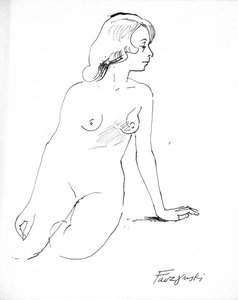
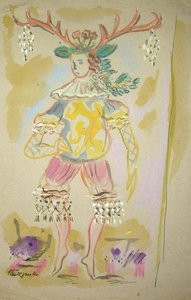
      While his architectural achievements provided a structural legacy, his graphic works offered a window into his emotional landscape. Faczynski’s artistry was remarkably diverse, ranging from the delicate precision of monochrome sketches to the raw, emotive power of watercolor and ink. In pieces such as Manor House, one observes a captivating, almost nostalgic exploration of historical themes through impressionistic detail. Conversely, his more experimental works reveal a fascination with the psychological depths of the human condition. His haunting watercolor, Man With A Cigarette, utilizes expressive distortion and vibrant color to evoke profound feelings of isolation and vulnerability, bordering on the realms of Surrealism. Similarly, his ink drawings, such as the Reclining Woman, utilize the dynamic, fragmented lines of Abstract Expressionism to capture raw emotion. Through these varied mediums, Faczynski remained a lifelong witness to the beauty and the turbulence of the world, leaving behind a body of work that continues to resonate with historical depth and artistic brilliance.