Atelier — Complimentary worldwide shipping — Delivery 2–6 weeks

      Paul Huet

      1803 - 1869

      At a glance

      • Works on this site: 104
      • Best occasions:
        • accent
        • statement
      • Died: 1869
      • Top-ranked work: Woodland Stream
      • Also known as:
        • Huet
        • P. Huet
        • بول هويت
        • ポール・ヌエ
        • Поль Юэ
      • Art period: 19th Century
      • Color intensity:
        • monochromatic
        • balanced
      • Museums on this site:
        • The Louvre
        • Petit Palais
        • Minneapolis Institute of Art
        • Musée des Beaux-Arts de Bordeaux
        • Musée d'Arts de Nantes

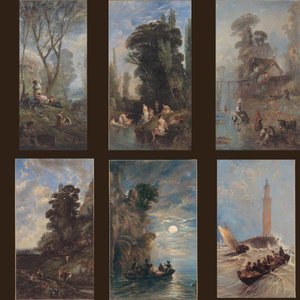
      Paul Huet: A Pioneer of Romantic Landscape

      Paul Huet (1803-1869) stands as a pivotal, yet often understated, figure in 19th-century French art – a landscape painter who profoundly influenced both the Barbizon School and the nascent Impressionists. Born in Paris amidst a burgeoning artistic climate, Huet’s journey was one of relentless observation, a deep connection to nature, and a deliberate rejection of prevailing neoclassical trends. His work wasn't merely depictions of scenery; it was an attempt to capture the very essence of light, atmosphere, and the fleeting beauty of the natural world, a pursuit that cemented his place as a key innovator in French painting.

      Early Influences and Artistic Training

      Huet’s artistic development began with a grounding in traditional techniques. He received early instruction from Jaques-Louis David's former pupil, Jean-Julien Deltil, followed by studies at the École des Beaux-Arts under Pierre Guérin and Antoine-Jean Gros. Crucially, his path intersected with that of Richard Parkes Bonington, a fellow student at Gros’s studio. This encounter proved transformative. Bonington’s approach to plein-air painting – working directly from nature – captivated Huet, leading him to abandon the rigid formality of Neoclassicism and embrace a more spontaneous and observational style. The British landscape paintings exhibited in the Salon of 1824 served as a revelation; John Constable's ability to render freshness and verdant beauty without resorting to dark shadows or artificiality deeply resonated with Huet, shaping his own artistic philosophy. He famously described Constable’s work as “the first time perhaps that one felt the freshness, that one saw a luxuriant, verdant nature, without blackness, crudity or mannerism.”

      The Barbizon Style and Dutch Masters

      Huet's style evolved through a fascinating synthesis of influences. He initially emulated Bonington’s watercolor technique, but his artistic sensibilities extended far beyond mere imitation. He drew inspiration from the atmospheric landscapes of Dutch masters like Jacob van Ruysdael and Meindert Hobbema, particularly their masterful use of light and color to convey mood and atmosphere. This admiration for the Old Masters informed his own approach, resulting in paintings that possessed a quiet dignity and a remarkable sense of realism—not photographic, but deeply felt. His work during this period was characterized by a deliberate rejection of academic conventions, favoring loose brushwork, vibrant colors, and an emphasis on capturing the immediate impression of nature.

      Salon Recognition and Political Involvement

      Huet’s artistic career gained momentum with his debut at the Salon in 1827, where one of his eight submitted paintings was accepted. He continued to exhibit regularly at the Salon throughout the 1830s and 40s, steadily building a reputation among critics and collectors. Eugène Delacroix, a fellow artist and close friend, championed Huet’s work, recognizing its unique qualities. However, Étienne-Jean Delécluze offered a more critical perspective, viewing Huet as overly devoted to Constable and Turner, sometimes neglecting fundamental design principles. Beyond his artistic pursuits, Huet was an active participant in the July Revolution of 1830 and subsequently involved in republican politics, reflecting the turbulent social and political climate of France at the time. His commitment to these ideals earned him recognition from King Louis-Philippe, who awarded him a pair of Sèvres porcelain vases in 1844, and a gold medal at the Salon of 1848.

      Legacy and Artistic Significance

      Paul Huet’s impact on French landscape painting is considerable. His innovative use of watercolor—not just for sketching but as a primary medium for finished works—demonstrated its potential to achieve remarkable depth and richness, often resembling oil paintings. He was an early adopter of plein-air painting, prioritizing direct observation of nature over studio work. More importantly, Huet’s emphasis on capturing the fleeting effects of light and atmosphere profoundly influenced the Barbizon School and later the Impressionists. Artists like Théodore Rousseau and Jean-François Millet, who sought to paint directly from nature with a focus on rural life and landscapes, owe a debt to Huet's pioneering approach. His work stands as a testament to the power of observation, the beauty of simplicity, and the enduring appeal of capturing the essence of the natural world. He died in Paris in 1869, leaving behind a substantial body of work that continues to captivate viewers with its evocative atmosphere and profound connection to nature.

      A little quiz

      There is only one correct answer for each question.

      Question 1:
      Paul Huet is best known for his work during which artistic movement?
      Question 2:
      Which English painter significantly influenced Paul Huet's approach to landscape painting?
      Question 3:
      What was a key characteristic of Huet’s watercolor technique, as noted by critics?
      Question 4:
      During which period did Paul Huet participate in the July Revolution?
      Question 5:
      Which of the following best describes Huet's relationship with Eugène Delacroix?

      Questions & Answers

      Who taught Paul Huet?

      Paul Huet trained under Pierre Narcisse Guérin and Antoine-Jean Gros.

      What art movement did Paul Huet belong to?

      Paul Huet is associated with the Romanticism movement.

      What are Paul Huet's earliest and latest paintings?

      What are the birthplace and birth year of Paul Huet?

      Paul Huet was born in Paris in 1803.

      How long did Paul Huet live?

      Paul Huet lived about 66 years, from 1803 to 1869.

      What other names is Paul Huet known by?

      Paul Huet is also known as Huet, P. Huet, بول هويت, ポール・ヌエ, Поль Юэ.

      How long was Paul Huet's career?

      The dated works by Paul Huet listed here run from 1820 to 1864, 21 works in all. See Paul Huet's career period by period.

      Which paintings is Paul Huet known for?

      Paul Huet is known for the works listed in the most famous paintings by Paul Huet.

      Where can I order a Paul Huet reproduction?

      Paul Huet painting reproductions can be ordered here, hand-painted in oil or as prints.