Atelier — Complimentary worldwide shipping — Delivery 2–6 weeks
      Augustus Edwin John, 1878 – 1961

      Augustus Edwin John's 100 Most Famous Paintings

      Portrait of the Rt. Hon. William Morris Hughes (1919) is the painting Augustus Edwin John is best remembered for; it belongs to the Art Gallery of New South Wales, Sydney. Portrait of a Young Man (1929) and Air Mechanic Shaw (Colonel T. E. Lawrence of Arabia, 1888–1935) (1935) complete the trio of best-loved canvases. Our catalogue counts 244 works by Augustus Edwin John. Here are the 100 most famous, with the year, the museum and the story of each canvas.

      Ranked by our popularity score, which combines the searches, visits and orders for each work. Updated October 2026.

      Portrait of Augustus Edwin John
      Augustus Edwin John · 1878 – 1961
      Born · died
      1878 – 1961, Tenby
      Movement
      Post-impressionism
      Works in our catalogue
      244
      Most famous
      Portrait of the Rt. Hon. William Morris Hughes (1919)
      Most works at
      Fitzwilliam College

      The ten best-loved paintings by Augustus Edwin John

      Portrait of the Rt. Hon. William Morris Hughes (1919) by Augustus Edwin John
      1

      Portrait of the Rt. Hon. William Morris Hughes

      The portrait captures the likeness of William Morris Hughes in 1919, rendered in oil on canvas. The composition focuses on the psychological presence of the subject, moving beyond mere physical resemblance to seek an instantaneous attitude of the sitter. Through fluid brushwork and a command of tonal harmony, the artist attempts to reveal the inner life and fleeting emotions of the man. The work reflects a period of transition, executed…

      Air Mechanic Shaw (Colonel T. E. Lawrence of Arabia, 1888–1935) (1935) by Augustus Edwin John
      3

      Air Mechanic Shaw (Colonel T. E. Lawrence of Arabia, 1888–1935)

      1935 · Oil On Canvas · Grundy Art Gallery, Blackpool

      In the evocative portrait Air Mechanic Shaw (Colonel T. E. Lawrence of Arabia, 1888–1935), the viewer is invited into a profound encounter with one of the most complex figures of the twentieth century. Painted by the celebrated Welsh artist Augustus Edwin John in 1935, this work transcends mere military documentation to offer a psychological study of a man caught between identities. The subject, famously known as Lawrence of Arabia, is…

      Two Jamaican Girls (1937) by Augustus Edwin John
      5

      Two Jamaican Girls

      1937 · Oil On Canvas · Walker Art Gallery, Liverpool

      The painting is a portrait of two young girls sitting next to each other on a porch. They appear to be looking at the viewer with curiosity or interest. The girls are wearing dresses, which adds a sense of innocence and youthfulness to their appearance. In addition to the girls, there are several other elements in the painting that contribute to its overall atmosphere. A chair is visible on the…

      Girl Leaning on a Stick (1910) by Augustus Edwin John
      7

      Girl Leaning on a Stick

      1910 · Oil On Canvas · Fitzwilliam College, Cambridge

      In "Girl Leaning on a Stick," Augustus Edwin John presents a quiet study of a young woman. Painted about 1910, this work captures a moment of stillness. The subject is positioned in a contemplative pose, her presence defined by a sense of introspection. There is a certain weight to her stillness, a feeling of a private thought caught in a fleeting instant.

      Augustus Edwin John: canvases 11 to 100 of the ranking

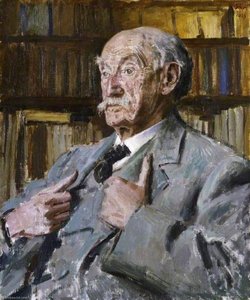
      Thomas Hardy (1840–1928) (1923) by Augustus Edwin John
      #14

      Thomas Hardy (1840–1928)

      1923 · Fitzwilliam College

      The portrait captures an elderly man seated within the quiet density of a library. He is framed by the weight of accumulated knowledge, surrounded by books that occupy…

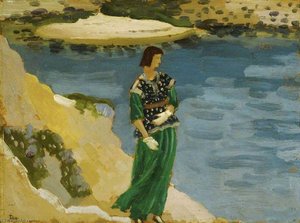
      The Blue Pool (1910) by Augustus Edwin John
      #15

      The Blue Pool

      1910 · Fitzwilliam College

      A solitary woman rests upon a rugged, rocky outcrop, her gaze meeting the viewer from the edge of a silent world. She wears a verdant green gown, the…

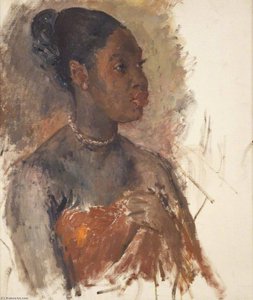
      Study in Provence (1926) by Augustus Edwin John
      #23

      Study in Provence

      1926 · Fitzwilliam College

      Study in Provence is an oil on canvas painting created circa AD 1926. The work features a portrait of a woman positioned in the center, standing before a…

      David and Dorelia in Normandy (1908) by Augustus Edwin John
      #29

      David and Dorelia in Normandy

      1908 · Fitzwilliam College

      In this 1908 portrait, David and Dorelia in Normandy captures a quiet, intimate scene set against a scenic landscape. The composition depicts David Garnett and Dorelia McNeill reclining…

      Lord Conway of Allington (1930) by Augustus Edwin John
      #30

      Lord Conway of Allington

      1930 · Courtauld Gallery

      Augustus Edwin John's “Lord Conway of Allington,” painted in 1930, isn’t merely a portrait; it’s a carefully constructed tableau vivant—a snapshot of a man brimming with intellect, experience,…

      Caspar (1909) by Augustus Edwin John
      #31

      Caspar

      1909 · Fitzwilliam College

      In the tenderly rendered portrait Caspar, created in 1909 by the celebrated Welsh artist Augustus Edwin John, we are invited into a moment of profound quietude. This intimate…

      Sir Edmund Craster (1879–1959) (1944) by Augustus Edwin John
      #32

      Sir Edmund Craster (1879–1959)

      1944 · Bodleian Libraries

      Augustus Edwin John’s 1944 portrait of Sir Edmund Craster is more than simply a likeness; it's a carefully constructed tableau of understated power and contemplative melancholy. The painting…

      Sir William Nicholson (1872–1949) (1909) by Augustus Edwin John
      #33

      Sir William Nicholson (1872–1949)

      1909 · Fitzwilliam College

      In this evocative portrait from 1909, Augustus Edwin John captures more than just the likeness of a man; he captures a moment of profound introspection. The subject, Sir…

      Dorelia and the Children at Martigues (1910) by Augustus Edwin John
      #34

      Dorelia and the Children at Martigues

      1910 · Fitzwilliam College

      In the gentle light of 1910, Augustus Edwin John captured a scene of profound intimacy and coastal serenity in Dorelia and the Children at Martigues. This exquisite painting…

      Villiers David (1932) by Augustus Edwin John
      #35

      Villiers David

      1932 · The Ashmolean Museum of Art And Archaeology

      “ Villiers David,” painted in 1932 by Augustus Edwin John, isn’t a grand historical portrait or a flamboyant depiction of celebrity. Instead, it offers a remarkably intimate glimpse…

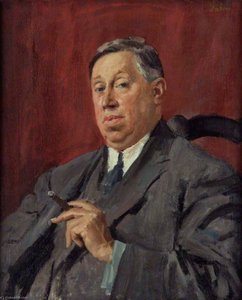
      Major Clifford Hugh Douglas (1879–1952) (1933) by Augustus Edwin John
      #36

      Major Clifford Hugh Douglas (1879–1952)

      1933 · Walker Art Gallery

      Augustus Edwin John’s 1933 portrait of Major Clifford Hugh Douglas is more than a simple likeness; it's a carefully constructed tableau of authority, intellect, and the nascent seeds…

      Dorelia Seated and Holding Flowers (1912) by Augustus Edwin John
      #37

      Dorelia Seated and Holding Flowers

      1912 · Fitzwilliam College

      Augustus Edwin John’s “Dorelia Seated and Holding Flowers” is not merely a depiction of a woman; it's an immersion into a moment of profound serenity, a carefully constructed…

      Yvonne (1922) by Augustus Edwin John
      #39

      Yvonne

      1922 · Nottingham Castle Museum And Art Gallery

      Augustus Edwin John, a name often associated with the bohemian spirit of late 19th and early 20th-century Wales, gifted us with a remarkable series of portraits that transcend…

      The Emir Feisal (1919) by Augustus Edwin John
      #40

      The Emir Feisal

      1919 · The Ashmolean Museum of Art And Archaeology

      In the quiet intensity of Augustus Edwin John’s 1919 masterpiece, The Emir Feisal, one encounters more than a mere historical likeness; one meets a profound study of human…

      Augustus Edwin John's canvases, period by period

      What Augustus Edwin John painted most

      The four subjects that return most often on these canvases, each with its best-loved example.

      Where Augustus Edwin John's canvases hang

      The 8 museums that hold the most of the paintings on this page.

      Museum City Works by Augustus Edwin John Paintings from this list
      Fitzwilliam College, CambridgeFitzwilliam College Cambridge 18 Girl Leaning on a Stick, Thomas Hardy (1840–1928), The Blue Pool
      National Gallery of Canada, OttawaNational Gallery of Canada Ottawa 12 Vincent Massey, A Summer Noon, Dorelia by the Gate
      Art Gallery of New South Wales, SydneyArt Gallery of New South Wales Sydney 5 Portrait of the Rt. Hon. William Morris Hughes, Corner, Vielle, France, Welsh mountains in snow
      Fitzwilliam MuseumFitzwilliam Museum 4 Woman with a daffodil, Sir William Nicholson, David and Dorelia in Normandy
      Walker Art Gallery, LiverpoolWalker Art Gallery Liverpool 3 Two Jamaican Girls, Major Clifford Hugh Douglas (1879–1952)
      The Ashmolean Museum of Art And Archaeology, OxfordThe Ashmolean Museum of Art And Archaeology Oxford 3 Villiers David, The Emir Feisal
      Jerwood Gallery, HastingsJerwood Gallery Hastings 3 Boy's Head, Two Disciples
      Grundy Art Gallery, BlackpoolGrundy Art Gallery Blackpool 1 Air Mechanic Shaw (Colonel T. E. Lawrence of Arabia, 1888–1935)

      Augustus Edwin John's most famous canvas, decade after decade

      1. 1890s
      2. 1900s
        Carlotta (1904) by Augustus Edwin John
        Ranked 6 of 100

        Carlotta

        Age 22 – 31 · National Gallery of Ireland
      3. 1910s
        Portrait of the Rt. Hon. William Morris Hughes (1919) by Augustus Edwin John
        Canvas 1 of 100

        Portrait of the Rt. Hon. William Morris Hughes

        Age 32 – 41 · Art Gallery of New South Wales

        The portrait captures the likeness of William Morris Hughes in 1919, rendered in oil on canvas. The composition focuses on the psychological presence of the subject, moving beyond…

      4. 1920s
      5. 1930s
      6. 1940s

      Augustus Edwin John's canvases, question by question

      Which canvas is Augustus Edwin John most remembered for?Read the answer

      Portrait of the Rt. Hon. William Morris Hughes (1919), Art Gallery of New South Wales, Sydney. Portrait of a Young Man (1929) and Air Mechanic Shaw (Colonel T. E. Lawrence of Arabia, 1888–1935) (1935) follow.

      Portrait of the Rt. Hon. William Morris Hughes: how old was Augustus Edwin John when it was painted?Read the answer

      Augustus Edwin John, born in 1878, was 41 years old: Portrait of the Rt. Hon. William Morris Hughes dates from 1919.

      What are Augustus Edwin John's ten most famous canvases?Read the answer

      Portrait of the Rt. Hon. William Morris Hughes, Portrait of a Young Man, Air Mechanic Shaw (Colonel T. E. Lawrence of Arabia, 1888–1935), Corner, Vielle, France, Two Jamaican Girls, Carlotta, Girl Leaning on a Stick, Woman with a daffodil, The Tutor and Dorelia McNeill (1881–1969), in the Garden at Alderney Manor. Each canvas in the ranking above comes with its year and its museum.

      How many paintings did Augustus Edwin John create?Read the answer

      244 works by Augustus Edwin John are in our catalogue, dated 1898 to 1944.

      Where do Augustus Edwin John's most famous canvases hang today?Read the answer

      Mostly in Fitzwilliam College (Cambridge), National Gallery of Canada (Ottawa) and Art Gallery of New South Wales (Sydney); the list above names each museum and its canvases.

      When did Augustus Edwin John paint the most famous canvases?Read the answer

      In 1910s, which gave 33 of the 100 works on this page, Portrait of the Rt. Hon. William Morris Hughes among them.

      Which famous Augustus Edwin John canvas came first, and which came last?Read the answer

      The earliest canvas here is Mrs A. A. Jack (d.c.1953) (1898); the latest is Sir Edmund Craster (1879–1959) (1944).

      Which subjects did Augustus Edwin John paint most?Read the answer

      Portrait (27), Woman (10) and Reflection (9), across the 100 works on this page.

      Which medium appears most in Augustus Edwin John's paintings?Read the answer

      Oil On Canvas, used in 9 of the 100 works on this page.

      Which movement is Augustus Edwin John associated with?Read the answer

      Post-impressionism, as the canvases on this page show.

      Which paintings by Augustus Edwin John are held by the Fitzwilliam College?Read the answer

      The Fitzwilliam College, Cambridge holds 9 of the works on this page, among them Girl Leaning on a Stick, Thomas Hardy (1840–1928) and The Blue Pool.

      Meet the painter: Augustus Edwin John

      A Welsh Bohemian: The Life and Art of Augustus Edwin John

      Augustus Edwin John emerged as a pivotal figure in early 20th-century British art, a painter whose life was as vibrant and unconventional as the canvases he produced. Born in Tenby, Wales, on January 4, 1878, his artistic journey began under the nurturing influence of his mother, who instilled in him a love for drawing from a young age. This early encouragement led him to the Tenby School of Art at seventeen, where his natural aptitude quickly became apparent. However, it was his subsequent enrollment at the Slade School of Fine Art, University College London (1894-1898), that truly ignited his artistic development. There, under the tutelage of Henry Tonks, he honed his draughtsmanship to an exceptional degree, earning accolades and establishing himself as a prodigious talent even before graduation. A dramatic turning point arrived in 1897 with a head injury sustained during a diving accident in Tenby. This incident profoundly altered his personality, unleashing a newfound spontaneity and boldness that would characterize both his life and art.

      Influences and the Shaping of a Style

      John’s artistic sensibilities were deeply rooted in the Old Masters, particularly Peter Paul Rubens, whose dynamic compositions and rich color palettes resonated with him. Simultaneously, he absorbed the innovations of French contemporaries like Matisse and Gauguin, embracing their expressive use of color and rejection of traditional academic constraints. The subtle tonal harmonies of Puvis de Chavannes also left an indelible mark on his aesthetic vision. These diverse influences coalesced into a distinctive style characterized by vibrant hues, fluid brushwork, and a compelling focus on capturing the essence of his subjects. He wasn’t merely interested in likeness; he sought to reveal the inner life, the fleeting emotions that defined each individual. This pursuit led him to excel in portraiture, where he possessed an uncanny ability to seize what he called an “instantaneous attitude” – a momentary glimpse into the soul of his sitter.

      Portraits and Gypsy Lore: A Life Lived Fully

      Augustus Edwin John is perhaps best remembered for his striking portraits of prominent figures from the aristocratic and literary worlds. His canvases brought to life personalities such as David Lloyd George, James Joyce, and George Bernard Shaw, each rendered with a psychological depth that transcended mere representation. Notable works like *Caspar* (1909), a poignant depiction of youthful innocence, and portraits of Archibald Henry Macdonald Sinclair (1924) and Francis Henry Crittall (1919) exemplify his mastery of the genre. However, John’s artistic interests extended beyond the confines of conventional portraiture. A profound fascination with Romani culture led him to embrace a nomadic lifestyle, traveling in a caravan with his family for an extended period. This immersive experience profoundly influenced his art, infusing it with themes of freedom, wanderlust, and the beauty of the natural world. His deep connection to this community culminated in his presidency of the Gypsy Lore Society, solidifying his commitment to understanding and celebrating their unique way of life. *Air Mechanic Shaw* (1935), a portrait of T.E. Lawrence, stands as another testament to his ability to capture complex characters with remarkable sensitivity.

      A Complex Legacy: Recognition and Reassessment

      Throughout his career, John experienced both widespread acclaim and periods of critical fluctuation. Initially celebrated for his innovative oil sketching techniques and figure drawings, some critics later found his work to be overly flamboyant or lacking in painterly finesse. His service as a war artist during World War I, attached to the Canadian forces, yielded memorable portraits of soldiers, but an unfortunate incident led to his recall to England. Despite these challenges, Augustus Edwin John remained a significant force in British art history. He was one of the few artists of his time to achieve widespread public recognition and played a crucial role in popularizing Post-Impressionism within the United Kingdom. Awarded the Order of Merit in 1942, he also documented his life and artistic philosophy in two volumes of autobiography: *Chiaroscuro* (1952) and *Finishing Touches* (published posthumously in 1964). While his reputation waned somewhat after World War II, there has been a renewed appreciation for his work in recent years, particularly for the vibrancy and originality of his early pieces. His legacy is further enriched by the artistic achievements of his sister, Gwen John, whose own unique vision contributed significantly to the modernist movement.
      • Born: January 4, 1878, Tenby, Wales
      • Died: October 31, 1961, Fordingbridge, England
      Augustus Edwin John’s art continues to captivate and inspire, reminding us of the power of individual expression and the enduring allure of a life lived with passion and artistic integrity.

      All 244 works by Augustus Edwin John →