Atelier — Complimentary worldwide shipping — Delivery 2–6 weeks
      Bernard Meninsky, 1891 – 1950

      Bernard Meninsky: The 62 Best-Known Paintings

      Of all Bernard Meninsky's paintings, The Red Hat (Margaret Meninsky) (1919) is the most famous; it hangs in the Ferens Art Gallery, Hull. Close behind come Portrait of a Girl (1916) and Portrait of a Boy (1917). Among the 62 works by Bernard Meninsky in our catalogue, these 62 are the most celebrated, each shown with its date, its museum and its story.

      Ranked by our popularity score, which combines the searches, visits and orders for each work. Updated October 2026. Each painting on this page can be ordered as an oil reproduction painted by hand on linen canvas, or as a fine art print, made to the size you choose.

      Portrait of Bernard Meninsky
      Bernard Meninsky · 1891 – 1950
      Born · died
      1891 – 1950, Konotop
      Movement
      Post-impressionism
      Works in our catalogue
      62
      Most famous
      The Red Hat (Margaret Meninsky) (1919)
      Most works at
      Somerville College

      Bernard Meninsky's 10 most celebrated paintings

      The Red Hat (Margaret Meninsky) (1919) by Bernard Meninsky
      1

      The Red Hat (Margaret Meninsky)

      1919 · Oil · Ferens Art Gallery, Hull

      In the quiet intimacy of The Red Hat, painted in 1919, we are invited into a world that feels both profoundly personal and timelessly poised. Bernard Meninsky, an artist whose life was shaped by the shifting shadows of early 20th-century Europe, captures here more than just a seated figure; he captures a breath held in time. The focal point is a woman, her presence commanding yet contemplative, draped in the…

      Portrait of a Boy (1923) by Bernard Meninsky
      6

      Portrait of a Boy

      1923

      The Portrait of a Boy by Bernard Meninsky, created in 1923, is a masterpiece that exudes an aura of serenity and contemplation. This oil on canvas painting measures 91 x 71 cm and is a testament to Meninsky's skillful brushwork and his ability to capture the essence of his subjects. Composition and Details The boy in the portrait sits on a wooden chair, which dominates the scene, stretching from the…

      Portrait of a Girl (1942) by Bernard Meninsky
      7

      Portrait of a Girl

      1942 · Oil · Arts Council Collection, London

      In the quietude of 1942, amidst a world convulsed by the tremors of global conflict, Bernard Meninsky captured a moment of profound stillness. His Portrait of a Girl serves as a poignant sanctuary of introspection, inviting the viewer into a private, contemplative space. The subject, a young woman with cascading locks, is caught in a downward gaze, her eyes averted from the observer to focus on something unseen—perhaps her own…

      Two Women and Child (1913) by Bernard Meninsky
      8

      Two Women and Child

      1913 · Drawing · Ben Uri Gallery and Museum, London

      In the quiet, evocative realm of Bernard Meninsky’s 1913 work, Two Women and Child, we are invited into a moment of profound intimacy that transcends the mere depiction of figures. This finely executed drawing serves as a poignant window into the artist's early mastery, capturing a scene that feels both timeless and deeply personal. The composition centers on two women standing in close proximity, their presence anchored by the delicate…

      Bernard Meninsky paintings ranked 11 to 62

      Landscape (1923) by Bernard Meninsky
      #43

      Landscape

      1923 · Walker Art Gallery

      In the quietude of 1923, Bernard Meninsky captured a moment of profound stillness in his masterpiece, Landscape. This evocative oil on canvas invites the viewer to wander through…

      Bring this light home →
      Study of Trees (1924) by Bernard Meninsky
      #58

      Study of Trees

      1924 · Somerville College

      The painting "Study of Trees" by Bernard Meninsky is a stunning representation of nature's beauty, showcasing the artist's skill in capturing the essence of the natural world. Created…

      Order this canvas →
      John Banting (1924) by Bernard Meninsky
      #59

      John Banting

      1924 · National Portrait Gallery

      The John Banting painting by Bernard Meninsky is a remarkable piece of art that showcases the artist's exceptional skill in capturing the essence of his subject. Created in…

      Order this canvas →
      Mother and Child (1919) by Bernard Meninsky
      #60

      Mother and Child

      1919 · The Stanley - Audrey Burton Gallery

      The painting Mother and Child by Bernard Meninsky is a beautiful example of early 20th-century art. Created in 1919, this oil on canvas piece measures 122 x 91…

      Have it painted by hand →
      Still Life with Apples (1927) by Bernard Meninsky
      #61

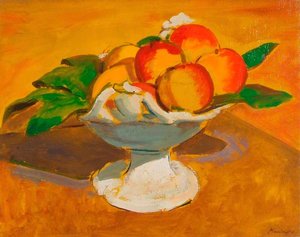
      Still Life with Apples

      1927 · Nottingham Castle Museum And Art Gallery

      The painting Still Life with Apples by Bernard Meninsky is a stunning example of oil on canvas artwork, created in 1927. Measuring 31 x 41 cm, this beautiful…

      Have it painted by hand →
      Mother and Child by Bernard Meninsky
      #62

      Mother and Child

      The painting Mother and Child by Bernard Meninsky is a beautiful representation of the love and bond between a mother and her child. Created in oil on canvas,…

      Order this canvas →

      What Bernard Meninsky painted most

      The four subjects that return most often on these canvases, each with its best-loved example.

      Where Bernard Meninsky's canvases hang

      The 8 museums that hold the most of the paintings on this page.

      Museum City Works by Bernard Meninsky Paintings from this list
      Somerville College, OxfordSomerville College Oxford 7 Beech Trees, View on the Oxford Canal, Hillside in Cumberland
      Ben Uri Gallery and Museum, LondonBen Uri Gallery and Museum London 4 Two Women and Child, Standing Female Nude, Torremolinos, South of Spain
      Walker Art Gallery, LiverpoolWalker Art Gallery Liverpool 3 Elsie Farleigh (1900–1981), The Bathers, Landscape
      The Hepworth Wakefield, WakefieldThe Hepworth Wakefield Wakefield 2 Portrait of a Boy, Lilies
      Arts Council Collection, LondonArts Council Collection London 2 Portrait of a Girl, Andalusian Landscape
      The Stanley - Audrey Burton Gallery, LeedsThe Stanley - Audrey Burton Gallery Leeds 2 Portrait of a Girl (The Artist's Sister), Mother and Child
      Nottingham Castle Museum And Art Gallery, NottinghamNottingham Castle Museum And Art Gallery Nottingham 2 Still Life with Yellow Bowl and Fruit, Still Life with Apples
      Jerwood Gallery, HastingsJerwood Gallery Hastings 2 Mother and Child, Irish Peasants

      Decade by decade: Bernard Meninsky's most celebrated canvas

      1. 1910s
        The Red Hat (Margaret Meninsky) (1919) by Bernard Meninsky
        Canvas 1 of 62

        The Red Hat (Margaret Meninsky)

        Age 19 – 28 · Ferens Art Gallery

        In the quiet intimacy of The Red Hat, painted in 1919, we are invited into a world that feels both profoundly personal and timelessly poised. Bernard Meninsky, an…

      2. 1920s
        Portrait of a Boy (1923) by Bernard Meninsky
        6 of 62

        Portrait of a Boy

        Age 29 – 38

        The Portrait of a Boy by Bernard Meninsky, created in 1923, is a masterpiece that exudes an aura of serenity and contemplation. This oil on canvas painting measures…

      3. 1930s
      4. 1940s
        Portrait of a Girl (1942) by Bernard Meninsky
        Canvas 7 of 62

        Portrait of a Girl

        Age 49 – 58 · Arts Council Collection

        In the quietude of 1942, amidst a world convulsed by the tremors of global conflict, Bernard Meninsky captured a moment of profound stillness. His Portrait of a Girl…

      Your questions on Bernard Meninsky's paintings, answered

      Which is the most celebrated painting by Bernard Meninsky?Read the answer

      The Red Hat (Margaret Meninsky) (1919), Ferens Art Gallery, Hull. Portrait of a Girl (1916) and Portrait of a Boy (1917) follow.

      How old was Bernard Meninsky at the time of The Red Hat (Margaret Meninsky)?Read the answer

      Bernard Meninsky, born in 1891, was 28 years old: The Red Hat (Margaret Meninsky) dates from 1919.

      Which ten paintings is Bernard Meninsky most famous for?Read the answer

      The Red Hat (Margaret Meninsky), Portrait of a Girl, Portrait of a Boy, Sketch of Soldiers Arriving on Leave, Portrait, Portrait of a Boy, Portrait of a Girl, Two Women and Child, Robin and The Woman's Head. Each canvas in the ranking above comes with its year and its museum.

      How many paintings by Bernard Meninsky are known?Read the answer

      62 works by Bernard Meninsky are in our catalogue, dated 1913 to 1948.

      Which museums hold Bernard Meninsky's best-known canvases?Read the answer

      Mostly in Somerville College (Oxford), Ben Uri Gallery and Museum (London) and Walker Art Gallery (Liverpool); the list above names each museum and its canvases.

      In which years did Bernard Meninsky paint the most celebrated canvases?Read the answer

      In 1920s, which gave 17 of the 62 works on this page, Portrait of a Boy among them.

      What are the first and the last of Bernard Meninsky's famous canvases?Read the answer

      The earliest canvas here is Two Women and Child (1913); the latest is Figure in a Landscape (1948).

      Which subjects return most often in Bernard Meninsky's paintings?Read the answer

      Portrait (5), Reflection (3) and Victorian era (2), across the 62 works on this page.

      What did Bernard Meninsky usually paint with?Read the answer

      Oil, used in 3 of the 62 works on this page.

      To which art movement does Bernard Meninsky belong?Read the answer

      Post-impressionism and Contemporary realism, as the canvases on this page show.

      What can I see by Bernard Meninsky at the Somerville College?Read the answer

      The Somerville College, Oxford holds 7 of the works on this page, among them Beech Trees, View on the Oxford Canal and Hillside in Cumberland.

      Can I order a hand-painted copy of a painting by Bernard Meninsky?Read the answer

      Yes. Every painting on this page can be ordered from its own page as an oil reproduction painted by hand, or as a fine art print, in the size you choose.

      Bernard Meninsky: the painter's story

      Bernard Meninsky: A Life Painted in Shadows and Light

      Born in Konotop, Ukraine – a place steeped in both Ukrainian and Yiddish heritage – Bernard Meninsky’s artistic journey began far from the bustling art centers of London. His early life, marked by a swift move to Liverpool with his family, laid the foundation for an artist deeply attuned to human emotion and the quiet dignity of everyday moments. Despite leaving formal education at eleven, a remarkable talent for drawing quickly surfaced, leading to scholarships that propelled him towards the prestigious Slade School of Fine Art in 1912. This pivotal period wasn’t merely about technical training; it was a transformative immersion into the burgeoning world of modern art, profoundly influenced by figures like Walter Sickert and Henry Tonks, while simultaneously challenging the established norms championed by Roger Fry.

      The Slade's rejection of avant-garde movements – particularly Cubism – shaped Meninsky’s approach. He didn’t immediately embrace radical experimentation but instead developed a distinctive style characterized by evocative figures, poignant landscapes, and above all, his deeply moving ‘Mother and Child’ scenes. These works, imbued with a sense of melancholy and quiet strength, became the hallmark of his oeuvre. His time at the school fostered connections that would prove invaluable throughout his career, including a lifelong friendship with William Roberts and mentorship from Walter Sickert, who provided a crucial platform for his work.

      The War Artist’s Eye

      World War I irrevocably altered Meninsky's trajectory. Enlisting in the Royal Fusiliers in 1918, he transitioned into a war artist under the British War Memorials Committee, documenting the realities of conflict with unflinching honesty and sensitivity. His wartime paintings – particularly ‘The Arrival of a Leave Train, Victoria Station’ – offer a powerful glimpse into the lives of returning soldiers, capturing their weariness, longing, and quiet resilience. These works weren't simply depictions of battle; they were intimate portraits of human experience amidst devastation. Meninsky’s commitment to this role extended beyond mere observation; he sought to convey the emotional weight of the war, reflecting a profound empathy for those affected by it.

      Following the war, Meninsky continued his teaching career at the Central School of Arts and Crafts, nurturing a new generation of artists. His dedication to instruction was matched by an unwavering belief in the power of art to illuminate the human condition. His work during this period reflected a shift towards greater introspection, with a focus on domestic scenes and familial relationships – particularly his celebrated ‘Mother and Child’ series. These paintings, rendered in muted tones and imbued with a sense of quiet intimacy, became increasingly central to his artistic identity.

      Style and Influences

      Meninsky's style is often described as Post-Impressionist, yet he developed a unique voice that transcended simple categorization. He absorbed the bold colors and expressive brushwork of artists like Cézanne and Van Gogh, but tempered them with a distinctly British sensibility. His landscapes are characterized by atmospheric perspective and a subtle use of color, while his figures possess a remarkable sense of realism combined with emotional depth. The influence of Walter Sickert is particularly evident in Meninsky’s use of light and shadow, as well as his ability to capture the mood and atmosphere of a scene.

      The impact of his wartime experiences undoubtedly shaped his artistic vision. The trauma of war instilled in him a deep appreciation for the fragility of life and the importance of human connection. This sensitivity is powerfully conveyed in his ‘Mother and Child’ paintings, which are not merely sentimental depictions but rather profound meditations on motherhood, loss, and hope. His work stands as a testament to the enduring power of art to bear witness to history and explore the complexities of the human spirit.

      Legacy and Continuing Relevance

      Bernard Meninsky's legacy extends beyond his individual paintings. He was a significant figure in the London Group and contributed to the development of British modernism. His work continues to resonate with viewers today, offering a poignant reminder of the enduring power of art to capture the human experience. The Imperial War Museum holds a substantial collection of his wartime works, ensuring that his powerful depictions of conflict will continue to be studied and appreciated for generations to come. His dedication to teaching also left an indelible mark on the artistic landscape of Britain, shaping the careers of countless aspiring artists.

      All 62 works by Bernard Meninsky →