Atelier — Complimentary worldwide shipping — Delivery 2–6 weeks
      Charles Conder, 1868 – 1909

      Charles Conder: The 100 Best-Known Paintings

      Of all Charles Conder's paintings, Colombo (1890) is the most famous; it hangs in the National Gallery of Victoria, Melbourne. Close behind come Rickett's Point (1890) and A Shady Hollow by a Dusty Road (also known as Pugh's Lagoon or A Cove on the Hawkesbury) (1887). Among the 100 works by Charles Conder in our catalogue, these 100 are the most celebrated, each shown with its date, its museum and its story.

      Ranked by our popularity score, which combines the searches, visits and orders for each work. Updated October 2026. Each painting on this page can be ordered as an oil reproduction painted by hand on linen canvas, or as a fine art print, made to the size you choose.

      Portrait of Charles Conder
      Charles Conder · 1868 – 1909
      Born · died
      1868 – 1909, Tottenham
      Movement
      Impressionism
      Works in our catalogue
      100
      Most famous
      Colombo (1890)
      Most works at
      National Gallery of Victoria

      Charles Conder's 10 most celebrated paintings

      Colombo (1890) by Charles Conder
      1

      Colombo

      1890 · Oil On Panel · National Gallery of Victoria, Melbourne

      The Heidelberg School emerged during a period of significant artistic experimentation in Australia. Influenced by Impressionism originating in France, artists like Conder sought to depict the Australian landscape with unprecedented sensitivity and immediacy. This movement challenged academic conventions and championed plein air painting—working outdoors directly from nature—a radical departure from studio practice at the time.

      Rickett's Point (1890) by Charles Conder
      2

      Rickett's Point

      1890 · Acrylic On Canvas · National Gallery of Victoria, Melbourne

      Rickett's Point – A Snapshot of Heidelberg School Idyllic Beauty Charles Edward Conder’s “Rickett’s Point,” completed in 1890, stands as a quintessential example of the Heidelberg School artistic movement—a celebration of Australian landscape painting at its zenith. Captured with remarkable precision and imbued with a palpable sense of tranquility, this artwork transports viewers to the shores of Rickett's Point, Victoria, offering a glimpse into the leisurely pursuits of Victorian society.…

      A Shady Hollow by a Dusty Road (also known as Pugh's Lagoon or A Cove on the Hawkesbury) (1887) by Charles Conder
      3

      A Shady Hollow by a Dusty Road (also known as Pugh's Lagoon or A Cove on the Hawkesbury)

      1887 · National Gallery of Victoria, Melbourne

      In the delicate brushstrokes of Charles Edward Conder’s 1887 masterpiece, A Shady Hollow by a Dusty Road, we are invited to step into a moment of profound tranquility. This evocative landscape, also known as Pugh's Lagoon, captures more than just a geographical location; it captures a feeling of suspended time. The scene unfolds along a sun-drenched shoreline where the gentle rhythm of the water meets the soft textures of the…

      On the River Yarra near Heidelberg, Victoria (1890) by Charles Conder
      4

      On the River Yarra near Heidelberg, Victoria

      1890 · Oil On Canvas · Art Gallery of New South Wales, Sydney

      In the gentle light of 1890, Charles Edward Conder captured a moment of profound tranquility in his masterpiece, On the River Yarra near Heidelberg, Victoria. This evocative oil on canvas serves as more than just a landscape; it is a window into the soul of the Australian countryside during a pivotal era of artistic discovery. The scene unfolds along the banks of the Yarra River, where the water rests in…

      The Moulin Rouge (1890) by Charles Conder
      5

      The Moulin Rouge

      1890 · Oil On Canvas · Manchester Art Gallery, Manchester

      In the heart of late Victorian Paris, amidst the bohemian pulse of the Pigalle district, Charles Edward Conder captured a fleeting moment of pure, unadulterated joy. The Moulin Rouge is not merely a painting of a cabaret; it is an immersive descent into the vibrant energy of the Belle Époque. Through his masterful lens, the canvas breathes with the spirit of a society indulging in its most exuberant pleasures. The…

      Night in the Garden in Spain (1895) by Charles Conder
      7

      Night in the Garden in Spain

      1895 · Oil On Canvas

      Night in the Garden in Spain is an oil on canvas painted by Charles Conder. The work emerged in 1895, capturing a specific moment of evening light and shadow. It remains part of the permanent collection at the Art Gallery of Western Australia in Perth, Australia.

      Dieppe (1895) by Charles Conder
      8

      Dieppe

      1895 · Oil On Canvas · Manchester Art Gallery, Manchester

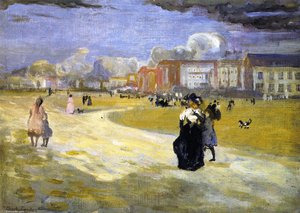
      Charles Edward Conder’s “Dieppe,” painted in 1895, isn't merely a depiction of a coastal scene; it’s an immersion into a fleeting moment of tranquility and observation. The canvas breathes with the muted palette of a late afternoon – a symphony of blues deepening towards the horizon, punctuated by the warm ochres and yellows of the sand and distant buildings. The composition immediately draws the eye along a gentle diagonal path…

      The Farm, Richmond, New South Wales (1888) by Charles Conder
      9

      The Farm, Richmond, New South Wales

      1888 · Oil On Canvas · National Gallery of Victoria, Melbourne

      To gaze upon Charles Edward Conder's "The Farm, Richmond, New South Wales" is to step through a veil of time directly into the sun-drenched heart of colonial Australian life. Painted in 1888, this oil on canvas is far more than a mere depiction of rural scenery; it is an evocative meditation on peace, community, and the enduring rhythm of agricultural existence. Conder masterfully captures a moment suspended in amber—a tableau…

      Charles Conder paintings ranked 11 to 100

      Sketch Portrait (1889) by Charles Conder
      #24

      Sketch Portrait

      1889 · National Gallery of Victoria

      In the delicate dance between light and shadow, Charles Edward Conder’s Sketch Portrait emerges as a captivating study of elegance and poise. Painted in 1889, this evocative work…

      Have it painted by hand →
      William Orpen (1900) by Charles Conder
      #26

      William Orpen

      1900 · National Gallery of Ireland

      The air in the studio feels heavy with the scent of oil and the weight of a silent gaze. A man sits before us, his dark hair framing…

      Have it painted by hand →
      A Taste for Literature (1888) by Charles Conder
      #27

      A Taste for Literature

      1888

      In the gentle embrace of the Australian countryside, Charles Edward Conder captures a moment of profound stillness in his 1888 masterpiece, A Taste for Literature. This evocative oil…

      Have it painted by hand →
      Ricketts Point, Beaumaris (1890) by Charles Conder
      #28

      Ricketts Point, Beaumaris

      1890 · National Gallery of Australia

      In the luminous masterpiece Ricketts Point, Beaumaris, Charles Edward Conder invites us to step into a world of pure, unadulterated joy. Painted in 1890, this sweeping composition captures…

      Bring this light home →
      The Sands, Newquay (1906) by Charles Conder
      #29

      The Sands, Newquay

      1906

      There is a profound, almost palpable warmth that radiates from Charles Edward Conder’s 1906 masterpiece, The Sands, Newquay. As one gazes upon this exquisite oil on canvas, the…

      Bring this light home →
      MIrage (1889) by Charles Conder
      #30

      MIrage

      1889 · National Gallery of Victoria

      Charles Edward Conder's "Mirage," painted in 1889, isn’t merely a depiction of a landscape; it’s an invitation into a realm where reality subtly bends, inviting contemplation on the…

      Have it painted by hand →
      Springime (1892) by Charles Conder
      #31

      Springime

      1892 · Tate Gallery

      Charles Edward Conder's "Springime," painted in 1892, isn’t merely a depiction of springtime; it’s an immersion into the very essence of renewal. This oil on canvas, currently residing…

      Have it painted by hand →
      Swnage (1900) by Charles Conder
      #33

      Swnage

      1900 · Tate Gallery

      “Swnage,” painted by Charles Edward Conder in approximately 1901, isn't merely a depiction of a beach scene; it’s an immersive experience of the Australian coastline captured with Impressionistic…

      Have it painted by hand →
      Hayfield, France (1894) by Charles Conder
      #82

      Hayfield, France

      1894 · Art Gallery of South Australia

      Charles Conder captured the quietude of the French countryside in his 1894 oil on canvas, Hayfield, France. The work presents a serene landscape of rural France, where the…

      Bring this light home →
      Newquay (Town Beach) (1906) by Charles Conder
      #83

      Newquay (Town Beach)

      1906 · Walker Art Gallery

      Charles Edward Conder’s “Newquay (Town Beach)” isn't merely a depiction of a seaside scene; it’s a vibrant distillation of a summer day, captured with the bold confidence and…

      Order this canvas →
      Springtime (1888) by Charles Conder
      #84

      Springtime

      1888 · National Gallery of Victoria

      Charles Edward Conder's "Springtime," painted in 1888, isn’t merely a depiction of a rural scene; it’s a vibrant distillation of the Heidelberg School’s artistic philosophy – a celebration…

      Have it painted by hand →
      A Dream of Handel's Largo (1889) by Charles Conder
      #85

      A Dream of Handel's Largo

      1889 · Art Gallery of South Australia

      “A Dream of Handel’s Largo” by Charles Edward Conder is more than just a painting; it’s an immersion into the atmosphere of Melbourne, Australia, circa 1889. Captured in…

      Have it painted by hand →
      The Hot Sands, Mustapha (1891) by Charles Conder
      #87

      The Hot Sands, Mustapha

      1891 · Art Gallery of New South Wales

      In the shimmering heat of 1891, Charles Edward Conder captured a moment that transcends the simple boundaries of a beach scene, inviting the viewer into a world where…

      Have it painted by hand →
      Coogee Bay (1888) by Charles Conder
      #88

      Coogee Bay

      1888 · National Gallery of Victoria

      Charles Edward Conder’s “Coogee Bay,” painted in 1888, stands as a quintessential example of the Heidelberg School movement—a group of Australian artists who championed plein air painting and…

      Bring this light home →
      Windy Day at Brighton (1905) by Charles Conder
      #89

      Windy Day at Brighton

      1905 · Tate Gallery

      “Windy Day at Brighton” by Charles Edward Conder stands as a testament to the burgeoning Impressionist movement in Britain during the early 20th century. Created in 1905 and…

      Order this canvas →
      Smoke and Chrysanthemum Flowers (1890) by Charles Conder
      #90

      Smoke and Chrysanthemum Flowers

      1890 · Manchester Art Gallery

      Smoke and Chrysanthemum Flowers – An Impressionistic Reflection Charles Edward Conder’s “Smoke and Chrysanthemum Flowers,” painted in 1890, is a deceptively simple yet profoundly evocative depiction of floral…

      Have it painted by hand →
      The Yarra, Heidelberg (1890) by Charles Conder
      #95

      The Yarra, Heidelberg

      1890 · National Gallery of Australia

      The painting The Yarra, Heidelberg by Charles Edward Conder is a beautiful representation of the Yarra River in Heidelberg, Australia. Created in 1890, this oil on canvas painting…

      Have it painted by hand →
      Sketch of Littlehapton Beach (1890) by Charles Conder
      #97

      Sketch of Littlehapton Beach

      1890 · National Gallery of Victoria

      Charles Edward Conder’s “Sketch of Littlehapton Beach,” painted in 1890, offers a glimpse into the burgeoning Impressionist movement's fascination with capturing fleeting moments of natural beauty. This unassuming…

      Bring this light home →
      In the Domain, Sydney (1888) by Charles Conder
      #98

      In the Domain, Sydney

      1888

      The painting In the Domain, Sydney by Charles Edward Conder is a masterpiece that embodies the essence of rural life in the late 19th century. Created in 1888,…

      Order this canvas →
      Bronte Beach (1888) by Charles Conder
      #99

      Bronte Beach

      1888 · National Gallery of Australia

      Charles Conder was one of a celebrated group of artists who painted landscapes outdoors around Sydney and Melbourne during the 1880s. Together with Tom Roberts and Arthur Streeton…

      Have it painted by hand →
      A Holiday at Mentone (1888) by Charles Conder
      #100

      A Holiday at Mentone

      1888 · Art Gallery of South Australia

      'A Holiday at Mentone' is a captivating beach scene painting created by Charles Edward Conder in 1888. This stunning oil on canvas masterpiece is currently housed in the…

      Have it painted by hand →

      Charles Conder's canvases, period by period

      What Charles Conder painted most

      The four subjects that return most often on these canvases, each with its best-loved example.

      Where Charles Conder's canvases hang

      The 8 museums that hold the most of the paintings on this page.

      Museum City Works by Charles Conder Paintings from this list
      National Gallery of Victoria, MelbourneNational Gallery of Victoria Melbourne 11 Colombo, Rickett's Point, A Shady Hollow by a Dusty Road (also known as Pugh's Lagoon or A Cove on the Hawkesbury)
      National Gallery of Australia, CanberraNational Gallery of Australia Canberra 9 Going home (The Gray and Gold), Ricketts Point, Beaumaris, Riddell's Creek
      Art Gallery of South Australia, AdelaideArt Gallery of South Australia Adelaide 7 All on a summer's day, How We Lost Poor Flossie, Tea-Time
      Art Gallery of New South Wales, SydneyArt Gallery of New South Wales Sydney 6 On the River Yarra near Heidelberg, Victoria, An Impressionist (Tom Roberts), Sunset, Sydney Harbour
      Manchester Art Gallery, ManchesterManchester Art Gallery Manchester 3 The Moulin Rouge, Dieppe, Smoke and Chrysanthemum Flowers
      Tate Gallery, LondonTate Gallery London 3 Springime, Swnage, Windy Day at Brighton
      National Gallery of Canada, OttawaNational Gallery of Canada Ottawa 2 Portrait of Mrs. Aikins, Beach Scene, Newquay
      Birmingham Museum and Art Gallery, BirminghamBirmingham Museum and Art Gallery Birmingham 1 Beauvais - The Inconstant, The Silenus, The Charlatan

      Decade by decade: Charles Conder's most celebrated canvas

      1. 1880s
      2. 1890s
        Colombo (1890) by Charles Conder
        Ranked 1 of 100

        Colombo

        Age 22 – 31 · National Gallery of Victoria

        The Heidelberg School emerged during a period of significant artistic experimentation in Australia. Influenced by Impressionism originating in France, artists like Conder sought to depict the Australian landscape…

      3. 1900s

      Your questions on Charles Conder's paintings, answered

      Which is the most celebrated painting by Charles Conder?Read the answer

      Colombo (1890), National Gallery of Victoria, Melbourne. Rickett's Point (1890) and A Shady Hollow by a Dusty Road (also known as Pugh's Lagoon or A Cove on the Hawkesbury) (1887) follow.

      How old was Charles Conder at the time of Colombo?Read the answer

      Charles Conder, born in 1868, was 22 years old: Colombo dates from 1890.

      Which ten paintings is Charles Conder most famous for?Read the answer

      Colombo, Rickett's Point, A Shady Hollow by a Dusty Road (also known as Pugh's Lagoon or A Cove on the Hawkesbury), On the River Yarra near Heidelberg, Victoria, The Moulin Rouge, Sandringham, Night in the Garden in Spain, Dieppe, The Farm, Richmond, New South Wales and All on a summer's day. Each canvas in the ranking above comes with its year and its museum.

      How many paintings by Charles Conder are known?Read the answer

      100 works by Charles Conder are in our catalogue, dated 1886 to 1907.

      Which museums hold Charles Conder's best-known canvases?Read the answer

      Mostly in National Gallery of Victoria (Melbourne), National Gallery of Australia (Canberra) and Art Gallery of South Australia (Adelaide); the list above names each museum and its canvases.

      In which years did Charles Conder paint the most celebrated canvases?Read the answer

      In 1890s, which gave 40 of the 100 works on this page, Colombo among them.

      What are the first and the last of Charles Conder's famous canvases?Read the answer

      The earliest canvas here is Landscape with Two Small Figures Richmond, New South Wales (1886); the latest is Beach Scene, Newquay (1907).

      Which subjects return most often in Charles Conder's paintings?Read the answer

      Landscape (20), Beach (10) and Leisure (8), across the 100 works on this page.

      What did Charles Conder usually paint with?Read the answer

      Oil On Canvas, used in 18 of the 100 works on this page.

      To which art movement does Charles Conder belong?Read the answer

      Impressionism and Heidelberg school, as the canvases on this page show.

      What can I see by Charles Conder at the National Gallery of Victoria?Read the answer

      The National Gallery of Victoria, Melbourne holds 11 of the works on this page, among them Colombo, Rickett's Point and A Shady Hollow by a Dusty Road (also known as Pugh's Lagoon or A Cove on the Hawkesbury).

      Can I order a hand-painted copy of a painting by Charles Conder?Read the answer

      Yes. Every painting on this page can be ordered from its own page as an oil reproduction painted by hand, or as a fine art print, in the size you choose.

      Charles Conder: the painter's story

      early life and artistic journey

      charles edward conder, a british-born painter, lithographer, and designer, left an indelible mark on the art world. born in tottenham, middlesex, on october 24, 1868, conder's early life was marked by his mother's passing in india when he was just four years old.

      artistic career in australia

      in 1884, at 16, conder moved to sydney, australia, working for his uncle as a land surveyor. however, he soon discovered his true passion lay in drawing the landscape rather than surveying it. by 1886, he had become an artist for the illustrated sydney news, alongside notable artists like albert henry fullwood and frank mahony.

      the heidelberg school and notable works

      conder's masterpiece, departure of the orient – circular quay (1888), showcased his newfound mastery of form and brushwork. this dockside scene, depicting the bustling harbour at sydney cove, was quickly purchased by the art gallery of new south wales, making it conder's first work to enter a public collection.
      • a holiday at mentone (1888), a fun-loving painting showcasing men and women relaxing on the beach, is another notable example of conder's work.
      • conder's association with g. p. nerli, an itinerant italian painter, significantly influenced his development as an artist.
      • his contributions to the 9 by 5 impression exhibition in melbourne, alongside tom roberts and arthur streeton, solidified his position within the heidelberg school movement.

      legacy and later life

      conder's later years were plagued by poor health, including paralysis and a bout of delirium tremens. despite this, he continued to paint, leaving behind a legacy as a key figure in the heidelberg school. his art was better received in england than in paris, with his portrait being painted by henri de toulouse-lautrec in 1892. view conder's works at the art gallery of new south wales or explore more about the heidelberg school on TopImpressionists's charles edward conder page.

      conclusion

      charles edward conder's impact on australian impressionism is undeniable. his legacy, marked by his captivating paintings and association with the heidelberg school, continues to inspire art enthusiasts worldwide.

      All 100 works by Charles Conder →