Atelier — Complimentary worldwide shipping — Delivery 2–6 weeks
      Cy Twombly, 1928 – 2011

      Cy Twombly's 100 Most Famous Paintings

      The Rose (IV) (2008) is the painting Cy Twombly is best remembered for. Proteus (1984) and Quattro Stagioni, Autunno (1995) complete the trio of best-loved canvases. Our catalogue counts 116 works by Cy Twombly. Here are the 100 most famous, with the year, the museum and the story of each canvas.

      Ranked by our popularity score, which combines the searches, visits and orders for each work. Updated October 2026.

      Portrait of Cy Twombly
      Cy Twombly · 1928 – 2011
      Born · died
      1928 – 2011, Lexington
      Movement
      Abstract expressionism
      Works in our catalogue
      116
      Most famous
      The Rose (IV) (2008)
      Most works at
      Metropolitan Museum of Art

      The ten best-loved paintings by Cy Twombly

      The Rose (IV) (2008) by Cy Twombly
      1

      The Rose (IV)

      2008 · Acrylic On Canvas

      The Rose (IV) by Cy Twombly: A Symphony of Color and Poetic Echoes Subject: The painting "The Rose (IV)" by Cy Twombly is an arresting exploration of the rose motif, rendered through a vibrant and dynamic abstract expressionist style. It’s not merely a depiction of a flower; it's an invocation of beauty, passion, and the transient nature of existence, deeply rooted in historical and literary references. Style: As a quintessential…

      Proteus (1984) by Cy Twombly
      2

      Proteus

      1984 · Painting

      To stand before Cy Twombly's Proteus is to encounter not merely paint on canvas, but a vibrant conversation across decades—a dialogue between raw energy and profound mythology. Created in 1984, this work pulses with the unmistakable spirit of Neo-Expressionism, a movement that yearned for visceral feeling after the cool intellectualism of earlier art forms. Twombly’s signature style here is breathtaking; it seems less applied and more excavated, as if the…

      Quattro Stagioni, Autunno (1995) by Cy Twombly
      3

      Quattro Stagioni, Autunno

      1995 · Mixed Media

      Quattro Stagioni, Autunno is a painting by Cy Twombly. Created in 1995, this work exists as a single movement within a larger cycle. It is part of the Quattro Stagioni series, a collection of four canvases that map the passage of time. This specific piece, Autunno, follows the sequence established by its counterparts: Primavera, Estate, and Inverno.

      Dutch Interior (1962) by Cy Twombly
      4

      Dutch Interior

      1962 · Acrylic On Canvas · Metropolitan Museum of Art, New York

      Cy Twombly's 1962 painting, *Dutch Interior*, isn’t merely a depiction of a room; it’s an immersive experience, a layered meditation on the act of creation itself. Emerging from a spacious studio in central Rome—a space that liberated him from the constraints of smaller formats—Twombly embarked on a work that immediately challenged conventional notions of representation. The painting’s genesis is inextricably linked to this new environment; it feels less like a…

      Quattro Stagioni, Estate (1995) by Cy Twombly
      5

      Quattro Stagioni, Estate

      1995 · Mixed Media

      Introduction to Cy Twombly and his Artistic Style Cy Twombly, born Edwin Parker Twombly Jr. in 1928, was an American painter, sculptor, and photographer who spent much of his career living and working in Italy. His art is characterized by its large-scale, freely-scribbled, calligraphic, and graffiti-like qualities, often incorporating poetic elements from various sources. Quattro Stagioni, Estate: A Representation of Summer 'Quattro Stagioni, Estate' (1993-1994) is the second painting in…

      The Four Seasons - Summer - Part II (1994) by Cy Twombly
      6

      The Four Seasons - Summer - Part II

      1994 · Acrylic On Canvas · MOMA - Museum of Modern Art, New York City

      Edwin Parker Twombly Jr., universally known as Cy Twombly, stands apart from the titans of 20th-century art—an American painter, sculptor, and photographer whose oeuvre defied easy categorization. Born April 25, 1928, in Lexington, Virginia, his artistic journey began with a grounding in classical education and an irrepressible spirit that propelled him across continents. Early studies under Pierre Daura at Washington and Lee University were followed by formative experiences at the…

      Untitled (19) (1970) by Cy Twombly
      7

      Untitled (19)

      1970 · Mixed Media

      Untitled (19) is a work by the American painter Cy Twombly, executed in 1970. This piece belongs to the artist's celebrated "blackboard" series, a period marked by a shift toward graphic regularity and formal restraint. The work is rooted in abstract expressionism, utilizing a specific vocabulary of gestural marks that emerged from Twombly's evolving aesthetic.

      Fifty Days at Iliam. The Fire that Consumes All before It (1978) by Cy Twombly
      8

      Fifty Days at Iliam. The Fire that Consumes All before It

      1978 · Oil On Canvas

      The canvas of Fifty Days at Iliam. The Fire that Consumes All before It pulses with a heavy, urgent energy. Created by Cy Twombly in 1978, this work exists as the fourth movement in a larger, ten-part cycle known as Fifty Days at Iliam. The narrative tension within the paint draws directly from the ancient echoes of Homer’s Iliad, specifically through the lens of Alexander Pope’s eighteenth-century translation. It is…

      Untitled (1954) by Cy Twombly
      9

      Untitled

      1954 · Painting

      This work, titled Untitled, was created by Cy Twombly in 1954. It represents a specific moment in the artist's early development, emerging from a period of significant transition. The piece carries the weight of a singular vision, captured through a deliberate and personal application of medium.

      Cold Stream (1966) by Cy Twombly
      10

      Cold Stream

      1966

      Introduction to Cy Twombly Edwin Parker "Cy" Twombly Jr. (April 25, 1928 – July 5, 2011) was an American painter, sculptor, and photographer known for his large-scale, abstract works that often incorporated text and symbols. Born in Lexington, Virginia, Twombly studied at the School of the Museum of Fine Arts in Boston before serving in the United States Army during World War II. After the war, he continued his studies…

      Cy Twombly: canvases 11 to 100 of the ranking

      Untitled (Rome [Wall]) (1961) by Cy Twombly
      #11

      Untitled (Rome [Wall]) (1961)

      Galleria Civica di Arte Moderna e Contemporanea Torino

      The artwork titled Untitled (Rome [Wall]) (1961) is a large-scale abstract painting executed with oil on canvas. The composition features a white background upon which various colors and…

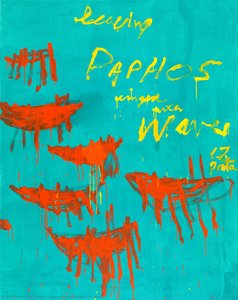
      Leaving Paphos Ringed With Waves III (2009) by Cy Twombly
      #17

      Leaving Paphos Ringed With Waves III

      2009

      In the vast, evocative landscape of contemporary abstraction, few works command the viewer's attention with such raw, visceral energy as Cy Twombly’s "Leaving Paphos Ringed With Waves III."…

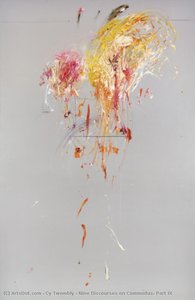
      Nine discourses on Commodus (1963) by Cy Twombly
      #18

      Nine discourses on Commodus

      1963 · Guggenheim Museum Bilbao

      Nine Discourses on Commodus: A Descent into Roman Excess Cy Twombly’s “Nine Discourses on Commodus,” painted in 1963, isn't merely a depiction of a historical event; it’s an…

      School of Athens (1961) by Cy Twombly
      #19

      School of Athens

      1961

      The painting presented here, tentatively titled “School of Athens,” offers a compelling glimpse into the intensely personal and often cryptic world of Cy Twombly. Executed in 1961, this…

      Odeion (Rome) (1960) by Cy Twombly
      #24

      Odeion (Rome)

      1960 · Bavarian State Painting Collections

      In 1960, Cy Twombly produced Odeion (Rome), a work that exists at the intersection of calligraphy and chaos. The canvas bears the physical traces of a restless hand,…

      Leda and the Swan (1962) by Cy Twombly
      #29

      Leda and the Swan

      1962

      A Symphony of Chaos and Eros: Exploring Cy Twombly’s Leda and the Swan Cy Twombly's *Leda and the Swan*, completed in 1962, stands as a cornerstone of abstract…

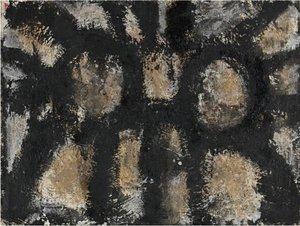
      Night Watch (1966) by Cy Twombly
      #32

      Night Watch

      1966

      The artwork Night Watch is an abstract piece created in 1966. The composition is characterized by a dark background against which a network of thin, white lines creates…

      Leaving Paphos Ringed With Waves V (2009) by Cy Twombly
      #47

      Leaving Paphos Ringed With Waves V

      2009

      “Leaving Paphos Ringed With Waves V,” created in 2009 by Cy Twombly, is a visceral and profoundly unsettling work that embodies the core tenets of Neo-Expressionism. This canvas,…

      Untitled (1953) by Cy Twombly
      #50

      Untitled

      1953 · Bavarian State Painting Collections

      In this color photograph titled "Untitled" by Cy Twombly, a single-story, rustic brick house sits quietly within a sprawling rural landscape. The composition centers entirely on the structure,…

      Untitled (1960) by Cy Twombly
      #64

      Untitled

      1960 · Metropolitan Museum of Art
      Untitled (1970) by Cy Twombly
      #80

      Untitled

      1970 · Metropolitan Museum of Art
      Olympia (1957) by Cy Twombly
      #86

      Olympia

      1957

      A Glimpse into Abstraction: Cy Twombly's *Olympia* Cy Twombly’s *Olympia*, created in 1957, is a captivating work of Neo-Expressionism that transcends traditional representation. This piece isn't about depicting…

      Untitled I (2005) by Cy Twombly
      #100

      Untitled I

      2005

      In the realm of contemporary art, few pieces have managed to captivate audiences with the same level of intrigue as Cy Twombly's "Untitled I". Created in 2005, this…

      Cy Twombly's canvases, period by period

      What Cy Twombly painted most

      The four subjects that return most often on these canvases, each with its best-loved example.

      Where Cy Twombly's canvases hang

      The 5 museums that hold the most of the paintings on this page.

      Museum City Works by Cy Twombly Paintings from this list
      Metropolitan Museum of Art, New YorkMetropolitan Museum of Art New York 3 Dutch Interior, Untitled, Untitled
      Bavarian State Painting Collections, MunichBavarian State Painting Collections Munich 2 Odeion (Rome), Untitled
      MOMA - Museum of Modern Art, New York CityMOMA - Museum of Modern Art New York City 1 The Four Seasons - Summer - Part II
      Galleria Civica di Arte Moderna e Contemporanea Torino, TurinGalleria Civica di Arte Moderna e Contemporanea Torino Turin 1 Untitled (Rome [Wall]) (1961)
      Guggenheim Museum Bilbao, BilbaoGuggenheim Museum Bilbao Bilbao 1 Nine discourses on Commodus

      Cy Twombly's most famous canvas, decade after decade

      1. 1940s
        Ritual (1949) by Cy Twombly
        Canvas 60 of 100

        Ritual

        Age 12 – 21
      2. 1950s
        Untitled (1954) by Cy Twombly
        9 of 100

        Untitled

        Age 22 – 31

        This work, titled Untitled, was created by Cy Twombly in 1954. It represents a specific moment in the artist's early development, emerging from a period of significant transition.…

      3. 1960s
        Dutch Interior (1962) by Cy Twombly
        Ranked 4 of 100

        Dutch Interior

        Age 32 – 41 · Metropolitan Museum of Art

        Cy Twombly's 1962 painting, *Dutch Interior*, isn’t merely a depiction of a room; it’s an immersive experience, a layered meditation on the act of creation itself. Emerging from…

      4. 1970s
        Untitled (19) (1970) by Cy Twombly
        7 of 100

        Untitled (19)

        Age 42 – 51

        Untitled (19) is a work by the American painter Cy Twombly, executed in 1970. This piece belongs to the artist's celebrated "blackboard" series, a period marked by a…

      5. 1980s
        Proteus (1984) by Cy Twombly
        2 of 100

        Proteus

        Age 52 – 61

        To stand before Cy Twombly's Proteus is to encounter not merely paint on canvas, but a vibrant conversation across decades—a dialogue between raw energy and profound mythology. Created…

      6. 1990s
        Quattro Stagioni, Autunno (1995) by Cy Twombly
        Ranked 3 of 100

        Quattro Stagioni, Autunno

        Age 62 – 71

        Quattro Stagioni, Autunno is a painting by Cy Twombly. Created in 1995, this work exists as a single movement within a larger cycle. It is part of the…

      7. 2000s
        The Rose (IV) (2008) by Cy Twombly
        Ranked 1 of 100

        The Rose (IV)

        Age 72 – 81

        The Rose (IV) by Cy Twombly: A Symphony of Color and Poetic Echoes Subject: The painting "The Rose (IV)" by Cy Twombly is an arresting exploration of the…

      8. 2010s

      Cy Twombly's canvases, question by question

      Which canvas is Cy Twombly most remembered for?Read the answer

      The Rose (IV) (2008), followed by Proteus (1984) and Quattro Stagioni, Autunno (1995).

      The Rose (IV): how old was Cy Twombly when it was painted?Read the answer

      Cy Twombly, born in 1928, was 80 years old: The Rose (IV) dates from 2008.

      What are Cy Twombly's ten most famous canvases?Read the answer

      The Rose (IV), Proteus, Quattro Stagioni, Autunno, Dutch Interior, Quattro Stagioni, Estate, The Four Seasons - Summer - Part II, Untitled (19), Fifty Days at Iliam. The Fire that Consumes All before It, Untitled and Cold Stream. Each canvas in the ranking above comes with its year and its museum.

      How many paintings did Cy Twombly create?Read the answer

      116 works by Cy Twombly are in our catalogue, dated 1949 to 2010.

      Where do Cy Twombly's most famous canvases hang today?Read the answer

      Mostly in Metropolitan Museum of Art (New York), Bavarian State Painting Collections (Munich) and MOMA - Museum of Modern Art (New York City); the list above names each museum and its canvases.

      When did Cy Twombly paint the most famous canvases?Read the answer

      In 1960s, which gave 28 of the 100 works on this page, Dutch Interior among them.

      Which famous Cy Twombly canvas came first, and which came last?Read the answer

      The earliest canvas here is Ritual (1949); the latest is Camino Real (II) (2010).

      Which subjects did Cy Twombly paint most?Read the answer

      Flowers (5), Color field (4) and Scribbles (4), across the 100 works on this page.

      Which medium appears most in Cy Twombly's paintings?Read the answer

      Acrylic On Canvas, used in 5 of the 100 works on this page.

      Which movement is Cy Twombly associated with?Read the answer

      Abstract expressionism and Neo-expressionism, as the canvases on this page show.

      Which paintings by Cy Twombly are held by the Metropolitan Museum of Art?Read the answer

      The Metropolitan Museum of Art, New York holds 3 of the works on this page, among them Dutch Interior, Untitled and Untitled.

      Meet the painter: Cy Twombly

      A Life Etched in Line and Color

      Edwin Parker Twombly Jr., known to the world as Cy Twombly, was a singular force in 20th and 21st-century art—an American painter, sculptor, and photographer whose work defied easy categorization. Born on April 25, 1928, in Lexington, Virginia, his artistic journey began with a foundation steeped in classical education and a restless spirit that propelled him across continents. Early studies under Pierre Daura at Washington and Lee University were followed by formative experiences at the Arts Students League of New York and Black Mountain College, where he encountered pivotal figures like Robert Rauschenberg, John Cage, and Merce Cunningham. These encounters fostered an environment of experimentation and interdisciplinary exploration that would profoundly shape his artistic vision. However, it was a 1952 voyage to Italy and North Africa with Rauschenberg—funded by a grant from the Virginia Museum of Fine Arts—that proved truly transformative. Immersed in ancient ruins, vibrant cultures, and the weight of history, Twombly discovered a wellspring of inspiration that would define his aesthetic for decades to come.

      The Evolution of an Enigmatic Style

      Twombly’s artistic style was not born fully formed; it evolved through a series of explorations and refinements. His early works, such as the *North African Sketchbooks* (1953), already hinted at his unique blend of abstract forms and poetic references. These weren't mere travel journals but rather investigations into the essence of place—a distillation of light, texture, and memory. Throughout the 1960s, Twombly’s style began to coalesce around a distinctive vocabulary of scribbled lines, gestural marks, and fragmented words on expansive canvases. Works like the *Ferragosto* series (1961) and *The Italians* (1961) exemplify this period—paintings that seem to exist between calligraphy and chaos, evoking both ancient inscriptions and the immediacy of graffiti. He wasn’t interested in replicating reality but rather in capturing a sense of feeling, memory, and the passage of time. This approach challenged conventional notions of painting, moving away from representation towards a more subjective and emotionally resonant form of expression. Cold Stream* (1966), with its swirling loops and bold text, is a powerful example of this evocative style.

      Influences and Artistic Lineage

      While fiercely independent, Twombly’s work wasn't created in a vacuum. He drew inspiration from a diverse range of sources—from the raw energy of Jean Dubuffet and Alberto Giacometti to the poetic sensibilities of Stéphane Mallarmé, Rainer Maria Rilke, and John Keats. Classical mythology and history also played a significant role, providing him with a rich tapestry of themes and symbols to explore. His paintings often allude to ancient narratives, subtly weaving together fragments of stories and legends. Twombly’s influence on subsequent generations of artists is undeniable. He paved the way for painters like Jean-Michel Basquiat, Anselm Kiefer, Francesco Clemente, and Julian Schnabel, who embraced a similar spirit of experimentation and emotional intensity. His willingness to break down traditional boundaries and explore new forms of expression resonated deeply with artists seeking to challenge the status quo. He demonstrated that painting could be more than just representation; it could be a vehicle for conveying complex emotions, ideas, and experiences.

      Major Achievements and Lasting Legacy

      Throughout his career, Twombly received numerous accolades, including the Golden Lion award at the Venice Biennale in 2001 and being named a Chevalier of the Légion d'Honneur in 2010. His work is represented in major museum collections worldwide, including the Menil Collection in Houston, the Tate Modern in London, and New York’s Museum of Modern Art. A particularly significant achievement was his commission to create a ceiling piece for the Musée du Louvre in Paris—a testament to his international recognition and artistic stature. Three studies from the Temeraire* (1998-99), now held by the Art Gallery of New South Wales, exemplifies his later style – large scale works that are both delicate and powerful. Twombly’s enigmatic style continues to fascinate art enthusiasts and scholars alike. His paintings invite viewers to engage in a dialogue—to decipher the hidden meanings within the layers of paint and scribbled lines. He passed away on July 5, 2011, in Rome after a long battle with cancer, leaving behind a legacy that will continue to inspire and challenge artists for generations to come. A plaque in Santa Maria in Vallicella serves as a lasting memorial to his profound contribution to the world of art.

      Exploring Twombly’s World

      Cy Twombly's work is an invitation to contemplate the complexities of human experience—to delve into the realms of memory, history, and emotion. His paintings are not simply objects to be admired but rather portals to another world—a world where lines dance, words whisper, and feelings take shape. Whether it’s the vibrant energy of *Untitled (Peony Blossom Painting)* or the evocative abstraction of *Proteus*, each work offers a unique glimpse into the artist's inner landscape. His influence extends beyond painting, impacting sculpture and photography as well. To truly appreciate Twombly’s genius, one must allow oneself to be swept away by the fluidity of his lines, the richness of his colors, and the depth of his poetic vision.

      All 116 works by Cy Twombly →