Atelier — Complimentary worldwide shipping — Delivery 2–6 weeks
      Emil Nolde, 1867 – 1956

      The 100 Most Famous Emil Nolde Paintings, Ranked

      The best-loved painting by Emil Nolde is Sunset. Sea with Red Sky and Couple on the beach (1903) come next among the canvases readers know best. Our catalogue holds 394 works by Emil Nolde: here are the 100 most famous, each with its year, its museum and what makes it memorable.

      Ranked by our popularity score, which combines the searches, visits and orders for each work. Updated October 2026. Each painting on this page can be ordered as an oil reproduction painted by hand on linen canvas, or as a fine art print, made to the size you choose.

      Portrait of Emil Nolde
      Emil Nolde · 1867 – 1956
      Born · died
      1867 – 1956, Nolde
      Movement
      Expressionism
      Works in our catalogue
      394
      Most famous
      Sunset
      Most works at
      Bavarian State Painting Collections

      Top 10 Emil Nolde paintings: the canvases everyone knows

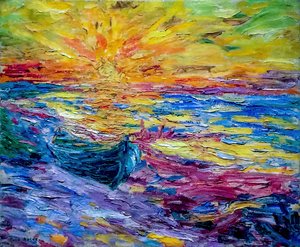
      Sunset by Emil Nolde
      1

      Sunset

      Oil On Canvas

      The sun hangs as a heavy, bright circle at the center of the sky, a singular eye watching the descent of the day. Below it, the atmosphere burns with shades of yellow, orange, and red, bleeding into one another to create a warm, thick air. The ocean receives this light, its waves rolling gently toward the shore in a rhythmic, quiet motion. A lone boat floats upon the water, a…

      Sea with Red Sky by Emil Nolde
      2

      Sea with Red Sky

      Oil

      Sea with Red Sky is an expressionist painting by Emil Nolde. The canvas captures a moment of intense color, where the sky burns with a deep, saturated red. This work belongs to the early movements of expressionism, a style that prioritizes the internal pulse of a subject over its literal likeness. The artist sought to translate raw sensation into pigment, moving beyond the surface of the natural world to reach…

      Couple on the beach (1903) by Emil Nolde
      3

      Couple on the beach

      1903 · Oil

      In "Couple on the beach" by Emil Nolde, painted about 1903, the arrangement of figures creates a quiet sense of intimacy against a vast landscape. At the center of the composition, a man and a woman stand close together. He has his arm around her, and she is dressed in a long dress. Their bodies are oriented toward the water, their gazes fixed on the horizon. This shared focus directs…

      Masks (1911) by Emil Nolde
      4

      Masks

      1911 · Acrylic On Canvas · Nelson-Atkins Museum of Art, Kansas City

      Emil Nolde's "Masks," painted in 1911, isn’t merely a depiction of carnival revelry; it’s a profound exploration of identity, hidden desires, and the unsettling duality inherent within human nature. Created during his time as a key member of Die Brücke – “The Bridge” – a group pushing the boundaries of German Expressionism in Dresden and Berlin, the painting embodies the movement's core tenets: a rejection of academic realism in favor…

      Christ among the Children by Emil Nolde
      5

      Christ among the Children

      Oil On Canvas

      Emil Nolde’s “Christ Among the Children” is not merely a depiction of a biblical scene; it’s an immersive experience, a visceral outpouring of emotion rendered with the raw energy characteristic of his mature style. This large-scale painting captures a moment of profound intimacy – Christ surrounded by children – yet it vibrates with a primal intensity that speaks to the core of human connection and faith. The photograph reveals a…

      The Great Gardener by Emil Nolde
      6

      The Great Gardener

      The Great Gardener emerges from the brush of Emil Nolde, a man whose very name carries the weight of his birthplace. Born in 1867 in Nolde, Denmark, the artist carries the essence of his origins into every stroke. He moves through the world of color with a sense of purpose, much like the subject of this work. The painting, titled The Great Gardener, captures a moment of quiet connection within…

      Light-flooded Sea (Green) by Emil Nolde
      7

      Light-flooded Sea (Green)

      Watercolor

      Light-flooded Sea (Green) is a work by Emil Nolde. This piece presents a highly stylized and abstracted seascape, stripping the horizon of its literal boundaries. The subject matter focuses on the meeting of water and sky, rendered through a lens of intense, personal feeling rather than precise representation.

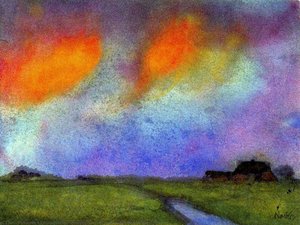
      Marshy Landscape under the Evening Sky by Emil Nolde
      8

      Marshy Landscape under the Evening Sky

      Watercolor

      The scene unfolds in Marshy Landscape under the Evening Sky, a work that carries the unmistakable hand of the artist Emil Nolde. This piece captures a specific, quiet moment where the land meets a heavy, atmospheric sky. The artist, Emil Nolde, was born in Nolde, Denmark, in 1867, and his connection to the natural world remains palpable in the way he approaches the canvas. He lived until 1956, leaving behind…

      Animal and Figures (1912) by Emil Nolde
      9

      Animal and Figures

      1912 · Black and White Photography · Bavarian State Painting Collections, Munich

      A monochrome stillness settles over the scene. Two men stand in the rigid geometry of early 20th-century military attire, their forms anchored against a dark, featureless void. They are framed by a slender pedestal that divides the composition with mathematical precision. On the left, a hand rests firmly on a hip; on the right, a hand finds rest upon the stand. The fabric of their tunics, the heavy weave of…

      Anna Wieds Garden by Emil Nolde
      10

      Anna Wieds Garden

      Acrylic

      Emile Nolde, a prominent German-Danish painter and printmaker, is renowned for his vibrant and expressive works of art. One of his notable pieces, Anna Wieds Garden, exemplifies the essence of Expressionism, a modernist movement that emerged in the early 20th century. This captivating oil painting is a testament to Nolde's unique style, which blends elements of Expressionism with a deep appreciation for nature. The Expressionist Style Expressionism, as described by…

      More Emil Nolde canvases, 11 to 100

      Festival Girls (1918) by Emil Nolde
      #11

      Festival Girls

      1918 · Bavarian State Painting Collections

      Festival Girls is a painting by Emil Nolde, executed in 1918. The work measures 67 x 58.5 cm and is rendered on canvas. This piece was created during…

      Order this canvas →
      Nordermühle (1932) by Emil Nolde
      #14

      Nordermühle

      1932 · Bavarian State Painting Collections

      is a studio portrait by the German artist Emile Nolde, dating to 1932. The work captures four individuals in a formal arrangement, presented as a monochromatic study of…

      Order this canvas →
      untitled (1534) by Emil Nolde
      #15

      untitled (1534)

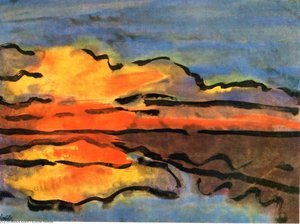
      The horizon is a wound of orange and red. Light bleeds through heavy, dark silhouettes of clouds, casting a warm glow over the quiet landscape. Below, the sand…

      Order this canvas →
      Shivering Russians (1914) by Emil Nolde
      #16

      Shivering Russians

      1914 · Statens Museum For Kunst

      The painting presents two figures in a tight, cropped composition, focusing on their upper bodies as they huddle together. They are enveloped in thick, heavy clothing that obscures…

      Bring this light home →
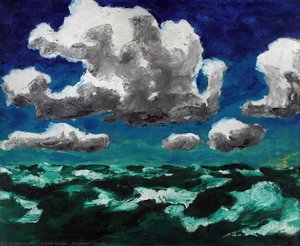
      Summer Clouds by Emil Nolde
      #17

      Summer Clouds

      Summer Clouds is an expressionist work by Emil Nolde. Born in 1867 in Nolde, Denmark, the artist developed a visual language centered on intense, personal feeling and the…

      Order this canvas →
      Wild Animals (1921) by Emil Nolde
      #24

      Wild Animals

      1921 · Bavarian State Painting Collections

      The work belongs to a period of intense experimentation. It reflects a shift toward the subjective, where the internal world dictates the external appearance. The textures are thick…

      Have it painted by hand →
      Autumn Sea by Emil Nolde
      #25

      Autumn Sea

      Emile Nolde’s “Autumn Sea” is not merely a depiction of a seascape; it’s an immersion into the raw, untamed heart of nature itself. Painted during his most intensely…

      Have it painted by hand →
      Mills (1924) by Emil Nolde
      #33

      Mills

      1924 · Bavarian State Painting Collections

      In the large-scale black and white group portrait titled "Mills" by Emil Nolde, a dense assembly of men is positioned in front of a wooden structure. The composition…

      Bring this light home →
      Robbers at Bombüll (1917) by Emil Nolde
      #34

      Robbers at Bombüll

      1917 · Statens Museum For Kunst

      Robbers at Bombüll is a painting by the German artist Emile Nolde. Created in 1917, this work belongs to the Expressionist movement. The piece focuses on a group…

      Have it painted by hand →
      Mask Still Life III, (1911) by Emil Nolde
      #35

      Mask Still Life III,

      1911

      The painting features five different faces on masks, each displaying unique expressions. These masks are arranged across the canvas in a specific configuration: the first face is in…

      Order this canvas →
      The Mocking of Christ (1909) by Emil Nolde
      #36

      The Mocking of Christ

      1909

      Emil Nolde’s 1909 painting is a powerfully unsettling work that plunges the viewer into a scene of raw emotion and psychological turmoil. While often interpreted as “The Mocking…

      Have it painted by hand →
      The Blacksmith (1912) by Emil Nolde
      #38

      The Blacksmith

      1912 · Statens Museum For Kunst

      is an oil painting by Emil Nolde, executed in 1912. The work emerged during a period of significant artistic transition for the creator, who was establishing a distinct…

      Have it painted by hand →
      Young Women (1947) by Emil Nolde
      #69

      Young Women

      1947 · Statens Museum For Kunst

      In this work, titled Young Women, we encounter a significant piece from the later period of Emil Nolde. Painted in 1947, the canvas reflects the artist's continued engagement…

      Bring this light home →
      Large Sunflowers (1928) by Emil Nolde
      #70

      Large Sunflowers

      1928 · Metropolitan Museum of Art

      The Presence of the Bloom In this 1928 oil painting on wood, the sunflowers emerge with a heavy, physical presence. There is no attempt at delicate botanical precision…

      Have it painted by hand →
      Figures and Dahlias (1919) by Emil Nolde
      #71

      Figures and Dahlias

      1919 · Statens Museum For Kunst

      Emile Nolde produced Figures and Dahlias in 1919. The artist, born in 1867 in Nordel, Germany, developed a practice centered on the physical properties of his materials. His…

      Bring this light home →
      Garden path by Emil Nolde
      #72

      Garden path

      A Symphony of Red: Exploring Emile Nolde’s “Garden Path” “Garden Path” by German-Danish Expressionist painter Emile Nolde is a captivating oil painting that plunges the viewer into an…

      Bring this light home →
      Masks (1911) by Emil Nolde
      #79

      Masks

      1911 · Nelson-Atkins Museum of Art

      In the evocative realm of German Expressionism, few works capture the raw, unbridled energy of the human psyche quite like Emil Nolde’s Masks. Painted in 1911, this masterpiece…

      Have it painted by hand →
      Mother and Child by Emil Nolde
      #80

      Mother and Child

      Mother and Child, also known by the German title Mutter und Kind, is a work by the German artist Emil Nolde. Born in 1867, Nolde remained a significant…

      Order this canvas →
      In the coffee by Emil Nolde
      #82

      In the coffee

      In the coffee is a genre painting by Emil Nolde. Created in 1911, the work captures a social gathering within a cafe setting. The canvas holds a moment…

      Have it painted by hand →
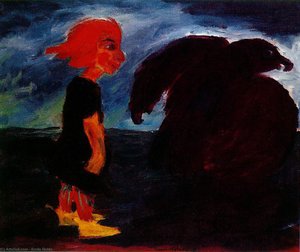
      Child and Large Bird (1912) by Emil Nolde
      #100

      Child and Large Bird

      1912 · Statens Museum For Kunst

      The painting Child and Large Bird by Emile Nolde is a captivating work of art that showcases the artist's unique style and technique. Created in 1912, this oil…

      Have it painted by hand →

      Emil Nolde's canvases, period by period

      What Emil Nolde painted most

      The four subjects that return most often on these canvases, each with its best-loved example.

      Where Emil Nolde's canvases hang

      The 7 museums that hold the most of the paintings on this page.

      Museum City Works by Emil Nolde Paintings from this list
      Bavarian State Painting Collections, MunichBavarian State Painting Collections Munich 10 Animal and Figures, Festival Girls, Nordermühle
      Statens Museum For Kunst, CopenhagenStatens Museum For Kunst Copenhagen 10 Shivering Russians, Robbers at Bombüll, The Blacksmith
      Nelson-Atkins Museum of Art, Kansas CityNelson-Atkins Museum of Art Kansas City 2 Masks, Masks
      Staatliche Kunsthalle Karlsruhe, CarlsruheStaatliche Kunsthalle Karlsruhe Carlsruhe 4 At the Fountain
      Brücke Museum, BerlinBrücke Museum Berlin 2 Ridicule (Verspottung)
      Museum Kunstpalast, DuesseldorfMuseum Kunstpalast Duesseldorf 1 Flower Garden (Girl and Washing)
      Metropolitan Museum of Art, New YorkMetropolitan Museum of Art New York 1 Large Sunflowers

      Emil Nolde's best-loved canvas of each decade

      1. 1900s
        Couple on the beach (1903) by Emil Nolde
        Canvas 3 of 100

        Couple on the beach

        Age 33 – 42

        In "Couple on the beach" by Emil Nolde, painted about 1903, the arrangement of figures creates a quiet sense of intimacy against a vast landscape. At the center…

      2. 1910s
        Masks (1911) by Emil Nolde
        4 of 100

        Masks

        Age 43 – 52 · Nelson-Atkins Museum of Art

        Emil Nolde's "Masks," painted in 1911, isn’t merely a depiction of carnival revelry; it’s a profound exploration of identity, hidden desires, and the unsettling duality inherent within human…

      3. 1920s
        Wild Animals (1921) by Emil Nolde
        Canvas 24 of 100

        Wild Animals

        Age 53 – 62 · Bavarian State Painting Collections

        The work belongs to a period of intense experimentation. It reflects a shift toward the subjective, where the internal world dictates the external appearance. The textures are thick…

      4. 1930s
        Nordermühle (1932) by Emil Nolde
        14 of 100

        Nordermühle

        Age 63 – 72 · Bavarian State Painting Collections

        is a studio portrait by the German artist Emile Nolde, dating to 1932. The work captures four individuals in a formal arrangement, presented as a monochromatic study of…

      5. 1940s
        Young Women (1947) by Emil Nolde
        Ranked 69 of 100

        Young Women

        Age 73 – 82 · Statens Museum For Kunst

        In this work, titled Young Women, we encounter a significant piece from the later period of Emil Nolde. Painted in 1947, the canvas reflects the artist's continued engagement…

      About Emil Nolde's canvases: your questions answered

      What is the best-known painting by Emil Nolde?Read the answer

      Sunset, followed by Sea with Red Sky and Couple on the beach (1903).

      What are the 10 most famous paintings by Emil Nolde?Read the answer

      Sunset, Sea with Red Sky, Couple on the beach, Masks, Christ among the Children, The Great Gardener, Light-flooded Sea (Green), Marshy Landscape under the Evening Sky, Animal and Figures and Anna Wieds Garden. Each canvas in the ranking above comes with its year and its museum.

      How many works did Emil Nolde paint in all?Read the answer

      394 works by Emil Nolde are in our catalogue, dated 1903 to 1947.

      Where can I see Emil Nolde's most famous canvases?Read the answer

      Mostly in Bavarian State Painting Collections (Munich), Statens Museum For Kunst (Copenhagen) and Nelson-Atkins Museum of Art (Kansas City); the list above names each museum and its canvases.

      When did Emil Nolde paint the best-loved canvases?Read the answer

      In 1910s, which gave 22 of the 100 works on this page, Masks among them.

      Which are Emil Nolde's earliest and latest famous canvases?Read the answer

      The earliest canvas here is Couple on the beach (1903); the latest is Young Women (1947).

      What did Emil Nolde paint most often?Read the answer

      Sea (10), Clouds (10) and Beach (10), across the 100 works on this page.

      Which medium did Emil Nolde paint in most often?Read the answer

      Oil On Canvas, used in 15 of the 100 works on this page.

      Which movement is Emil Nolde's painting part of?Read the answer

      Expressionism, as the canvases on this page show.

      Which Emil Nolde canvases hang at the Bavarian State Painting Collections?Read the answer

      The Bavarian State Painting Collections, Munich holds 7 of the works on this page, among them Animal and Figures, Festival Girls and Nordermühle.

      Can I buy a reproduction of a Emil Nolde canvas?Read the answer

      Yes. Every painting on this page can be ordered from its own page as an oil reproduction painted by hand, or as a fine art print, in the size you choose.

      Emil Nolde: a life in paint

      The Life and Identity of Emile Nolde

      Born Hans Emil Hansen on 7 August 1867, the man who would become known as Emile Nolde grew up near the village of Nolde in the Duchy of Schleswig. His early years were shaped by the rural, agrarian life of his family. He eventually moved away from this path, choosing instead to work as a wood carver and furniture decorator. This tactile, physical labor preceded his shift toward painting and printmaking. He adopted his artistic name as a way to establish a separate identity from his family's expectations.

      His presence in the early 20th century was marked by a move toward the internal and the subjective. As one of the first Expressionists, he sought to move beyond the surface of things. He became a member of the Die Brücke group, a collective that looked to break away from academic traditions. His work often focused on the psychological and the primal, using color and form to reach for something deeper than a simple likeness. He was a painter who looked at the world through a lens of intense, personal feeling.

      Early Life and Artistic Beginnings

      Born Hans Emil Hansen, he grew up on a farm in the Duchy of Schleswig. His parents were Danish and Frisian peasants, and the rhythms of rural life shaped his early years. He eventually realized that the life of a farmer was not his own. He felt a sense of unsuitability for the heavy, repetitive work of the land. Instead of the plow, his hands sought the grain of wood.

      He turned to woodcarving as a craft, working with the material in a way that required a steady, tactile connection. This period of manual labor was not a detour but a foundation. He later moved through studies in Karlsruhe and Munich, though the academic constraints of those institutions often felt restrictive. He eventually adopted the name Emil Nolde, a choice that marked a departure from his family's expectations and a step toward his own identity.

      Artistic Development and Influences

      The way he approached a canvas was shaped by a deep connection to the Post-Impressionist style. He looked toward the work of Paul Gauguin and found a way to move beyond simple representation. This shift allowed him to focus on the inner weight of a subject rather than its outward appearance. His interest in the natural world often manifested in his preoccupation with flowers, a habit that mirrored the influence of Vincent van Gogh. He did not merely paint a garden; he sought the pulse within the petals.

      His path was never a straight line. While he found a place among the artists of the Die Brücke group, his interests often pulled him toward different circles. In 1912, he exhibited alongside the members of Wassily Kandinsky's Der Blaue Reiter group. This period of his life was marked by a constant search for a visual language that could hold the intensity of his observations. He moved between the study of color and the study of form, always looking for a way to make the paint speak of something more than the surface of the world.

      Membership in the Die Brücke Group

      In early 1906, a shift occurred when his work was seen at Arnold’s in Dresden. This encounter led to an invitation to join the Die Brücke group. He remained part of this collective from February 1906 until November 1907. The group itself had been active in Dresden since 1905, seeking to move away from academic traditions through a search for a new pictorial language.

      His time with the group was marked by a connection to Post-Impressionist influences. While the members shared a common goal of breaking from established norms, his own path remained distinct. He brought a specific interest in the expressive power of primitive masks and carvings from his native Schleswig-Holstein to the group's shared explorations. This period in Dresden helped define his early approach to color and form before he moved toward a more independent direction.

      Technique and Expressive Style

      The brushwork reveals a preoccupation with the immediate sensation of color. He was among the first oil painters and watercolorists of the early twentieth century to push the boundaries of how color could be used. His palette often leans into heavy, golden yellows and deep reds. These choices give a certain weight to the surface, making the colors feel present rather than merely decorative. He did not settle for the subtle shifts of light seen in earlier traditions, opting instead for a directness that prioritizes the feeling of a subject over its literal likeness.

      Watercolor became a primary medium for him from the 1930s until his death. He found that the medium allowed him to translate his ideas and concepts to the paper much faster than oil painting. This speed is visible in the way he handled the pigment, creating vivid, brooding storm-scapes and brilliant florals. The paint often moves with a sense of urgency, capturing a specific moment of light or weather before it shifts. In his landscapes, the color is not just a layer on top of a shape; it is the substance of the shape itself.

      Persecution and the Nazi Regime

      The relationship between Nolde and the Nazi regime was a complicated one. He was a member of the Nazi Party, yet his own paintings were condemned by the state. His work was deemed “degenerate” by the regime, leading to a direct conflict between his political affiliations and his creative output. This tension resulted in the removal of 1,052 of his works from museums by the Nazi Party.

      The restrictions on his practice grew more severe as the years passed. After 1941, he was forbidden to paint. During this period of silence, he turned to other means to keep his vision alive. He created hundreds of watercolors that he kept hidden, often referred to as his "Unpainted Pictures." These works remained out of sight while the official art world turned away from his style.

      Notable Works and Artistic Achievements

      His brushwork often sought the essence of a subject through a direct application of color. In 1912, he produced Man, Woman and Cat, a work that reflects his interest in the forms of objects and figures. By 1917, his focus turned toward the natural world in Blumengarten (Utenwarf). These pieces show a steady commitment to his specific way of seeing, using thick layers of paint to build up the surface.

      As the years passed, his relationship with his medium shifted. From the 1930s until his death, watercolor became his primary way of working, allowing him to move his ideas onto the paper more quickly than with oil. This is evident in the 1930 watercolor Stormy Sea, where the movement of the water is captured through rapid, expressive strokes. Even when he was forbidden from painting in public, he continued to work in private, creating hundreds of hidden watercolors that he called his "Unpainted Pictures."

      His later years saw a continued exploration of the human form and the psychological weight of a portrait. In 1937, he created Doppelbildnis, a double portrait that emerged from a series of his watercolor studies. His work remains a record of a man who used color to reach for a specific, internal truth.

      • Man, Woman and Cat (1912)
      • Blumengarten (Utenwarf) (1917)
      • Stormy Sea (1930)
      • Doppelbildnis (1937)

      Legacy and Historical Impact

      The weight of his influence is felt in the way color was allowed to move beyond mere description. By pushing the boundaries of what a canvas could hold, he helped shape the direction of Expressionism. His work moved away from the academic rules of the past, favoring a directness that prioritized the internal state over the external likeness. This shift allowed for a new kind of visual language, one where the application of paint and the choice of hue were used to communicate a raw, unmediated sense of being.

      His presence in the early movements of the twentieth century helped establish a precedent for the artist as an individual voice, often at odds with the prevailing political or social climate. Even when his work was removed from public view and labeled as degenerate, he continued to produce art in private. This persistence ensured that his specific approach to color and form would eventually be recognized as a significant contribution to modern art. He left behind a body of work that continues to be studied for its intensity and its refusal to conform to the expectations of his time.

      Where to See His Works Today

      Tracing his presence in public collections reveals a scattered but significant trail. In Hanover, the Sprengel Museum holds his watercolor landscape, Stormy Sea. Moving north to Stockholm, Sweden, the Moderna Museet contains Blumengarten (Utenwarf). These pieces offer a way to see how his hand moved across different surfaces and subjects.

      The Böttcherstraße Museums in Bremen also house his works, keeping his presence felt within the German landscape. For those looking for a more concentrated view of his life and output, the Nolde Stiftung Seebüll was created in 1956. This foundation remains a central point for his legacy.

      • Stormy Sea
      • Blumengarten (Utenwarf)
      All 394 works by Emil Nolde →