Atelier — Complimentary worldwide shipping — Delivery 2–6 weeks
      Marc Chagall, 1887 – 1985

      The 100 Most Famous Marc Chagall Paintings, Ranked

      The best-loved painting by Marc Chagall is I and the Village (1911), which hangs in the MOMA - Museum of Modern Art, New York City. White Crucifixion (1938) and The Birthday (1915) come next among the canvases readers know best. Our catalogue holds 936 works by Marc Chagall: here are the 100 most famous, each with its year, its museum and what makes it memorable.

      Ranked by our popularity score, which combines the searches, visits and orders for each work. Updated October 2026.

      Portrait of Marc Chagall
      Marc Chagall · 1887 – 1985
      Born · died
      1887 – 1985, Liozna
      Works in our catalogue
      936
      Most famous
      I and the Village (1911)
      Most works at
      MOMA - Museum of Modern Art

      Top 10 Marc Chagall paintings: the canvases everyone knows

      I and the Village (1911) by Marc Chagall
      1

      I and the Village

      1911 · Oil On Canvas · MOMA - Museum of Modern Art, New York City

      Created in 1911, this captivating oil on canvas is a cornerstone of Marc Chagall's early oeuvre and a pivotal work within the development of modern art. Measuring 191 x 150 cm, it’s a substantial piece that commands attention, drawing viewers into a world steeped in personal memory and universal symbolism.

      White Crucifixion (1938) by Marc Chagall
      2

      White Crucifixion

      1938 · Oil On Canvas · Art Institute of Chicago, Chicago

      The center of the canvas holds a pale figure on a white cross. This Christ wears a prayer shawl, a tallit, draped across his body. Above his head, the inscription INRI appears alongside its Aramaic translation in Hebrew characters. The palette is drained of much color, leaving a landscape of muted greys and whites.

      The Birthday (1915) by Marc Chagall
      3

      The Birthday

      1915 · Oil On Canvas

      Painted in 1915, this captivating artwork by Marc Chagall is more than just a depiction of a birthday; it’s a vibrant expression of love, anticipation, and the burgeoning spirit of modern art. The scene portrays the artist himself, suspended in a joyful embrace above his beloved wife, Bella Rosenfeld, moments before their marriage – a testament to a relationship that profoundly shaped Chagall's artistic vision.

      Over the town (1918) by Marc Chagall
      4

      Over the town

      1918 · Oil On Canvas

      Painted in 1918, this captivating artwork transports viewers to a realm where reality and imagination intertwine. Featuring two figures suspended above a stylized town, the piece embodies Marc Chagall's signature blend of personal symbolism, vibrant color, and dreamlike atmosphere – making it a compelling focal point for any art collection or interior space.

      The Green Violinist (1924) by Marc Chagall
      5

      The Green Violinist

      1924 · Oil On Canvas

      Step into the dreamlike realm of Marc Chagall's The Green Violinist, a masterpiece that captures the essence of Jewish folklore and the vibrant energy of early 20th-century modernism. This iconic painting, created in 1924, is a testament to Chagall's unique ability to blend surrealism, cubism, and symbolism into a cohesive and emotionally resonant composition.

      The Falling Angel (1947) by Marc Chagall
      6

      The Falling Angel

      1947 · Oil On Canvas · Kunstmuseum, Basel

      Subject and Composition This striking masterpiece presents a complex, symbolic tableau filled with vivid imagery and dynamic movement. Central to the composition is a fiery, winged figure that appears to be falling or ascending, evoking themes of spiritual conflict, transformation, and divine intervention. Surrounding this focal point are allegorical figures—an introspective green-faced individual, a somber bearded figure holding a sheet of music or text, and surreal animal-like faces—each contributing to…

      The Soldier Drinks (1912) by Marc Chagall
      7

      The Soldier Drinks

      1912 · Acrylic On Canvas · Solomon R. Guggenheim Museum, New York City

      Subject and Composition This captivating artwork depicts a scene imbued with emotional depth and layered symbolism, featuring a soldier immersed in a moment of introspection or camaraderie. The fragmented forms suggest a narrative that hints at themes of war, memory, and human connection. The composition invites viewers to explore multiple perspectives simultaneously, revealing a complex interplay between figures, objects, and space. The presence of a small dancing couple adds a…

      Abraham and three Angels (1966) by Marc Chagall
      8

      Abraham and three Angels

      1966 · Acrylic On Canvas

      Marc Chagall's “Abraham and Three Angels,” completed in 1966, stands as a cornerstone of Naïve Art (Primitivism), embodying Chagall’s singular artistic voice and his profound engagement with biblical narratives. Measuring an impressive 190 x 292 cm on canvas, this painting transcends mere representation; it's a deliberate orchestration of color, form, and symbolism designed to evoke a visceral response—a feeling akin to stepping into the artist’s own subconscious.

      Adam and Eve expelled from Paradise (1961) by Marc Chagall
      9

      Adam and Eve expelled from Paradise

      1961 · Oil On Canvas

      A Dreamscape of Divine Disobedience In the luminous realm of Marc Chagall’s 1961 masterpiece, Adam and Eve Expelled from Paradise, the boundaries between the earthly and the ethereal dissolve into a vibrant tapestry of color and myth. This monumental work, part of his profound Biblical Message cycle, is far more than a mere illustration of Genesis; it is a poetic meditation on loss, memory, and the enduring human spirit. As…

      Liberation (1952) by Marc Chagall
      10

      Liberation

      1952 · Oil On Canvas

      Created in 1952, this captivating artwork by Marc Chagall is a vibrant testament to the enduring power of love, faith, and cultural heritage. More than simply a depiction of a wedding ceremony, it’s a deeply symbolic and emotionally resonant composition that invites viewers into a dreamlike world brimming with spiritual intensity.

      More Marc Chagall canvases, 11 to 100

      The blue bird (1968) by Marc Chagall
      #11

      The blue bird

      1968

      A Portal into Chagall’s Dreamscape To gaze upon Marc Chagall’s The Blue Bird is to step through a threshold where the boundaries of reality and imagination dissolve into…

      Madonna of village (1942) by Marc Chagall
      #12

      Madonna of village

      1942

      A Vision of Peace: Exploring Marc Chagall’s *Madonna of the Village* Marc Chagall's *Madonna of the Village*, painted between 1938 and 1942, is a profoundly moving work that…

      A wheatfield on a summer's afternoon (1942) by Marc Chagall
      #13

      A wheatfield on a summer's afternoon

      1942

      Marc Chagall, born Moishe Shagal in 1887 in the Belarusian town of Liozna near Vitebsk, wasn't merely a painter; he was a poet of color, a weaver of…

      The Concert (1957) by Marc Chagall
      #14

      The Concert

      1957

      In the vast, evocative landscape of twentieth-century modernism, few works capture the ethereal boundary between reality and reverie as profoundly as Marc Chagall’s 1957 masterpiece, "The Concert." This…

      Solitude (1933) by Marc Chagall
      #15

      Solitude

      1933

      Marc Chagall’s “Solitude,” painted in 1933, isn't merely a depiction of a man seated on the ground; it’s a profound meditation on Jewish identity, cultural displacement, and the…

      The Promenade (1918) by Marc Chagall
      #16

      The Promenade

      1918

      A Celebration of Love and Liberation: Decoding Marc Chagall’s *The Promenade* Marc Chagall's *The Promenade*, painted in 1918, is more than just a depiction of a couple; it’s…

      Moses receiving the Tablets of Law (1966) by Marc Chagall
      #17

      Moses receiving the Tablets of Law

      1966

      A Divine Revelation: Exploring Marc Chagall’s *Moses Receiving the Tablets of Law* Marc Chagall's 1966 masterpiece, *Moses Receiving the Tablets of Law*, is a vibrant and emotionally resonant…

      Song of Songs III (8) (1960) by Marc Chagall
      #18

      Song of Songs III (8)

      1960

      In the vast landscape of twentieth-century modernism, few artists possessed the ability to weave the fabric of memory and myth as seamlessly as Marc Chagall. His 1960 masterpiece,…

      Bouquet with flying lovers (1947) by Marc Chagall
      #19

      Bouquet with flying lovers

      1947

      A Dream of Love: Exploring Marc Chagall’s *Bouquet with Flying Lovers* This captivating painting by Marc Chagall, created in 1947, is more than just a beautiful image; it's…

      Laid Table with View of Saint-Paul de Vance (1968) by Marc Chagall
      #20

      Laid Table with View of Saint-Paul de Vance

      1968

      In the vast, luminous tapestry of modern art, few threads are as vibrant or as emotionally resonant as those woven by Marc Chagall. His 1968 masterpiece, Laid Table…

      The Myth of Orpheus (1977) by Marc Chagall
      #21

      The Myth of Orpheus

      1977

      In the twilight of his long and luminous career, Marc Chagall gifted the world with The Myth of Orpheus, a 1977 masterpiece that serves as a profound window…

      Resurrection (1952) by Marc Chagall
      #22

      Resurrection

      1952

      A Vision of Resurrection: Chagall’s Surrealist Masterpiece Marc Chagall's 1952 painting, *Resurrection*, is a profoundly moving work that encapsulates the artist’s signature blend of dreamlike imagery, vibrant color,…

      A red horse (1938) by Marc Chagall
      #23

      A red horse

      1938

      Marc Chagall, a renowned Russian-French artist, is celebrated for his captivating and dreamlike paintings that blend elements of surrealism with deep emotional resonance. One of his most intriguing…

      The Betrothed and Eiffel Tower (1913) by Marc Chagall
      #24

      The Betrothed and Eiffel Tower

      1913

      The Betrothed and Eiffel Tower: A Cubist Dreamscape Marc Chagall’s “The Betrothed and Eiffel Tower,” painted in 1913, stands as a cornerstone of Cubism and a poignant reflection…

      Moses with the Burning Bush (1966) by Marc Chagall
      #25

      Moses with the Burning Bush

      1966

      A Symphony of Color and Myth: Exploring Marc Chagall’s “Moses with the Burning Bush” Marc Chagall's "Moses with the Burning Bush," completed in 1966, isn’t simply a painting;…

      Blue Lovers (1914) by Marc Chagall
      #26

      Blue Lovers

      1914

      Marc Chagall’s “Blue Lovers,” completed in 1914 during his formative years as a Cubist innovator, transcends mere visual representation; it embodies the very essence of romantic connection. Measuring…

      The Wedding (1944) by Marc Chagall
      #27

      The Wedding

      1944

      A Celebration of Joy and Tradition: Exploring Marc Chagall’s “The Wedding” Marc Chagall's “The Wedding is a captivating oil on canvas painting that embodies the essence of joy,…

      The Praying Jew (Rabbi of Vitebsk) (1914) by Marc Chagall
      #28

      The Praying Jew (Rabbi of Vitebsk)

      1914

      Marc Chagall’s The Praying Jew (Rabbi of Vitebsk), painted in 1914, isn't merely a portrait; it’s an immersive experience—a vibrant, dreamlike plunge into the heart of Jewish identity…

      The Three Candles (1940) by Marc Chagall
      #29

      The Three Candles

      1940

      The Three Candles: A Dreamscape of Hope Amidst Darkness Marc Chagall’s *The Three Candles* stands as a poignant emblem of resilience and spiritual yearning—a testament to the artist's…

      Midsummer Night's Dream (1939) by Marc Chagall
      #30

      Midsummer Night's Dream

      1939

      Marc Chagall's "Midsummer Night's Dream," completed in 1939, is not simply a painting; it’s an invitation into the artist’s deeply personal and profoundly symbolic universe. This oil-on-canvas work,…

      The Wedding Candles (1945) by Marc Chagall
      #31

      The Wedding Candles

      1945

      Marc Chagall's 1945 painting, "The Wedding Candles," isn’t merely a depiction of a wedding; it’s an immersive journey into the artist’s deeply personal and profoundly symbolic world. Created…

      Nude Lying Down (1914) by Marc Chagall
      #32

      Nude Lying Down

      1914

      In his 1914 masterpiece, Nude Lying Down, Marc Chagall invites the viewer into a realm where the boundaries between reality and the subconscious dissolve. This striking black and…

      Birthday, Moma NY (1915) by Marc Chagall
      #33

      Birthday, Moma NY

      1915

      Birthday, Moma NY Marc Chagall's Birthday, Moma NY, painted in 1915, is a quintessential representation of his unique style, which blends elements of expressionism, cubism, and surrealism. This…

      Moses receiving the Tablets of Law (1963) by Marc Chagall
      #34

      Moses receiving the Tablets of Law

      1963

      A Divine Revelation: Exploring Marc Chagall’s *Moses Receiving the Tablets of Law* Marc Chagall, a master of color and emotion, consistently revisited biblical narratives throughout his prolific career.…

      Snow, Winter in Vitebsk (1911) by Marc Chagall
      #35

      Snow, Winter in Vitebsk

      1911 · Metropolitan Museum of Art

      To look upon Snow, Winter in Vitebsk is to step into a memory that has been softened by time and colored by emotion. The scene captures a quiet,…

      The 'Antilopa' Passengers (1969) by Marc Chagall
      #36

      The 'Antilopa' Passengers

      1969

      A Dreamscape in Color: Unveiling Marc Chagall’s 'Antilopa' Passengers In the ethereal realm of Marc Chagall, reality is merely a suggestion, and memory serves as the true architect…

      Homage to Gogol. Design for curtain for Gogol festival. (1917) by Marc Chagall
      #37

      Homage to Gogol. Design for curtain for Gogol festival.

      1917 · MOMA - Museum of Modern Art

      Marc Chagall’s “Homage to Gogol,” conceived as a design for a curtain destined for the Gogol Festival, isn't merely a decorative element; it’s a vibrant distillation of memory,…

      Paris through the Window (1913) by Marc Chagall
      #38

      Paris through the Window

      1913

      A Window into Chagall’s Soul: Decoding ‘Paris Through the Window’ Marc Chagall's 1913 masterpiece, *Paris Through the Window*, is more than just a cityscape; it’s a deeply personal…

      Exodus (1966) by Marc Chagall
      #39

      Exodus

      1966

      A Dreamscape of Faith: Decoding Marc Chagall’s “Exodus” The moment one encounters Marc Chagall's 1966 masterpiece, Exodus, the boundaries between reality and the subconscious begin to dissolve. This…

      The Poet Reclining (1915) by Marc Chagall
      #40

      The Poet Reclining

      1915

      Marc Chagall's 1915 painting, The Poet Reclining, is more than just a visual representation; it’s an intimate glimpse into the artist’s burgeoning love for his wife, Bella Rosenfeld,…

      War (1966) by Marc Chagall
      #41

      War

      1966

      Marc Chagall’s “War,” completed in 1966, stands as a poignant testament to the anxieties simmering beneath the surface of postwar Europe. More than just a depiction of figures…

      Bella and Ida by the Window (1916) by Marc Chagall
      #42

      Bella and Ida by the Window

      1916

      A Window Into Chagall’s Dreamscape Marc Chagall's “Bella and Ida by the Window,” painted in 1916, isn’t merely a depiction of a domestic scene; it’s an immersion into…

      Dans mon pays by Marc Chagall
      #43

      Dans mon pays

      Galleria Civica di Arte Moderna e Contemporanea Torino

      Dans Mon Pays: A Dreamscape of Memory and Symbol “Dans Mon Pays,” painted in 1943 during Chagall’s exile in Cranberry Lake, New York State, stands as a poignant…

      The Jacob's Dream (1966) by Marc Chagall
      #44

      The Jacob's Dream

      1966

      A Vision of Faith and Ascent: Exploring Marc Chagall’s *The Jacob's Dream* The Jacob's Dream*, painted in 1966, is a monumental work (195 x 278 cm) by the…

      The House with the Green Eye (1944) by Marc Chagall
      #45

      The House with the Green Eye

      1944

      Step closer and observe the quiet tension held within this canvas. Painted in 1944, during a period of profound global uncertainty, the work presents a landscape that feels…

      Newlywedds with Eiffel Towel in the Background (1983) by Marc Chagall
      #46

      Newlywedds with Eiffel Towel in the Background

      1983

      A Parisian Reverie: Exploring Marc Chagall’s “Newlywedds with Eiffel Tower in the Background” Marc Chagall, a master of lyrical abstraction and poignant symbolism, created "Newlywedds with Eiffel Tower…

      Lovers in pink (1916) by Marc Chagall
      #47

      Lovers in pink

      1916

      A Dreamscape of Tenderness In the quiet, evocative depths of Marc Chagall’s 1916 masterpiece, Lovers in Pink, we find a world where the boundaries between reality and memory…

      The cowshed (1917) by Marc Chagall
      #48

      The cowshed

      1917

      A Glimpse into Chagall’s Inner World: Decoding ‘The Cowshed’ Marc Chagall's *The Cowshed*, painted in 1917, is far more than a simple depiction of rural life; it’s a…

      To Russia, with Asses and Others (1912) by Marc Chagall
      #49

      To Russia, with Asses and Others

      1912

      In the vibrant tapestry of early twentieth-century modernism, few works capture the whimsical intersection of reality and fantasy as poignantly as Marc Chagall's 1912 masterpiece, "To Russia, with…

      The Lovers (1929) by Marc Chagall
      #50

      The Lovers

      1929 · Tel Aviv Museum of Art

      Painted during Chagall's formative years in Vitebsk—a city pulsating with cultural diversity—the artwork reflects the artist’s engagement with both Jewish tradition and Russian Orthodox spirituality. Vitebsk served as…

      Moses and the burning bush (1966) by Marc Chagall
      #51

      Moses and the burning bush

      1966

      In the ethereal realm of Marc Chagall’s "Moses and the Burning Bush," the boundaries between the earthly and the divine do not merely blur; they dissolve entirely. Created…

      The dream (The rabbit) (1927) by Marc Chagall
      #52

      The dream (The rabbit)

      1927

      A Surrealist Reverie: Marc Chagall’s “The Dream (The Rabbit)” Marc Chagall's "The Dream (The Rabbit)," painted in 1927, isn’t merely a depiction of an image; it’s an immersion…

      Still Life with Lamp (1910) by Marc Chagall
      #53

      Still Life with Lamp

      1910

      The Threshold of Dreams In 1910, Marc Chagall crafted a work that transcends the boundaries of mere representation, inviting us into a world where memory and imagination intertwine.…

      The Big Circus (1968) by Marc Chagall
      #54

      The Big Circus

      1968

      A Carnival of Dreams: Decoding Marc Chagall’s *The Big Circus* Marc Chagall's *The Big Circus*, painted in 1968, is more than just a depiction of a lively performance;…

      The Creation of Man (1958) by Marc Chagall
      #55

      The Creation of Man

      1958

      Created in 1958, this dynamic work by Marc Chagall – measuring a captivating 45 x 28 cm – is a quintessential example of his mature style. It's not…

      The flying clown (1981) by Marc Chagall
      #56

      The flying clown

      1981

      In the ethereal realm of Marc Chagall’s “The Flying Clown,” the boundaries between the tangible world and the boundless landscape of dreams dissolve into a vibrant, kinetic dance.…

      The Sky inflames (1954) by Marc Chagall
      #57

      The Sky inflames

      1954

      Marc Chagall's "The Sky Inflames," painted in 1954, isn’t merely a depiction of a scene; it’s an immersion into the artist’s intensely personal and profoundly symbolic world. This…

      White crucifixion, The Art Institute of Chicag (1938) by Marc Chagall
      #58

      White crucifixion, The Art Institute of Chicag

      1938

      Marc Chagall’s “White Crucifixion,” painted in 1938 amidst the escalating horrors of Europe, is not merely a depiction of Christ's sacrifice; it’s a searing indictment of injustice and…

      The Feast of the Tabernacles (1916) by Marc Chagall
      #59

      The Feast of the Tabernacles

      1916

      Marc Chagall's The Feast of the Tabernacles is a vibrant and captivating painting that showcases the artist's unique blend of Cubism and Jewish heritage. Created in 1916, this…

      Lovers near Bridge (1948) by Marc Chagall
      #60

      Lovers near Bridge

      1948

      Explore high-quality reproductions of "Lovers near Bridge" and other iconic Chagall paintings at AllPaintingsStore.com.

      The circus (1964) by Marc Chagall
      #61

      The circus

      1964

      Photo Description: The painting is a colorful depiction of a circus scene with various performers and animals. There are several people in the picture, some standing while others…

      Song of Songs II (10) (1957) by Marc Chagall
      #62

      Song of Songs II (10)

      1957

      To stand before Marc Chagall’s Song of Songs II is not merely to observe a painting; it is to step directly into the vibrant, intoxicating current of a…

      Circus (1980) by Marc Chagall
      #64

      Circus

      1980

      Marc Chagall's "Circus," painted in 1980, isn’t merely a depiction of a traveling show; it’s an immersion into a world where reality and fantasy intertwine, a testament to…

      Nude over Vitebsk (1933) by Marc Chagall
      #65

      Nude over Vitebsk

      1933

      Introduction to the Artist: Marc Chagall Marc Chagall, born Moishe Segal in 1887, was a renowned Russian-French artist known for his unique style that combined elements of surrealism,…

      Green Lovers (1915) by Marc Chagall
      #67

      Green Lovers

      1915

      A Tender Embrace Captured in Geometric Dreams: Exploring Marc Chagall’s “Green Lovers” Marc Chagall's "Green Lovers," painted in 1915, stands as a cornerstone of Synthetic Cubism and an…

      The Carnival, scene II of the Ballet ''Aleko'' (1942) by Marc Chagall
      #68

      The Carnival, scene II of the Ballet ''Aleko''

      1942

      The artwork titled The Carnival, scene II of the Ballet ''Aleko'' is a surrealist piece created by Marc Chagall in 1942. The composition presents a dynamic and energetic…

      The Fiddler, National Gallery of Art at Was (1913) by Marc Chagall
      #69

      The Fiddler, National Gallery of Art at Was

      1913

      Marc Chagall’s “The Fiddler,” painted in 1913 during his formative years in Paris, isn't merely a depiction of a musician; it’s a vibrant distillation of memory, folklore, and…

      The rooster in love (1947) by Marc Chagall
      #70

      The rooster in love

      1947

      The Rooster in Love Marc Chagall's The Rooster in Love is a captivating surrealist painting that embodies the artist’s unique blend of fantasy and symbolism. Created in 1947,…

      Cow with Parasol (1946) by Marc Chagall
      #71

      Cow with Parasol

      1946

      A Surrealist Dreamscape: Unpacking Marc Chagall’s “Cow with Parasol” Marc Chagall's "Cow with Parasol," painted in 1946, isn’t merely a depiction of a cow sheltering beneath an umbrella;…

      The Vision of Ezekiel (Ezekiel, I, 4-14) (1956) by Marc Chagall
      #72

      The Vision of Ezekiel (Ezekiel, I, 4-14)

      1956

      In the profound depths of Marc Chagall’s 1956 masterpiece, “The Vision of Ezekiel,” viewers are invited to step beyond the boundaries of the physical world and into a…

      Three angels visit Abraham (Genesis, XVIII, 1 8) (1956) by Marc Chagall
      #73

      Three angels visit Abraham (Genesis, XVIII, 1 8)

      1956

      A Divine Encounter: Exploring Chagall’s “Three Angels Visit Abraham” Marc Chagall's 1956 etching, *Three Angels Visit Abraham*, is a poignant distillation of faith, hospitality, and the enduring power…

      Mounting the ebony horse (1948) by Marc Chagall
      #74

      Mounting the ebony horse

      1948

      A Surreal Journey: Exploring Marc Chagall’s *Mounting the Ebony Horse* Marc Chagall's *Mounting the Ebony Horse*, created in 1948, is a captivating and enigmatic work that exemplifies his…

      Birth (1910) by Marc Chagall
      #75

      Birth

      1910

      Marc Chagall's “Birth,” painted in 1910, stands as a cornerstone of Expressionism and an enduring testament to the artist’s unparalleled ability to translate emotion into visual form. Measuring…

      In the night (1943) by Marc Chagall
      #76

      In the night

      1943

      In the quietude of 1943, amidst a world gripped by the shadows of global conflict, Marc Chagall captured a moment of profound intimacy that transcends time. In the…

      Field of Mars (1955) by Marc Chagall
      #77

      Field of Mars

      1955

      Marc Chagall’s “Field of Mars,” painted in 1955, isn't merely a depiction of a landscape; it’s an immersion into a deeply personal and profoundly symbolic dreamscape. Born Moishe…

      The War (1943) by Marc Chagall
      #78

      The War

      1943

      The canvas unfolds as a turbulent dream where gravity has lost its grip on reality. Figures float through a heavy, somber atmosphere, drifting amidst broken buildings and a…

      The walk (1973) by Marc Chagall
      #80

      The walk

      1973

      To encounter Marc Chagall’s 1973 masterpiece, “The Walk,” is to step through a veil separating the tangible world from the ethereal realm of memory. This evocative work does…

      The Father (1911) by Marc Chagall
      #81

      The Father

      1911 · Musée d'Art et d'Histoire du Judaïsme

      A vertical close-up focuses on an elderly man, his face and upper torso filling the frame. He possesses a prominent, heavy beard that descends toward his chest. The…

      Le Quai de Bercy by Marc Chagall
      #82

      Le Quai de Bercy

      In the ethereal realm of Marc Chagall’s Le Quai de Bercy, the boundaries between the Parisian cityscape and the artist's Belarusian soul dissolve into a luminous, nocturnal dance.…

      Lovers by Marc Chagall
      #83

      Lovers

      Marc Chagall's "Lovers," rendered in a captivating monochrome palette, isn’t merely a depiction of an intimate moment; it’s a portal into the artist’s deeply personal world—a realm where…

      Grey Lovers (1917) by Marc Chagall
      #85

      Grey Lovers

      1917

      The Intimacy of Shadows In Grey Lovers, Marc Chagall invites the viewer into a world where the boundaries between personal connection and global upheaval dissolve into a hauntingly…

      Bercy Embankment (1953) by Marc Chagall
      #86

      Bercy Embankment

      1953

      A Luminous Voyage Through a Surrealist Dream In 1953, amidst the heavy shadows of the Cold War era, Marc Chagall gifted the world Bercy Embankment, a masterpiece that…

      Feast Day (Rabbi with Lemon) (1914) by Marc Chagall
      #87

      Feast Day (Rabbi with Lemon)

      1914

      In the luminous realm of Marc Chagall’s "Feast Day (Rabbi with Lemon)," created in 1914, the boundaries between reality and dream dissolve into a breathtaking display of color.…

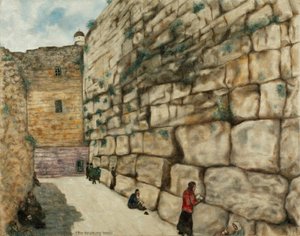
      The Wailing Wall (1932) by Marc Chagall
      #88

      The Wailing Wall

      1932 · Tel Aviv Museum of Art

      In the quiet, textured expanse of Marc Chagall’s 1932 masterpiece, The Wailing Wall, the viewer is not merely looking at a depiction of a historical site, but is…

      Portrait of Brother David with Mandolin (1914) by Marc Chagall
      #89

      Portrait of Brother David with Mandolin

      1914

      A Glimpse into Chagall’s Soul: Brother David with Mandolin Marc Chagall's *Portrait of Brother David with Mandolin*, painted in 1914, is more than just a depiction of a…

      Lovers for Berggruen (The offering) (1965) by Marc Chagall
      #90

      Lovers for Berggruen (The offering)

      1965

      In the ethereal realm of Marc Chagall’s "Lovers for Berggruen (The offering)," the boundaries between reality and the subconscious dissolve into a breathtaking dance of form and feeling.…

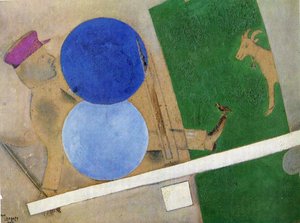
      Composition with Circles and Goat (1920) by Marc Chagall
      #91

      Composition with Circles and Goat

      1920

      In the ethereal realm of Marc Chagall’s “Composition with Circles and Goat,” painted in 1920, the boundaries between the tangible world and the subconscious dissolve into a luminous…

      Great Circus (1984) by Marc Chagall
      #93

      Great Circus

      1984

      Marc Chagall’s “Great Circus,” completed in 1984, isn't merely a depiction of an itinerant spectacle; it’s a profound meditation on memory, faith, and the fantastical realm of childhood…

      Marching (1915) by Marc Chagall
      #94

      Marching

      1915

      Ultimately, Chagall’s “I Am Alone” transcends its historical origins to resonate with viewers across generations. It's a hauntingly beautiful meditation on solitude, loss, and the enduring quest for…

      Night (1953) by Marc Chagall
      #95

      Night

      1953

      A Dreamscape Unveiled: The Surreal Magic of Marc Chagall’s Night In the quiet depths of 1953, Marc Chagall conjured a vision that defies the boundaries of reality, inviting…

      The Holy Coachman (1912) by Marc Chagall
      #96

      The Holy Coachman

      1912

      In the profound depths of Marc Chagall’s 1912 masterpiece, The Holy Coachman, viewers are not merely observing a canvas but are invited into a shimmering tapestry woven from…

      Song of Songs I (1960) by Marc Chagall
      #97

      Song of Songs I

      1960

      In the vast landscape of twentieth-century modernism, few works possess the ethereal, dreamlike magnetism of Marc Chagall’s "Song of Songs I." Created in 1960, this monumental canvas serves…

      The Praying Jew, oil on canvas, The Art Instit (1923) by Marc Chagall
      #98

      The Praying Jew, oil on canvas, The Art Instit

      1923 · Art Institute of Chicago

      The Praying Jew: A Meditation on Faith and Form Marc Chagall’s *The Praying Jew*, painted in 1923, transcends mere representation; it embodies the artist's profound engagement with Jewish…

      The return of the prodigal son (1975) by Marc Chagall
      #99

      The return of the prodigal son

      1975

      The Return of the Prodigal Son: A Symphony of Emotion in Chagall’s Naive Vision Marc Chagall's "The Return of the Prodigal Son," created in 1975, transcends mere representation;…

      Marc Chagall's canvases, period by period

      What Marc Chagall painted most

      The four subjects that return most often on these canvases, each with its best-loved example.

      Where Marc Chagall's canvases hang

      The 8 museums that hold the most of the paintings on this page.

      Museum City Works by Marc Chagall Paintings from this list
      MOMA - Museum of Modern Art, New York CityMOMA - Museum of Modern Art New York City 4 I and the Village, Homage to Gogol. Design for curtain for Gogol festival.
      Art Institute of Chicago, ChicagoArt Institute of Chicago Chicago 4 White Crucifixion, The Praying Jew, oil on canvas, The Art Instit
      Tel Aviv Museum of Art, Tel AvivTel Aviv Museum of Art Tel Aviv 2 The Lovers, The Wailing Wall
      Metropolitan Museum of Art, New YorkMetropolitan Museum of Art New York 2 Snow, Winter in Vitebsk
      Kunstmuseum, BaselKunstmuseum Basel 1 The Falling Angel
      Solomon R. Guggenheim Museum, New York CitySolomon R. Guggenheim Museum New York City 1 The Soldier Drinks
      Galleria Civica di Arte Moderna e Contemporanea Torino, TurinGalleria Civica di Arte Moderna e Contemporanea Torino Turin 1 Dans mon pays
      Szépművészeti Múzeum, BudapestSzépművészeti Múzeum Budapest 1 Compositional Study for ‘To Russia, to the Asses and Others’

      Marc Chagall's best-loved canvas of each decade

      1. 1910s
        I and the Village (1911) by Marc Chagall
        Ranked 1 of 100

        I and the Village

        Age 23 – 32 · MOMA - Museum of Modern Art

        Created in 1911, this captivating oil on canvas is a cornerstone of Marc Chagall's early oeuvre and a pivotal work within the development of modern art. Measuring 191…

      2. 1920s
        The Green Violinist (1924) by Marc Chagall
        Ranked 5 of 100

        The Green Violinist

        Age 33 – 42

        Step into the dreamlike realm of Marc Chagall's The Green Violinist, a masterpiece that captures the essence of Jewish folklore and the vibrant energy of early 20th-century modernism.…

      3. 1930s
        White Crucifixion (1938) by Marc Chagall
        Ranked 2 of 100

        White Crucifixion

        Age 43 – 52 · Art Institute of Chicago

        The center of the canvas holds a pale figure on a white cross. This Christ wears a prayer shawl, a tallit, draped across his body. Above his head,…

      4. 1940s
        The Falling Angel (1947) by Marc Chagall
        6 of 100

        The Falling Angel

        Age 53 – 62 · Kunstmuseum

        Subject and Composition This striking masterpiece presents a complex, symbolic tableau filled with vivid imagery and dynamic movement. Central to the composition is a fiery, winged figure that…

      5. 1950s
        Liberation (1952) by Marc Chagall
        Ranked 10 of 100

        Liberation

        Age 63 – 72

        Created in 1952, this captivating artwork by Marc Chagall is a vibrant testament to the enduring power of love, faith, and cultural heritage. More than simply a depiction…

      6. 1960s
        Abraham and three Angels (1966) by Marc Chagall
        8 of 100

        Abraham and three Angels

        Age 73 – 82

        Marc Chagall's “Abraham and Three Angels,” completed in 1966, stands as a cornerstone of Naïve Art (Primitivism), embodying Chagall’s singular artistic voice and his profound engagement with biblical…

      7. 1970s
        The Myth of Orpheus (1977) by Marc Chagall
        21 of 100

        The Myth of Orpheus

        Age 83 – 92

        In the twilight of his long and luminous career, Marc Chagall gifted the world with The Myth of Orpheus, a 1977 masterpiece that serves as a profound window…

      8. 1980s
        Newlywedds with Eiffel Towel in the Background (1983) by Marc Chagall
        Canvas 46 of 100

        Newlywedds with Eiffel Towel in the Background

        Age 93 – 98

        A Parisian Reverie: Exploring Marc Chagall’s “Newlywedds with Eiffel Tower in the Background” Marc Chagall, a master of lyrical abstraction and poignant symbolism, created "Newlywedds with Eiffel Tower…

      About Marc Chagall's canvases: your questions answered

      What is the best-known painting by Marc Chagall?Read the answer

      I and the Village (1911), MOMA - Museum of Modern Art, New York City. White Crucifixion (1938) and The Birthday (1915) follow.

      What age was Marc Chagall when I and the Village was painted?Read the answer

      Marc Chagall, born in 1887, was 24 years old: I and the Village dates from 1911.

      What are the 10 most famous paintings by Marc Chagall?Read the answer

      I and the Village, White Crucifixion, The Birthday, Over the town, The Green Violinist, The Falling Angel, The Soldier Drinks, Abraham and three Angels, Adam and Eve expelled from Paradise and Liberation. Each canvas in the ranking above comes with its year and its museum.

      How many works did Marc Chagall paint in all?Read the answer

      936 works by Marc Chagall are in our catalogue, dated 1910 to 1984.

      Where can I see Marc Chagall's most famous canvases?Read the answer

      Mostly in MOMA - Museum of Modern Art (New York City), Art Institute of Chicago (Chicago) and Tel Aviv Museum of Art (Tel Aviv); the list above names each museum and its canvases.

      When did Marc Chagall paint the best-loved canvases?Read the answer

      In 1910s, which gave 30 of the 100 works on this page, I and the Village among them.

      Which are Marc Chagall's earliest and latest famous canvases?Read the answer

      The earliest canvas here is Still Life with Lamp (1910); the latest is Great Circus (1984).

      What did Marc Chagall paint most often?Read the answer

      Folklore (26), Jewish folklore (16) and Dreams (16), across the 100 works on this page.

      Which medium did Marc Chagall paint in most often?Read the answer

      Oil On Canvas, used in 59 of the 100 works on this page.

      Which Marc Chagall canvases hang at the MOMA - Museum of Modern Art?Read the answer

      The MOMA - Museum of Modern Art, New York City holds 2 of the works on this page, among them I and the Village and Homage to Gogol. Design for curtain for Gogol festival..

      Marc Chagall: a life in paint

      Early Life, Family and Training

      Marc Chagall enters the world on July 7, 1887, in Vitebsk, Russian Empire, born Moishe Segal. He is the first of nine children in a modest Jewish family. Life is defined by the rhythms of labor and small-scale commerce. His father, Khatskel Segal, works as a herring pickler at a warehouse, while his mother, Feïga-Ita Tchernina, manages a small grocery store. These early years are rooted in the specific textures of a provincial town, where the boundaries of his world are shaped by the needs of a large household and the traditions of his community.

      Education begins within the walls of the heder, a traditional Jewish elementary school. Here, the focus remains on religious instruction and the foundational texts of his upbringing. By age thirteen, the scope of his learning shifts toward the secular. He enters Vitebsk’s official middle school to pursue a Russian education, a move that marks a departure from the strictly religious sphere of his childhood. This dual existence—between the sacred traditions of the heder and the secular requirements of the state school—creates a tension that defines his early development.

      Artistic impulse finds its first formal outlet in Vitebsk. Chagall receives his initial training at a local art school operated by Iouri Pen. It is here that the raw instinct for visual expression begins to coalesce into a disciplined practice. He moves from the structured lessons of the classroom toward a more profound engagement with the act of seeing, setting the stage for a life spent translating memory into form.

      The Formative Years in St. Petersburg

      The transition from the provincial quiet of Vitebsk to the imperial scale of Saint-Petersburg is marked by struggle. Between 1907 and 1909, the capital offers little in the way of comfort. Poverty is a constant companion; there are moments of hunger so severe that physical collapse becomes a reality. To survive, he takes to the streets, earning a meager living by drawing shop signs. These commercial tasks provide the necessary rubles to sustain a presence in the city while he navigates the complexities of being a Jewish student in a vast, shifting empire.

      The academic pursuit is relentless. He enrolls in several academies, seeking a formal structure for his burgeoning visual language. The atmosphere of the capital is heavy with the influence of the avant-garde, a tension that pulls him away from classical training. He finds himself in the studio of Léon Bakst, a designer for the Ballets Russes, where the theatricality of set design begins to seep into his perception of space and form. This period is a collision of necessity and ambition, a time of sketching for survival while simultaneously absorbing the radical shifts occurring in the Russian art scene.

      The Paris Years and Avant-Garde Influence

      Paris arrives in 1910 or 1911, a sudden shift from the provincial constraints of the Russian Empire. The city offers a sensory shock. He finds light, color, and liberty in the streets of Montparnasse. This is no longer the world of the herring merchant or the traditional heder school; it is a landscape of radical possibility. He settles in La Ruche, the famous artist's residence, where the air is thick with the presence of the new avant-garde. He shares this space with Amedeo Modigliani and Fernand Léger, figures who are redefining the boundaries of modern expression. The influence of the era is inescapable, yet he remains an outlier, absorbing the discoveries of Fauvism and Cubism without surrendering his own internal logic.

      The work produced during this period begins to reflect a departure from literal representation. He moves toward a style that prioritizes emotional and poetic associations over the strict rules of pictorial logic. The colors brighten, fueled by the exposure to the Parisian scene. He navigates the tension between the formal training of his past and the experimental freedom of the present. This period of intense creative friction continues until the political upheavals of the war pull him back toward the East. It is not until 1923 that he returns to Paris with his family, re-establishing his presence in the city that first unlocked his visual language.

      The Russian Years and Revolution

      The revolution pulls Chagall back to Vitebsk. He does not merely observe the upheaval; he attempts to shape its cultural landscape. He takes on the mantle of Vitebsk Commissioner of Fine Arts and assumes the directorship of a local Fine Arts School. His vision is one of community and education, yet the political climate shifts beneath his feet. The rise of Suprematism creates a fracture. Figures like Malevitch and Lissitzky push for a radical, non-objective abstraction that clashes with Chagall’s more lyrical, figurative approach. The tension is unsustainable. He is forced out of his positions, his dream of a localized artistic renaissance colliding with the rigid demands of the new regime.

      By 1920, the focus shifts to Moscow. He works on the decoration of the Jewish theatre, a project that captures the intersection of his personal identity and the public stage. His lines are confident, his colors strong and pale, even as the world around him fractures. He navigates a period of intense creative output and profound material struggle, moving between the memory of the shtetl and the demands of a changing state. The era is defined by this friction: the attempt to build a cultural home while the very foundations of his world are being rewritten.

      Life in the United States

      The outbreak of World War II forces a sudden shift in geography. In 1941, Chagall and his family seek refuge in the United States, fleeing the instability of occupied France. He settles in and around New York City, a period of residence that lasts until 1948. The city provides a backdrop of profound emotional upheaval. Amidst the anxieties of the war years, his brush captures the tension of a world in flux. The work reflects the uncertainty of the era, translating personal and global unrest into a visual language of suffering and hope.

      During these seven years, the artist finds a way to engage with large-scale institutional projects. He undertakes major commissions for the United Nations headquarters, translating his poetic vision into the architectural fabric of a global institution. This period in America marks a significant chapter of experimentation and survival, bridging his European roots with a new, intense reality. He remains a man between worlds, his heart still pulling him toward France even as he navigates the complexities of his American exile.

      Technique and Artistic Style

      Logic yields to emotion. Chagall rejects the rigid rules of pictorial logic, choosing instead to compose images through poetic association. His canvases operate on the mechanics of a dream. Figures float through the air, defying gravity, while colors pulse with a non-naturalistic intensity. This approach allows him to capture the essence of feeling rather than the literal appearance of the world. He moves beyond mere imitation, using a bold palette to translate memory into a visual language.

      His aesthetic is a collision of influences. He absorbs the fragmented structures of Cubism and the intense color of Fauvism, yet he filters these avant-garde movements through a deeply personal lens. The result is a style that bridges Expressionism and abstraction. He weaves together the sacred and the mundane, populating his scenes with symbolic and surreal imagery. Jewish folktales and the quiet, lived-in details of shtetl life become the building blocks of a private mythology. The familiar becomes fantastic.

      The imagery often centers on recurring motifs: flying lovers, fiddlers, and massive bouquets. These elements are not mere decorations but symbols of a spiritual and emotional landscape. In works like The Lovers (1929), the sense of weightlessness and the use of intense color create a space where the physical laws of the world no longer apply. His work remains a constant negotiation between the tangible reality of his upbringing and the boundless possibilities of the imagination.

      Patrons, Workshop and Commissions

      The mid-1920s find Chagall in Paris, navigating the influential circles of the art market. He enters the orbit of Ambroise Vollard, a dealer whose influence shapes the trajectory of many avant-garde artists. Vollard commissions a series of engravings from Chagall, tasking him with illustrating the works of Nikolay Gogol, specifically Dead Souls. This period marks a shift toward the precision of printmaking, moving away from the fluid spontaneity of his earlier canvases.

      In 1931, the focus shifts toward the Middle East. The Mayor of Tel Aviv extends an invitation to Chagall to travel to Palestine. The objective is ambitious: the founding of a Jewish Art Museum. This period deepens his engagement with religious and cultural symbolism, a theme that would persist through his later, large-scale architectural works. His ability to translate personal and communal memory into physical space becomes a defining aspect of his professional output.

      As his reputation grows, the scale of his work expands from the intimate page to the monumental. He moves into the realm of light and architecture, designing stained-glass windows for the Cathedral of Metz and the United Nations building in New York. These works demand a mastery of how color interacts with sunlight. In 1964, he reaches a peak of public recognition with a commission for the ceiling of the Paris Opera, a massive undertaking that brings his dreamlike imagery into one of Europe's most significant cultural venues.

      Where to See the Works Today

      The legacy of his vision remains anchored in several key institutions across the globe. In Nice, France, the Musée National Marc Chagall houses an extensive collection of his works, preserving the core of his creative output. This museum offers a concentrated look at the imagery that defined his long career. Meanwhile, the State Russian Museum in Saint-Petersburg, Russia, maintains a significant presence of his art, holding pieces that connect back to his early years and his time in the Russian Empire.

      The reach of his work extends across the Atlantic to the United States. The Museum of Modern Art in New York City holds works that reflect his complex relationship with the city during his years of exile. In the American Midwest, the Art Institute of Chicago features his art, ensuring his presence in major international collections. These locations provide the primary physical touchpoints for those seeking to encounter his specific use of color and form.

      All 936 works by Marc Chagall →