
Atelier — Complimentary worldwide shipping — Delivery 2–6 weeks
      Maria Prymachenko, 1908 – 1997

      Maria Prymachenko: The 97 Best-Known Paintings

      Of all Maria Prymachenko's paintings, Three Parrots on a Soldier's Grave (1982) is the most famous. Close behind come I Give My Little Stars to Children (1983) and The Little Elephant Who Wanted to Be a Sailor (1973). Among the 97 works by Maria Prymachenko in our catalogue, these 97 are the most celebrated, each shown with its date, its museum and its story.

      Ranked by our popularity score, which combines the searches, visits and orders for each work. Updated October 2026.

      Portrait of Maria Prymachenko
      Maria Prymachenko · 1908 – 1997
      Born · died
      1908 – 1997, Bolotnia
      Movement
      Naive art
      Works in our catalogue
      97
      Most famous
      Three Parrots on a Soldier's Grave (1982)

      Maria Prymachenko's 10 most celebrated paintings

      Let Us Go to the Betrothal Party (1968) by Maria Prymachenko
      7

      Let Us Go to the Betrothal Party

      1968 · Gouache

      In the vibrant tapestry of twentieth-century Naive Art, few works radiate as much warmth and cultural vitality as Maria Primachenko’s 1968 masterpiece, "Let Us Go to the Betrothal Party." This gouache painting is far more than a mere depiction of a festive occasion; it is an immersive window into the heart of Ukrainian folklore. At its center, a man and a woman stand in a tender embrace, their figures rendered…

      Flax Blooms and a Cossack Goes to a Girl (1982) by Maria Prymachenko
      8

      Flax Blooms and a Cossack Goes to a Girl

      1982 · Acrylic On Canvas

      In the enchanting realm of Maria Primachenko’s artistry, the boundaries between reality and folklore dissolve into a vibrant tapestry of color and cultural memory. Her masterpiece, Flax Blooms and a Cossack Goes to a Girl, serves as a breathtaking window into the soul of Ukraine. At first glance, the viewer is swept up in a whirlwind of saturated hues and whimsical forms that evoke the joyous spirit of a traditional…

      Maria Prymachenko paintings ranked 11 to 97

      My Flowers To Those Who Love Peace (1983) by Maria Prymachenko
      #11

      My Flowers To Those Who Love Peace

      1983

      In this 1983 work, Maria Primachenko offers a quiet, colorful meditation on the concept of tranquility. The composition centers on a stylized, ornamental structure, reminiscent of a central…

      Wild Bull and Raven Are Friends (1983) by Maria Prymachenko
      #14

      Wild Bull and Raven Are Friends

      1983

      In the enchanting realm of Maria Primachenko’s 1983 masterpiece, "Wild Bull and Raven Are Friends," the boundaries between reality and folklore dissolve into a vibrant tapestry of color…

      Crane Makes Friends with a Fox (1979) by Maria Prymachenko
      #15

      Crane Makes Friends with a Fox

      1979

      The Maria Primachenko painting, "Crane Makes Friends with a Fox", is a captivating example of Naive Art/Primitivism, a style characterized by its simplicity, flat rendering, and lack of…

      Lovely Spring, What Did You Bring. (1977) by Maria Prymachenko
      #16

      Lovely Spring, What Did You Bring.

      1977

      In the vibrant masterpiece "Lovely Spring, What Did You Bring," the legendary Ukrainian artist Maria Primachenko invites us into a world where nature and myth intertwine with breathtaking…

      Two-Headed Chicken (1977) by Maria Prymachenko
      #17

      Two-Headed Chicken

      1977

      In this 1977 composition, two large yellow birds occupy the central space of a 62 x 85 cm canvas. These avian figures possess elongated necks and are positioned…

      Ukrainian Wedding (1966) by Maria Prymachenko
      #18

      Ukrainian Wedding

      1966

      In the vibrant tapestry of twentieth-century Naive Art, few threads are as luminous and emotionally resonant as those woven by Maria Primachenlyko. Her 1966 masterpiece, Ukrainian Wedding, serves…

      Ukraine Blooming (1979) by Maria Prymachenko
      #19

      Ukraine Blooming

      1979

      In the enchanting realm of Naive Art, few works capture the pure, unadulterated joy of nature quite like Maria Primachenko’s Ukraine Blooming. Created in 1979, this masterpiece serves…

      Flax Blooms, a Bride Goes to Her Groom (1983) by Maria Prymachenko
      #20

      Flax Blooms, a Bride Goes to Her Groom

      1983

      In the enchanting realm of Maria Primachenko’s imagination, reality dissolves into a tapestry of myth and memory. Flax Blooms, a Bride Goes to Her Groom serves as a…

      Do I Love Orchards, Do I Love Forests (1968) by Maria Prymachenko
      #21

      Do I Love Orchards, Do I Love Forests

      1968

      In the vibrant masterpiece Do I Love Orchards, Do I Love Forests, created in 1968, the legendary Ukrainian artist Maria Primachenko invites us into a world where the…

      Wild and Big-Eared (1977) by Maria Prymachenko
      #22

      Wild and Big-Eared

      1977

      The Naive Art/Primitivism style has always been a fascinating genre, and one artist who embodies its spirit is Maria Primachenko. Her painting, Wild and Big-Eared, created in 1977,…
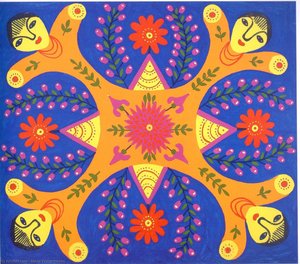
      Tablecloth (1976) by Maria Prymachenko
      #23

      Tablecloth

      1976

      Created in 1976, this gouache work by Maria Primachenko utilizes a flattened perspective to organize a complex visual field. The composition centers on a large circle, which is…

      Ukrainian Dancers (1983) by Maria Prymachenko
      #24

      Ukrainian Dancers

      1983

      In the vibrant tapestry of twentieth-century Ukrainian art, few works capture the pure, unadulterated joy of nature quite like Maria Primachenko’s Ukrainian Dancers. Created in 1983, this masterpiece…

      Monkey Riding a Four-Headed Beast (1982) by Maria Prymachenko
      #25

      Monkey Riding a Four-Headed Beast

      1982

      The painting Monkey Riding a Four-Headed Beast by Maria Primachenko is a vibrant and captivating example of Naive Art/Primitivism, a style characterized by its simplicity, flat rendering, and…

      Dumplings on the Shelf (1979) by Maria Prymachenko
      #26

      Dumplings on the Shelf

      1979

      In the tender, vibrant strokes of "Dumplings on the Shelf," we encounter the enchanting world of Maria Primachenko, a master of Naive Art who transformed the mundane into…
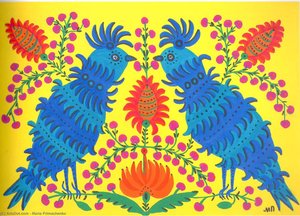
      Two Kites (1982) by Maria Prymachenko
      #27

      Two Kites

      1982

      In the vibrant realm of Naive Art, few works capture the whimsical essence of nature as tenderly as Maria Primachenko’s 1982 masterpiece, Two Kites. This enchanting gouache painting…

      Red Poppies (1982) by Maria Prymachenko
      #29

      Red Poppies

      1982

      Red Poppies is a work by Maria Prymachenko, executed in 1982. Measuring 85 x 61 cm, the piece belongs to the Naive Art and Primitivism movements. It reflects…

      Poppy (1983) by Maria Prymachenko
      #52

      Poppy

      1983

      In the enchanting realm of Naive Art, few works capture the rhythmic pulse of life as tenderly as Maria Primachenko’s Poppy. Created in 1983, this masterpiece serves as…

      This Bear Wants to Have Some Flour Milled (1972) by Maria Prymachenko
      #54

      This Bear Wants to Have Some Flour Milled

      1972

      In the enchanting realm of Maria Primachenko’s imagination, the boundaries between the mundane and the magical dissolve into a vibrant tapestry of color and folklore. Her captivating gouache…

      Tiger Laughs (1982) by Maria Prymachenko
      #66

      Tiger Laughs

      1982

      Here are the cantos, eighteen of them, each one different in form, mood, color, beat, scale, and key. There are no cadenzas. Each is separate. Each can stand…

      Pigeons (1968) by Maria Prymachenko
      #75

      Pigeons

      1968

      In the vast landscape of twentieth-century art, few voices resonate with as much pure, unadulterated joy as that of Maria Primachenko. Her 1968 masterpiece, "Pigeons," serves as a…

      A Cow Like That Gives 5,000 Liters a Day (1978) by Maria Prymachenko
      #76

      A Cow Like That Gives 5,000 Liters a Day

      1978

      The painting "A Cow Like That Gives 5,000 Liters a Day" by Maria Primachenko is a stunning example of Naive Art/Primitivism, a style characterized by its simplicity, flat…

      Ukrainian Dough Looks Into Every House (1977) by Maria Prymachenko
      #77

      Ukrainian Dough Looks Into Every House

      1977

      In the enchanting realm of Maria Primachenko’s 1977 masterpiece, "Ukrainian Dough Looks Into Every House," the boundaries between reality and myth dissolve into a vibrant, dreamlike landscape. This…

      My Bouquet to Grain Growers (1983) by Maria Prymachenko
      #78

      My Bouquet to Grain Growers

      1983

      In the vibrant tapestry of twentieth-century Ukrainian art, few works capture the whimsical essence of life quite like Maria Primachenko’s My Bouquet to Grain Growers. Created in 1983,…

      Our Army, Our Protectors (1978) by Maria Prymachenko
      #79

      Our Army, Our Protectors

      1978

      The painting "Our Army, Our Protectors" by Maria Primachenko is a stunning example of Naive Art/Primitivism, a style characterized by its simplicity, flat rendering, and lack of formal…

      Savage Hump-Shaker (1977) by Maria Prymachenko
      #80

      Savage Hump-Shaker

      1977

      The Naive Art/Primitivism style has always been a fascinating genre, and one artist who embodies its spirit is Maria Primachenko. Her painting, Savage Hump-Shaker, created in 1977, is…

      Maiden and Cossack Enjoying a Ride on Horseback (1982) by Maria Prymachenko
      #81

      Maiden and Cossack Enjoying a Ride on Horseback

      1982

      The painting Maiden and Cossack Enjoying a Ride on Horseback by Maria Primachenko is a stunning example of Naive Art, a style characterized by its simplicity, flat rendering,…

      A Hare's Birthday Party (1977) by Maria Prymachenko
      #82

      A Hare's Birthday Party

      1977

      The Naive Art/Primitivism style has always been a fascinating genre, and one artist who embodies its spirit is Maria Primachenko. Her painting, "A Hare's Birthday Party", created in…

      A Coward Went A-Hunting (1983) by Maria Prymachenko
      #83

      A Coward Went A-Hunting

      1983

      The Naive Art/Primitivism movement has long been a source of fascination for art enthusiasts, and Maria Primachenko's work is a stunning example of this style. Her painting, A…

      A Bunch of Red Flowers on Read Army Day (1970) by Maria Prymachenko
      #84

      A Bunch of Red Flowers on Read Army Day

      1970

      The painting A Bunch of Red Flowers on Read Army Day is a stunning example of Naive Art/Primitivism, a style characterized by its simplicity, flat rendering, and lack…

      October Flowers (1968) by Maria Prymachenko
      #85

      October Flowers

      1968

      The painting October Flowers is a stunning example of Naive Art/Primitivism, a style characterized by its simplicity, flat rendering, and lack of formal training. Created in 1968 by…

      This Beast is Making Magic (1983) by Maria Prymachenko
      #86

      This Beast is Making Magic

      1983

      The painting "This Beast is Making Magic" by Maria Primachenko is a captivating example of Naive Art/Primitivism, a style characterized by its simplicity, flat rendering, and lack of…

      Menagerie (1977) by Maria Prymachenko
      #87

      Menagerie

      1977

      The Menagerie by Maria Primachenko is a captivating example of Naive Art/Primitivism, a style characterized by its simplicity, flat rendering, and lack of formal training. Created in 1977,…

      An Outer Space Memory (1977) by Maria Prymachenko
      #88

      An Outer Space Memory

      1977

      The Maria Primachenko painting, An Outer Space Memory, is a fascinating example of Naive Art/Primitivism. Created in 1977, this piece showcases the artist's unique style and perspective. The…
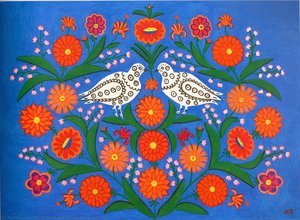
      Pigeon and Dove (1982) by Maria Prymachenko
      #89

      Pigeon and Dove

      1982

      The painting "Pigeon and Dove" by Maria Primachenko is a stunning example of Naive Art/Primitivism, a style characterized by its simplicity, flat rendering, and lack of formal training.…

      Blue Birds in Flowers (1983) by Maria Prymachenko
      #90

      Blue Birds in Flowers

      1983

      The painting Blue Birds in Flowers by Maria Primachenko is a stunning example of Naive Art, a style characterized by its simplicity, flat rendering, and lack of formal…

      Dear Cosmonauts, I Give You These Red Poppies (1983) by Maria Prymachenko
      #91

      Dear Cosmonauts, I Give You These Red Poppies

      1983

      The painting Dear Cosmonauts, I Give You These Red Poppies is a stunning example of Naive Art/Primitivism, a style characterized by its simplicity, flat rendering, and lack of…

      Wild Cat (1977) by Maria Prymachenko
      #92

      Wild Cat

      1977

      The Wild Cat painting by Maria Primachenko is a stunning example of Naive Art/Primitivism, a style characterized by its simplicity, flat rendering, and lack of formal training. Created…

      Red Snowball Tree Blooms Over a Well (1982) by Maria Prymachenko
      #93

      Red Snowball Tree Blooms Over a Well

      1982

      The painting "Red Snowball Tree Blooms Over a Well" by Maria Primachenko is a stunning example of Naive Art/Primitivism, a style characterized by its simplicity, flat rendering, and…

      A Dove Has Spread Her Wings and Asks for Peace (1982) by Maria Prymachenko
      #94

      A Dove Has Spread Her Wings and Asks for Peace

      1982

      The painting A Dove Has Spread Her Wings and Asks for Peace by Maria Primachenko is a stunning example of Naive Art/Primitivism, a style characterized by its simplicity,…

      Ukrainian Milkmaids Work Hard Like Miners (1970) by Maria Prymachenko
      #95

      Ukrainian Milkmaids Work Hard Like Miners

      1970

      The Ukrainian Milkmaids Work Hard Like Miners painting by Maria Primachenko is a stunning example of Naive Art/Primitivism, a style characterized by its simplicity, flat rendering, and lack…

      Ola Man and Old Woman Carry a Turnip (1983) by Maria Prymachenko
      #96

      Ola Man and Old Woman Carry a Turnip

      1983

      The painting "Ola Man and Old Woman Carry a Turnip" by Maria Primachenko is a stunning example of Naive Art/Primitivism, a style characterized by its simplicity, flat rendering,…

      The Lark (1976) by Maria Prymachenko
      #97

      The Lark

      1976

      The Maria Primachenko painting, The Lark, is a stunning example of Naive Art/Primitivism, a style characterized by its simplicity, flat rendering, and lack of formal training. Created in…

      Maria Prymachenko's canvases, period by period

      What Maria Prymachenko painted most

      The four subjects that return most often on these canvases, each with its best-loved example.

      Decade by decade: Maria Prymachenko's most celebrated canvas

      1. 1930s
      2. 1960s
        Let Us Go to the Betrothal Party (1968) by Maria Prymachenko
        7 of 97

        Let Us Go to the Betrothal Party

        Age 52 – 61

        In the vibrant tapestry of twentieth-century Naive Art, few works radiate as much warmth and cultural vitality as Maria Primachenko’s 1968 masterpiece, "Let Us Go to the Betrothal…

      3. 1970s
      4. 1980s

      Your questions on Maria Prymachenko's paintings, answered

      Which is the most celebrated painting by Maria Prymachenko?Read the answer

      Three Parrots on a Soldier's Grave (1982), followed by I Give My Little Stars to Children (1983) and The Little Elephant Who Wanted to Be a Sailor (1973).

      How old was Maria Prymachenko at the time of Three Parrots on a Soldier's Grave?Read the answer

      Maria Prymachenko, born in 1908, was 74 years old: Three Parrots on a Soldier's Grave dates from 1982.

      Which ten paintings is Maria Prymachenko most famous for?Read the answer

      Three Parrots on a Soldier's Grave, I Give My Little Stars to Children, The Little Elephant Who Wanted to Be a Sailor, Corncob Horse in Outer Space, Lamd Has Harnesed a Wolf, Magpie in Roses, Let Us Go to the Betrothal Party, Flax Blooms and a Cossack Goes to a Girl, Black Beast and Taras Hryhorovych Shevchenko Arrives From His Exile to Flowering Ukraine. Each canvas in the ranking above comes with its year and its museum.

      How many paintings by Maria Prymachenko are known?Read the answer

      97 works by Maria Prymachenko are in our catalogue, dated 1936 to 1983.

      In which years did Maria Prymachenko paint the most celebrated canvases?Read the answer

      In 1980s, which gave 46 of the 97 works on this page, Three Parrots on a Soldier's Grave among them.

      What are the first and the last of Maria Prymachenko's famous canvases?Read the answer

      The earliest canvas here is Black Beast (1936); the latest is I Give My Little Stars to Children (1983).

      Which subjects return most often in Maria Prymachenko's paintings?Read the answer

      Animals (30), Flowers (23) and Birds (14), across the 97 works on this page.

      What did Maria Prymachenko usually paint with?Read the answer

      Gouache, used in 24 of the 97 works on this page.

      To which art movement does Maria Prymachenko belong?Read the answer

      Naive art, as the canvases on this page show.

      Maria Prymachenko: the painter's story

      A Life Rooted in the Ukrainian Soil

      Maria Aksentievna Primachenko, born in the small village of Bolotnya near Kyiv in 1908, emerged as one of Ukraine’s most celebrated and distinctive artists—a true visionary whose work transcends categorization. Her life was deeply interwoven with the rhythms of rural existence, a world steeped in ancient folklore, vibrant traditions, and an intimate connection to nature. From a young age, Maria's path diverged from conventional expectations; contracting polio as a child confined her indoors for extended periods, yet this isolation proved unexpectedly fertile ground for artistic blossoming. Her mother and grandmother, skilled embroiderers, imparted the intricate techniques and symbolic language of Ukrainian folk art—a heritage that would become the bedrock of her unique style. These early lessons weren’t merely technical; they were a transmission of cultural memory, a way of seeing the world imbued with meaning and magic. It was in these formative years, surrounded by the colorful threads and age-old patterns, that Maria began to develop an extraordinary visual vocabulary.

      The Naive Revelation: A Style Unbound

      Primachenko’s art is often described as “naive,” a term that can be deceptively limiting. While she received no formal artistic training, her work possesses a profound sophistication—a raw, untamed energy coupled with a deep understanding of composition and color. In the 1930s, after being discovered by artist Tetiana Floru, Maria joined the Kyiv Cooperative Embroidery Association, where her talent quickly became apparent. This led to an invitation to participate in experimental workshops at the Kyiv Museum of Ukrainian Art, marking a pivotal moment in her artistic journey. It was here that she began to translate the motifs and techniques of embroidery into paintings—large-scale canvases teeming with fantastical creatures, vibrant flowers, and scenes of everyday life reimagined through a uniquely personal lens. Her subjects weren’t drawn from observation alone; they sprang from dreams, memories, and a deep wellspring of imagination. Lions with human faces, birds engaged in playful courtship rituals, horses adorned with intricate patterns—these were not mere representations but embodiments of hopes, fears, and the enduring spirit of Ukraine.

      Symbolism Woven into Every Brushstroke

      The power of Primachenko’s art lies not only in its visual exuberance but also in its rich symbolism. Her paintings are replete with motifs drawn from Ukrainian folklore—ancient sun wheels representing life and renewal, birds symbolizing freedom and peace, and horses acting as protectors against evil spirits. These symbols weren't consciously deployed as a form of coded messaging; rather, they emerged organically from her cultural background and intuitive understanding of the natural world. The animals in her paintings often take on human characteristics—engaging in weddings, birthdays, and other social events—blurring the boundaries between the animal kingdom and the human realm. This anthropomorphism isn’t whimsical but reflects a deep respect for all living creatures and a belief in their inherent dignity. Her use of color is equally significant—bold, saturated hues that evoke joy, vitality, and a sense of otherworldly beauty. The layering of patterns and textures creates a dynamic visual surface that draws the viewer into her fantastical world.

      Recognition and Enduring Legacy

      Maria Primachenko’s talent didn't go unnoticed. In 1937, her work was exhibited at the Paris World Fair, where it captivated audiences—and even earned the admiration of Pablo Picasso, who famously declared that she could have become more famous than he had if she had lived in France. She received a gold medal at the exhibition and gained international recognition for her unique style. Despite facing periods of hardship and political upheaval, Primachenko continued to paint throughout her life, creating over 800 works that celebrate the beauty and resilience of Ukraine. Her art became a symbol of national identity—a testament to the enduring power of folk traditions and the human spirit. Today, Maria Primachenko is revered as one of Ukraine’s most important artists, with her likeness appearing on stamps and coinage. The recent attacks on Ivankiv Historical and Local History Museum, which housed many of her paintings, have only served to underscore the importance of preserving her legacy—a cultural treasure that embodies the heart and soul of a nation.

      A Call for Peace: Primachenko in the Modern World

      In the wake of the 2022 Russian invasion of Ukraine, Maria Primachenko’s art has taken on new resonance. Her vibrant paintings, often depicting scenes of harmony between humans and animals, have become powerful symbols of peace and resistance. The destruction of some of her works during the attacks on Ivankiv served as a stark reminder of the fragility of cultural heritage in times of conflict. However, it also sparked a renewed appreciation for her art—a testament to its enduring power and universal message. Primachenko’s paintings are not merely aesthetic objects; they are expressions of hope, resilience, and a deep love for Ukraine. Her legacy continues to inspire artists and audiences around the world, reminding us of the importance of preserving cultural traditions and celebrating the beauty of human creativity in the face of adversity. Her work stands as a vibrant testament to the enduring power of art—a beacon of hope in a world often overshadowed by darkness.

      All 97 works by Maria Prymachenko →