Atelier — Complimentary worldwide shipping — Delivery 2–6 weeks
      Robert Rauschenberg, 1925 – 2008

      Robert Rauschenberg's 100 Most Famous Paintings

      Estate (1963) is the painting Robert Rauschenberg is best remembered for. Signs (1970) and Barge (1963) complete the trio of best-loved canvases. Our catalogue counts 109 works by Robert Rauschenberg. Here are the 100 most famous, with the year, the museum and the story of each canvas.

      Ranked by our popularity score, which combines the searches, visits and orders for each work. Updated October 2026.

      Portrait of Robert Rauschenberg
      Robert Rauschenberg · 1925 – 2008
      Born · died
      1925 – 2008, Port Arthur
      Movement
      Pop art
      Works in our catalogue
      109
      Most famous
      Estate (1963)
      Most works at
      Bavarian State Painting Collections

      The ten best-loved paintings by Robert Rauschenberg

      Estate (1963) by Robert Rauschenberg
      1

      Estate

      1963 · Mixed Media

      A Dynamic Urban Vision: Robert Rauschenberg’s *Estate* Robert Rauschenberg's *Estate* (1963) is a vibrant and compelling exploration of modern urban life, skillfully blending abstract forms with recognizable elements drawn from the cityscape – street signs, architectural fragments, and suggestions of bustling activity. This mixed-media masterpiece doesn’t simply depict a city; it embodies its energy, chaos, and underlying complexities, making it a striking focal point for any contemporary art collection or…

      Signs (1970) by Robert Rauschenberg
      2

      Signs

      1970 · Screenprint

      In the landscape of twentieth-century art, few works possess the visceral, haunting power of Robert Rauschenberg’s Signs. Created in 1970, this masterful screenprint serves as a profound visual eulogy for the 1960s, a decade defined by both unprecedented social progress and staggering tragedy. As a prominent figure in the Pop Art movement, Rauschenberg moved beyond mere representation, instead utilizing a complex, layered montage to capture the fragmented psyche of an…

      Barge (1963) by Robert Rauschenberg
      3

      Barge

      1963 · Oil On Canvas · Guggenheim Museum Bilbao, Bilbao

      Robert Rauschenberg completed Barge in 1963. This large-scale work is the largest of seventy-nine screenprint paintings produced by the artist between 1962 and 1964. The canvas measures 203 x 980 cm.

      Odalisk (1958) by Robert Rauschenberg
      4

      Odalisk

      1958 · Mixed Media · Museum Ludwig, Cologne

      Robert Rauschenberg created Odalisk in 1958. This mixed media installation exists as a Combine, a term for his specific approach to merging the boundaries of sculpture and painting. It occupies a space between the painted surface and the physical object, pulling fragments of the everyday into a singular, structured presence.

      Bed (1955) by Robert Rauschenberg
      5

      Bed

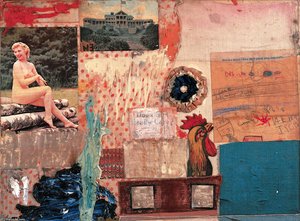
      1955 · Mixed Media · MOMA - Museum of Modern Art, New York City

      is a work by Robert Rauschenberg created in 1955. It is recognized as one of the first of the artist's Combines, a series of works that blurred the boundaries between painting and sculpture by incorporating found objects into the composition.

      Erased de Kooning (1953) by Robert Rauschenberg
      6

      Erased de Kooning

      1953 · Oil On Canvas

      Robert Rauschenberg’s “Erased de Kooning” (1953) is far more than just what it appears to be – a faded, almost ghostly impression. It represents a pivotal moment in art history, challenging conventional notions of authorship, originality, and the very definition of a work of art. This groundbreaking piece isn't about *what* is depicted, but rather about the *act* of erasure itself.

      Collection (1955) by Robert Rauschenberg
      7

      Collection

      1955 · Mixed Media · San Francisco Museum of Modern Art, San Francisco

      In the mid-1950s, the art world was gripped by the intense, often brooding emotionalism of Abstract Expressionism. Yet, amidst this era of heavy shadows and singular gestures, Robert Rauschenberg emerged with a vision that refused to be contained by the edges of a traditional canvas. His 1955 masterpiece, “Collection,” serves as a breathtaking manifesto of this new era—a work that does not merely sit upon a wall but breathes with…

      Tracer (1964) by Robert Rauschenberg
      9

      Tracer

      1964

      Introduction to the Artist and his Work Robert Rauschenberg, born in 1925, was an American painter and sculptor who played a significant role in the Pop Art movement. He is known for his innovative use of materials and techniques, often incorporating everyday objects and images into his work. One of his most notable series is the silkscreen paintings, which he created between 1963 and 1964, including the painting 'Tracer'. The…

      Robert Rauschenberg: canvases 11 to 100 of the ranking

      Untitled (1955) by Robert Rauschenberg
      #32

      Untitled

      1955 · Art Institute of Chicago
      Vault (1962) by Robert Rauschenberg
      #43

      Vault

      1962 · Bavarian State Painting Collections
      Monogram (1955) by Robert Rauschenberg
      #46

      Monogram

      1955

      Robert Rauschenberg’s 1955 “Monogram” is a seminal work from his groundbreaking “Combines” series, a pivotal moment in art history that blurred the lines between painting, sculpture, and assemblage.…

      Wooden Gallop by Robert Rauschenberg
      #68

      Wooden Gallop

      Chrysler Museum of Art

      Robert Rauschenberg's "Wooden Gallop," painted in the early 1960s, isn’t merely a painting; it’s an invitation to a conversation with chance, incongruity, and the very nature of art…

      Choke by Robert Rauschenberg
      #83

      Choke

      Hungarian National Gallery
      Booster (1967) by Robert Rauschenberg
      #98

      Booster

      1967

      Few artists of the twentieth century exerted as immense an influence over a diversity of fields as Robert Rauschenberg. As a visual artist, Rauschenberg sensed the limitations of…

      Untitled (1964) by Robert Rauschenberg
      #99

      Untitled

      1964

      The Untitled painting by Robert Rauschenberg, created in 1964, is a quintessential representation of the Pop Art movement. This artwork, measuring 147 x 127 cm, is executed in…

      Vacation Mirage (Borealis) by Robert Rauschenberg
      #100

      Vacation Mirage (Borealis)

      The painting Vacation Mirage (Borealis) by Robert Rauschenberg B is a thought-provoking piece that showcases the artist's unique style and technique. Measuring 91 x 244 cm, this large-scale…

      Robert Rauschenberg's canvases, period by period

      What Robert Rauschenberg painted most

      The four subjects that return most often on these canvases, each with its best-loved example.

      Where Robert Rauschenberg's canvases hang

      The 8 museums that hold the most of the paintings on this page.

      Museum City Works by Robert Rauschenberg Paintings from this list
      Bavarian State Painting Collections, MunichBavarian State Painting Collections Munich 2 Jungle Watch (Borealis), Vault
      Guggenheim Museum Bilbao, BilbaoGuggenheim Museum Bilbao Bilbao 1 Barge
      Museum Ludwig, CologneMuseum Ludwig Cologne 1 Odalisk
      MOMA - Museum of Modern Art, New York CityMOMA - Museum of Modern Art New York City 1 Bed
      San Francisco Museum of Modern Art, San FranciscoSan Francisco Museum of Modern Art San Francisco 1 Collection
      Art Institute of Chicago, ChicagoArt Institute of Chicago Chicago 1 Untitled
      Toledo Museum of Art, ToledoToledo Museum of Art Toledo 1 Round Sum
      Dallas Museum of Art, DallasDallas Museum of Art Dallas 1 Night Hutch (Hoarfrost)

      Robert Rauschenberg's most famous canvas, decade after decade

      1. 1950s
        Odalisk (1958) by Robert Rauschenberg
        Ranked 4 of 100

        Odalisk

        Age 25 – 34 · Museum Ludwig

        Robert Rauschenberg created Odalisk in 1958. This mixed media installation exists as a Combine, a term for his specific approach to merging the boundaries of sculpture and painting.…

      2. 1960s
        Estate (1963) by Robert Rauschenberg
        Canvas 1 of 100

        Estate

        Age 35 – 44

        A Dynamic Urban Vision: Robert Rauschenberg’s *Estate* Robert Rauschenberg's *Estate* (1963) is a vibrant and compelling exploration of modern urban life, skillfully blending abstract forms with recognizable elements…

      3. 1970s
        Signs (1970) by Robert Rauschenberg
        Canvas 2 of 100

        Signs

        Age 45 – 54

        In the landscape of twentieth-century art, few works possess the visceral, haunting power of Robert Rauschenberg’s Signs. Created in 1970, this masterful screenprint serves as a profound visual…

      4. 1980s
      5. 1990s
      6. 2000s

      Robert Rauschenberg's canvases, question by question

      Which canvas is Robert Rauschenberg most remembered for?Read the answer

      Estate (1963), followed by Signs (1970) and Barge (1963).

      Estate: how old was Robert Rauschenberg when it was painted?Read the answer

      Robert Rauschenberg, born in 1925, was 38 years old: Estate dates from 1963.

      What are Robert Rauschenberg's ten most famous canvases?Read the answer

      Estate, Signs, Barge, Odalisk, Bed, Erased de Kooning, Collection, Big Pile of Bones (Scenario), Tracer and Coca Cola Plan. Each canvas in the ranking above comes with its year and its museum.

      How many paintings did Robert Rauschenberg create?Read the answer

      109 works by Robert Rauschenberg are in our catalogue, dated 1951 to 2008.

      Where do Robert Rauschenberg's most famous canvases hang today?Read the answer

      Mostly in Bavarian State Painting Collections (Munich), Guggenheim Museum Bilbao (Bilbao) and Museum Ludwig (Cologne); the list above names each museum and its canvases.

      When did Robert Rauschenberg paint the most famous canvases?Read the answer

      In 1960s, which gave 18 of the 100 works on this page, Estate among them.

      Which famous Robert Rauschenberg canvas came first, and which came last?Read the answer

      The earliest canvas here is Should Love Come First (1951); the latest is Untitled (Runt) (2008).

      Which subjects did Robert Rauschenberg paint most?Read the answer

      Collage (8), Assemblage (5) and Birds (3), across the 100 works on this page.

      Which medium appears most in Robert Rauschenberg's paintings?Read the answer

      Mixed Media, used in 4 of the 100 works on this page.

      Which movement is Robert Rauschenberg associated with?Read the answer

      Pop art and Neo-dada, as the canvases on this page show.

      Which paintings by Robert Rauschenberg are held by the Bavarian State Painting Collections?Read the answer

      The Bavarian State Painting Collections, Munich holds 2 of the works on this page, among them Jungle Watch (Borealis) and Vault.

      Meet the painter: Robert Rauschenberg

      A Life Forged in Transition

      Robert Rauschenberg, born Milton Ernest Rauschenberg in 1925 amidst the oil-rich landscapes of Port Arthur, Texas, was an artist whose very existence seemed to echo the dynamic energy and transformative spirit he brought to the art world. His childhood wasn’t defined by a single location; his father's profession necessitated a nomadic lifestyle, traversing diverse terrains that subtly instilled within him a receptiveness to varied visual stimuli and a willingness to embrace change. This early exposure fostered a sensibility attuned to the textures and rhythms of American life—an undercurrent profoundly shaping his artistic explorations. Though initially drawn towards pharmacology at the University of Texas, Rauschenberg’s path swiftly diverged, leading him into art – first through necessity during wartime service in the Navy, then with focused study at the Kansas City Art Institute and crucially, at Black Mountain College in North Carolina. It was within this hothouse of avant-garde thought, alongside luminaries like Josef Albers, Merce Cunningham, John Cage, and Cy Twombly, that his experimental spirit truly ignited. This environment wasn’t merely educational; it was a crucible forging a new artistic sensibility, laying the groundwork for an approach fundamentally challenging established norms.

      The Birth of the “Combine”

      Rauschenberg's most enduring legacy lies in his revolutionary "Combines," artworks that deliberately blurred the boundaries between painting, sculpture, and assemblage. These weren’t simply paintings *or* sculptures; they were complex constructions incorporating found objects – everything from everyday detritus like tires and wood scraps to photographs, newspaper clippings, even taxidermied animals. This radical departure wasn't about novelty for its own sake; it was a fundamental questioning of what constituted art itself. His style evolved as a conscious rejection of the prevailing Abstract Expressionist aesthetic, embracing instead the imagery and energy of popular culture and the discarded remnants of modern life. Influenced by the anti-art stance of Dada and the readymades of Marcel Duchamp, Rauschenberg challenged the notion that artistic merit resided solely in technical skill or original conception. He believed in incorporating chance, spontaneity, and the unexpected into his creative process, allowing the inherent qualities of found objects to contribute their own narratives to the artwork. Monogram, with its jarring juxtaposition of a stuffed goat head mounted on an automobile tire, stands as perhaps the most iconic example – a provocative statement about consumer culture, decay, and the collision between organic and industrial elements. This willingness to embrace the unconventional wasn’t merely aesthetic; it was philosophical, reflecting a broader cultural shift questioning traditional values and hierarchies. The Combines weren't just objects; they were statements—fragments of a rapidly changing world reassembled into something new and challenging.

      Expanding Horizons: Silkscreen, Performance, and Beyond

      Rauschenberg’s artistic explorations didn’t remain confined to the Combines. He continually pushed boundaries, experimenting with new techniques and materials. His engagement with silkscreen printing in the early 1960s, exemplified by works like Retroactive I & II, allowed him to incorporate images from newspapers and magazines, reflecting the political and social anxieties of the era and anticipating Pop Art’s embrace of popular imagery. The Overseas Tech Series (1964), created using transfer techniques during travels in Italy and France, explored themes of cultural exchange and globalization by combining photographs taken abroad with silkscreened images. But his influence extended beyond the visual arts; his collaborations with choreographer Merce Cunningham were equally significant. These partnerships resulted in groundbreaking performance pieces that seamlessly integrated dance and visual art, further blurring disciplinary lines and creating immersive experiences challenging conventional notions of artistic expression. He wasn’t simply creating objects or images; he was constructing environments, orchestrating events—a holistic approach to artmaking anticipating the multimedia installations of later generations. This collaborative spirit underscored his belief in art's potential to transcend traditional boundaries and engage with a wider audience.

      A Lasting Legacy

      Robert Rauschenberg’s impact on American art is undeniable. He played a crucial role in bridging the gap between Abstract Expressionism and Pop Art, paving the way for subsequent artists who embraced appropriation, collage, and mixed media. His “Combines” fundamentally redefined the very definition of art, challenging traditional notions of painting and sculpture and expanding the possibilities of artistic expression exponentially. He wasn’t simply creating objects; he was constructing environments reflecting the complexities and contradictions of modern life. Rauschenberg's willingness to experiment with materials, his embrace of chance operations, and his engagement with popular culture served as a powerful inspiration for countless artists who followed in his wake. His work continues to be exhibited in major museums worldwide, serving as a vital source of inspiration for contemporary artists exploring the intersection of art, technology, and everyday life. He left behind not just a body of artwork but a legacy of innovation, challenging us to reconsider our assumptions about what art can be and how it interacts with the world around us. His influence resonates today in the work of artists who continue to push boundaries and explore new forms of creative expression, solidifying his place as one of the most important and influential figures in 20th-century art.

      Key Themes & Influences

      • Dada & Marcel Duchamp: Rauschenberg’s use of found objects and rejection of traditional artistic values were directly influenced by the Dada movement's anti-art stance and Duchamp’s concept of “readymades.”
      • Abstract Expressionism’s Aftermath: He consciously moved away from the emotional intensity and subjective expression of Abstract Expressionism, seeking a more objective and inclusive approach to artmaking.
      • Popular Culture & Mass Media: Rauschenberg embraced imagery from newspapers, magazines, and advertising, reflecting the growing influence of mass media on American society.
      • Collaboration & Interdisciplinarity: His collaborations with Merce Cunningham and John Cage demonstrated his belief in the power of artistic exchange and the blurring of disciplinary boundaries.
      • Chance & Spontaneity: He incorporated elements of chance into his creative process, allowing for unexpected juxtapositions and a sense of openness to new possibilities.

      All 109 works by Robert Rauschenberg →