

Bivega is the painting Victor Vasarely is best remembered for. Quadrature and ORION-MC complete the trio of best-loved canvases. Our catalogue counts 776 works by Victor Vasarely. Here are the 100 most famous, with the year, the museum and the story of each canvas.
Ranked by our popularity score, which combines the searches, visits and orders for each work. Updated October 2026.


Victor Vasarely's *Quadrature* isn't merely a painting; it’s an invitation – an invitation to question the very nature of visual reality. Created by a visionary who anticipated the digital age, this work embodies the core tenets of Op Art, a movement that sought to manipulate perception through carefully constructed geometric forms and vibrant color fields. Painted in 1960s, *Quadrature* showcases Vasarely’s mastery of optical illusion, transforming two dynamic spheres into…

Victor Vasarely's ORION-MC is not merely a painting; it’s an invitation to experience the world through a radically altered lens. This captivating work, rendered in a vibrant palette of red, yellow, green, blue, purple, orange, and black, exemplifies the core tenets of Op Art – Optical Art – pioneered by Vasarely himself. Born Károly Vaszary in 1906 in Pécs, Croatia, his artistic trajectory began with an unexpected detour into medicine…

The artwork titled Zebras (white on black) was created by the artist Victor Vasarely. This piece features two zebras positioned against a black background. The composition includes smaller figures of animals in the background, such as two birds and three additional zebras, which contribute to the depth of the image. The visual structure utilizes geometric shapes and patterns to form the figures.

Victor Vasarely's “Vega-Wa-3” isn’t merely a painting; it’s an invitation to experience visual perception in a radically new way. Completed in 1968, this striking artwork exemplifies the zenith of Op Art – Optical Art – a movement that sought to challenge our ingrained assumptions about how we see and interpret color and form. Imagine stepping into a space where lines seem to vibrate, circles shimmer with an unsettling depth, and…

To stand before Victor Vasarely’s Kaglo II is to enter a realm where the boundaries between the static and the kinetic dissolve into a rhythmic dance of light and color. Created in 1986, this masterful print serves as a profound testament to the enduring power of geometric abstraction. At first glance, the eye is drawn to a central, commanding red sphere, which acts as the sun within a private cosmos.…

Victor Vasarely’s *Vega 1* isn't merely a painting; it’s an invitation. An invitation to step outside the confines of traditional representation and into a world governed by perception itself. Born in 1906 in Pécs, Croatia – then part of Austria-Hungary – Vasarely’s artistic trajectory was initially rooted in medicine before he decisively embraced the burgeoning field of visual abstraction. This pivotal shift, fueled by his studies at the Podolini-Volkmann Academy…

Victor Vasarely’s “NB 22 Caope” is more than just an abstract painting; it's a meticulously crafted portal into the heart of Op Art, a movement that sought to redefine our perception of reality. This striking work, dominated by a precisely arranged grid of black and white circles, exemplifies Vasarely’s pioneering approach to visual illusion – a technique he developed with mathematical rigor and an almost obsessive attention to detail. The…

To stand before a work by Victor Vasarely is not merely to observe paint on canvas; it is to engage in a sophisticated dialogue with perception itself. This piece, characterized by its vibrant, almost pulsating geometric network, draws the viewer into a mesmerizing optical labyrinth. It speaks directly to the intellectual curiosity of the modern collector and the design sensibility of those who appreciate art as an architectural element. The…

To stand before Harmas is to step directly into the mind of its creator, Victor Vasarely. This piece is not merely an arrangement of color and pattern; it is a vibrant intellectual puzzle, a visual meditation on structure itself. The eye is immediately drawn into the intricate dance between the bold red checks and the myriad small circles that populate the background. It possesses the undeniable energy characteristic of Op…

Victor Vasarely's Pal-Ket, painted in 1974, isn’t merely a visual experience; it’s an invitation to reconsider the very nature of perception. This vibrant acrylic on canvas piece, measuring…

Victor Vasarely's "Vonal-2" is more than just a colorful pattern; it’s a meticulously crafted portal into the heart of Op Art and a testament to the revolutionary ideas…

In this 1957 work, titled Vega II, Victor Vasarely explores the fundamental mechanics of sight. The piece is a purely abstract composition, eschewing any recognizable subject matter in…

To stand before Victor Vasarely's Axo 99 is not merely to observe a painting; it is to engage in a visual dialogue with the very mechanics of sight…

Victor Vasarely's “Abstract Composition 9” is more than just a painting; it’s an invitation to experience the world through the lens of perception itself. Created by one of…

The artwork titled Zebras was created by the artist Victor Vasarely. This piece, dated 1938, emerged from a period of intense graphic experimentation. It is considered one of…

To encounter Victor Vasarely’s Kezdi-Ga is to step away from the stillness of traditional viewing and enter a realm where the canvas breathes, pulses, and vibrates with an…

Victor Vasarely’s ‘SIR-RIS,’ a captivating sculpture rendered in meticulous black and white, stands as a cornerstone of Op Art – a movement that fundamentally challenged our understanding of…

To stand before Victor Vasarely’s "Torony-Nagy" is not merely to observe paint on canvas; it is to engage in a sophisticated dialogue with perception itself. This vibrant 1969…

Victor Vasarely's 'Quasar' is not merely a painting; it’s an invitation into the very fabric of perception, a testament to the revolutionary impact of Op Art and the…

To stand before Victor Vasarely's Zett-Ka is not merely to observe a painting; it is to step into a meticulously constructed optical puzzle. This masterful piece, a quintessential…

Victor Vasarely's "Vega-Kontosh-Va" is not merely a painting; it’s an invitation to experience the world through a radically altered lens. This vibrant composition, dominated by a pulsating red…

We are looking at Vèga 3, a significant work by the artist Victor Vasarely. Created about 1968, this piece belongs to the Op Art movement, a style that…

Zoeld V, 1967 – A Geometric Dance of Color Victor Vasarely’s “Zoeld V” stands as a cornerstone of Op Art—a movement that revolutionized visual perception in the mid-20th…

Victor Vasarely (1906-1997) stands as an undisputed titan of Op Art – Optical Art – a movement that revolutionized visual perception in the mid-20th century. Born Károly Vaszary…


In the realm of Op Art, few works capture the hypnotic essence of visual disruption as masterfully as Victor Vasarely’s Zebras (full body white on blue-black). This striking…

Victor Vasarely's "Kezdi-All," a captivating exploration of optical illusion and geometric abstraction, stands as a cornerstone of Op Art – a movement that fundamentally challenged our understanding of…

To stand before Harmas is to step directly into the mind of its creator, Victor Vasarely. This piece is not merely an arrangement of color and pattern; it…

To encounter Victor Vasarely’s 1951 masterpiece, “Terek,” is to step away from the static world of traditional representation and enter a realm where the canvas itself seems to…

To stand before this piece is to step through a portal built entirely of color and calculated form. It is an immediate confrontation with perception itself. The composition,…

To encounter Victor Vasarely's 'Folklore' is to step away from the stillness of traditional viewing and enter a realm where the canvas begins to breathe, pulse, and vibrate…

Victor Vasarely’s “O N D - I I - V A” is more than just a painting; it's an invitation to experience the world through a radically altered…

The artwork is a grid-based abstract composition dominated by concentric circles of varying sizes and shades of red and green. It presents a highly geometric and symmetrical design,…

Victor Vasarely's "F-VERT-BLEU" is not merely a puzzle; it’s a meticulously crafted portal into the heart of Op Art, a movement that fundamentally altered our perception of space…

Victor Vasarely: A Pioneer of Geometric Abstraction and Optical Illusion Victor Vasarely (1906-1997), born Károly Vaszary in Pécs, Hungary – now Croatia – embarked on an artistic journey…

The painting Dia-Tuz-Neg is a blue and white composition characterized by a circular pattern. At the center of the work, a large circle is prominently featured, surrounded by…

Victor Vasarely’s “Caopeo” isn’t merely a painting; it’s an invitation, a carefully constructed illusion designed to challenge and delight the viewer. Created in 1962, this seminal work exemplifies…

Sorata-T is a painted glass triptych executed in 1953. The work is composed of three panels:

The artwork Triond features three colorful balls presented in various shades of blue, purple, pink, and green. These spheres are arranged in a triangular formation, with one ball…

Step closer to observe how the eye begins to move across the surface of Domb-B. At first glance, your attention is drawn to that central blue and yellow…

VP-115 by Victor Vasarely exists as a precise study in the mechanics of sight. The work operates through a calculated arrangement of geometric shapes, specifically a sphere and…

Victor Vasarely's 'Jong,' completed in 1968, is more than just an image; it’s an invitation to question the very nature of reality. This arresting work, a cornerstone of…

The artwork consists of four circles arranged in a square configuration. Each circle is assigned a specific color: blue, orange, yellow, and purple. These shapes are positioned at…

To encounter Victor Vasarely’s “Obor” is to step away from the stillness of traditional viewing and enter a realm where the canvas itself seems to breathe, pulse, and…

Victor Vasarely (1906-1997), a Hungarian sculptor and painter, stands as one of the most influential figures in Op Art – Optical Art – a movement that revolutionized visual…

A Dance of Circles on Crimson: Exploring Victor Vasarely's "Untitled 16" Victor Vasarely, a name synonymous with Op Art and kinetic abstraction, gifted the world a visual language…

Tridem K – A Geometric Revelation by Victor Vasarely Victor Vasarely (1906-1997) stands as an undisputed titan of Op Art, a movement that revolutionized visual perception in the…

The artwork Louisiana features a symmetrical, circular design composed of numerous small, overlapping circles in varying shades of red, orange, and brown. A blue grid subtly underlies the…

A Symphony of Geometry: Exploring Victor Vasarely's "Sikra-Z" Victor Vasarely, a name synonymous with Op Art and kinetic art, dedicated his life to unraveling the mysteries of perception…

Victor Vasarely stands as a pivotal figure in the realms of Op Art and kinetic art. His artistic journey transcended traditional painting by fearlessly exploring optical illusions and…

Victor Vasarely (1906-1997), born Győző Vásárhelyi in Pécs, Croatia, stands as a monumental figure in the history of 20th-century art. Often hailed as “the grandfather” of Op Art…

Quadrature ''X'' – A Symphony of Geometric Illusion The artwork “Quadrature ''X’” by Victor Vasarely stands as a testament to the transformative power of geometric abstraction and its…

A Dance of Light and Geometry: Unveiling Victor Vasarely’s “Untitled 18” Victor Vasarely's "Untitled 18" isn’t merely a painting; it’s an invitation to step into a world where…

To encounter Victor Vasarely’s Nobel is to step away from the stillness of traditional observation and enter a realm where the canvas itself seems to breathe, pulse, and…

KALOTA T is an artwork created by the artist Victor Vasarely. Born in 1906 and passing away in 1997, the French/Hungarian artist developed a visual language centered on…

Victor Vasarely's "Sikra," painted in 1966, is more than just a colorful composition; it’s a meticulously crafted portal into the heart of Op Art and a testament to…

Victor Vasarely's "Dia-Or" is not merely a painting; it’s an invitation into the very fabric of perception. This captivating work, rendered in oil with meticulous attention to detail,…

To encounter Victor Vasarely's “Mahn” is to step into a realm where the canvas ceases to be a static surface and begins to breathe, pulse, and vibrate with…

To encounter Victor Vasarely’s “Cheyt – L” is to step away from the stillness of traditional painting and enter a realm where the canvas itself seems to breathe,…

To encounter Victor Vasarely’s Caribe Negatif is to step away from the stillness of traditional viewing and enter a realm where the canvas breathes, vibrates, and dances before…

To encounter Victor Vasarely's “Tomor” is to step away from the static world of traditional imagery and enter a realm where the canvas itself seems to breathe, pulse,…

Victor Vasarely's Rhombus-B is more than just a painting; it’s an invitation to question the very nature of visual perception. Created by one of the foremost figures in…

Victor Vasarely's "Sreeh" is more than just a painting; it’s an invitation into the heart of Op Art, a visual exploration of perception itself. This striking work, dominated…

Victor Vasarely's "Hetta," a deceptively simple composition of four vibrant circles – red, orange, green, and blue – is far more than just an abstract arrangement. It’s a…

Victor Vasarely's *Opus 2604* is not merely a painting; it’s an invitation to question the very nature of visual reality. This mesmerizing work, dominated by a vibrant blue…

This vibrant artwork, designated VY-47-C, is a captivating embodiment of Victor Vasarely's groundbreaking contributions to Op Art and his pioneering exploration of geometric abstraction. Executed with a masterful…

In the realm of geometric abstraction, few works capture the hypnotic pulse of visual perception as effectively as EG. This striking piece by the master of Op Art,…

Victor Vasarely (1906-1997), a Hungarian-French artist, stands as an undeniable titan of Op Art – Optical Art – a movement that fundamentally challenged our perception of reality in…

Victor Vasarely's "Molnar" is more than just a painting; it’s an invitation into the mesmerizing world of Op Art, a realm where perception itself becomes the subject. This…

Victor Vasarely's Folkokta is more than just a colorful arrangement of squares; it’s a meticulously crafted portal into the heart of Op Art and a testament to the…

Victor Vasarely (1906-1997), a Hungarian-born artist, stands as one of the most influential figures in Op Art – Optical Art – a movement that revolutionized visual perception during…


Victor Vasarely's "Andromeda" isn't merely a painting; it’s an invitation into a realm where perception itself becomes the subject. This striking composition, dominated by a meticulously rendered geometric…

A Symphony of Geometric Forms: Exploring Victor Vasarely’s Planetary Folklore Participations No. 1 Victor Vasarely (French, born Hungary, 1906–1997) stands as a monumental figure in the realm of…
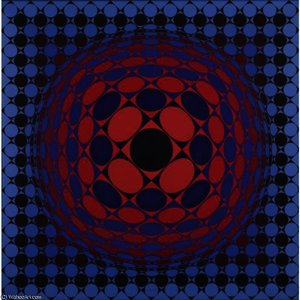
Victor Vasarely's "Versakk" is not merely a painting; it’s an invitation, a carefully constructed illusion that challenges our very perception of space and form. Created by the Hungarian…

Victor Vasarely's DVA-DVA is more than just a colorful square; it’s a meticulously crafted portal into the heart of Op Art and a testament to the revolutionary approach…


To encounter Victor Vasarely’s Tridim is to step into a realm where the boundaries of the two-dimensional canvas dissolve, replaced by a pulsating, architectural depth that defies the…


Victor Vasarely (1906-1997), a Hungarian-French artist, stands as an undeniable titan amongst the pioneers of Op Art – Optical Art – a movement that revolutionized visual perception in…

Victor Vasarely (1906-1997) stands as an undisputed titan of Op Art – Optical Art – a movement that revolutionized visual experience in the mid-20th century. Born Győző Vásárhelyi…

“MEH2,” a captivating work by Hungarian artist Victor Vasarely, is more than just a painting; it's an invitation to explore the very nature of visual perception. Executed in…

Victor Vasarely's Vega-Fel is not merely a painting; it’s an invitation to experience the world through a radically altered lens. This captivating work, dominated by a monumental blue…

Victor Vasarely's "Attam" is more than just a painting; it’s an invitation into the very heart of perception, a testament to the revolutionary impact of Op Art and…

To encounter Victor Vasarely’s “Sikra” is to step away from the stillness of traditional viewing and enter a realm where the canvas breathes, pulses, and vibrates with an…

Victor Vasarely's "Atelier Arcay" isn’t merely a painting; it’s an invitation to a perceptual adventure. Created in the heart of the Op Art movement, this vibrant geometric abstraction…

A Geometric Dance of Color: Exploring Victor Vasarely’s ‘Abstract Composition 5’ Victor Vasarely's “Abstract Composition 5” isn’t merely a painting; it’s an invitation to experience visual perception itself.…

Victor Vasarely's Composition 7 is more than just a colorful painting; it’s a portal into the heart of Op Art and a testament to the revolutionary ideas of…

Victor Vasarely’s "Variációk" (Variations), created in 1989, is more than just an arrangement of circles; it's a vibrant exploration of perception and the underlying mathematical order that governs…

A Dance of Geometry and Color: Exploring Victor Vasarely's "Abstract Composition 13" Victor Vasarely, a name synonymous with Op Art and kinetic art, gifted the world a visual…

Victor Vasarely's Firaxo II is more than just a colorful textile; it’s a meticulously constructed portal into the heart of Op Art and a testament to the revolutionary…

A Symphony in Black: Exploring Victor Vasarely's Serigraph Victor Vasarely’s serigraphy in black is more than just an image; it’s an experience, a visual puzzle that invites the…

“Vonal-Fegn,” created by Victor Vasarely, is more than just an abstract painting; it's a meticulously crafted exploration of perception itself. Painted in hues of orange, yellow, blue, gray,…

Victor Vasarely's "Ouivar," a captivating exploration of geometric abstraction, invites the viewer into a world where perception itself becomes the subject. This artwork, characterized by its precisely arranged…

Victor Vasarely's "Abstract Composition 17" is more than just an image; it’s an invitation to experience the world anew. Born in 1906 in Pécs, Croatia – then part…
The four subjects that return most often on these canvases, each with its best-loved example.
The 3 museums that hold the most of the paintings on this page.
| Museum | City | Works by Victor Vasarely | Paintings from this list |
|---|---|---|---|
 Bechtler Museum of Modern Art |
Charlotte | 4 | NB 22 Caope, SIR-RIS, Tridem K |
 Inter-American Development Bank |
Washington, D.C. | 2 | Kaglo II |
 Bilbao Fine Arts Museum |
Bilbao | 1 | Pal-Ket |
The artwork titled Zebras was created by the artist Victor Vasarely. This piece, dated 1938, emerged from a period of intense graphic experimentation. It is considered one of…
In this 1957 work, titled Vega II, Victor Vasarely explores the fundamental mechanics of sight. The piece is a purely abstract composition, eschewing any recognizable subject matter in…

Victor Vasarely's “Vega-Wa-3” isn’t merely a painting; it’s an invitation to experience visual perception in a radically new way. Completed in 1968, this striking artwork exemplifies the zenith…
Victor Vasarely's Pal-Ket, painted in 1974, isn’t merely a visual experience; it’s an invitation to reconsider the very nature of perception. This vibrant acrylic on canvas piece, measuring…

To stand before Victor Vasarely’s Kaglo II is to enter a realm where the boundaries between the static and the kinetic dissolve into a rhythmic dance of light…
Bivega, followed by Quadrature and ORION-MC.
Bivega, Quadrature, ORION-MC, Zebras (white on black), Vega-wa-3, Kaglo II, Vega 1, NB 22 Caope, Yon and Harmas. Each canvas in the ranking above comes with its year and its museum.
776 works by Victor Vasarely are in our catalogue, dated 1938 to 1986.
Mostly in Bechtler Museum of Modern Art (Charlotte), Inter-American Development Bank (Washington, D.C.) and Bilbao Fine Arts Museum (Bilbao); the list above names each museum and its canvases.
In 1960s, which gave 10 of the 100 works on this page, Vega-wa-3 among them.
The earliest canvas here is Zebras (1938); the latest is Kaglo II (1986).
Optical illusion (44), Visual perception (37) and Geometric abstraction (35), across the 100 works on this page.
Acrylic On Canvas, used in 61 of the 100 works on this page.
Op art, as the canvases on this page show.
The Bechtler Museum of Modern Art, Charlotte holds 3 of the works on this page, among them NB 22 Caope, SIR-RIS and Tridem K.
Born Károly Vaszary on 9 April 1906 in Pécs, Hungary, the man who would become known as Victor Vasarely began his path in a different field entirely. In 1925, he moved into the halls of Eötvös Loránd University in Budapest to study medicine. The logic of the human body and science occupied his time for two years, but the pull of visual expression eventually took precedence. By 1927, he left his medical studies behind to pursue the study of traditional academic painting at the Podolini-Volkmann Academy.
His training continued as he moved into Sándor Bortnyik’s műhely. This workshop was a place where the principles of the Bauhaus movement took root, focusing on the intersection of functional design and geometric abstraction. Here, the focus shifted toward the structural and the systematic. The lessons learned in these studios provided the foundation for his later investigations into how shapes and colors interact with the eye.
Between 1929 and 1944, Vasarely focused on graphic work. He spent these years experimenting with how light and shadow interact with simple forms. His early graphic period produced pieces like Chess Board (1935) and Girl-power (1934). He also worked on Zebras in 1937. These works show a growing interest in how a viewer perceives a flat surface. He moved away from traditional painting toward a more structured, graphic approach.
From 1944 to 1947, his direction shifted. He moved through several styles, including cubistic, futuristic, expressionistic, symbolistic, and surrealistic approaches. He eventually moved past these experiments, looking for a more precise way to organize space. This search for a new logic led him to publish his Yellow Manifest. His work became less about individual expression and more about the mechanics of sight. This systematic method eventually established him as a leader of the Op art movement.
Vasarely’s approach relies on a systematic use of geometry to trigger a physical response in the viewer. He did not rely on traditional light sources or classical chiaroscuro to create form. Instead, he used a sophisticated interplay of high-contrast pigments to simulate depth and movement. By manipulating color density, he could trick the eye into perceiving recession and protrusion on a flat plane. This method turns a static surface into a space that seems to swell or recede.
His method, which he referred to as visual kinetics or plastique cinétique, involves a precise arrangement of shapes. He utilized textural effects, perspective, shadow, and light to build these illusions. The work often relies on the way the eye interprets rhythmic, internal radiance rather than external illumination. Through the use of grids and mathematical principles, he created sensations of visual vibration and swirling effects. The result is a sense of movement that exists entirely within the viewer's perception.
The precision of his technique is evident in how he handles color and line to create architectural depth. In works like Torony-Nagy, the intersection of crisp white lines with deep blues and emerald greens creates a rhythmic optical vibration. These elements work together to produce a sensation of pulsing light. He used these tools to move beyond simple representation, focusing instead on the mechanics of how we see.
In 1937, the creation of Zebra marked a shift toward what many consider the earliest examples of Op Art. This work moved away from traditional representation, focusing instead on the way the eye interprets simple forms. By the 1960s, his experiments with rhythm and light reached a peak in the 1969 work Torony-Nagy. This piece uses four stylized towers and a high-contrast palette of blues, greens, and oranges to create a sense of internal radiance. The composition relies on intersecting white lines and color density to make the flat surface appear to pulse and recede.
His interest in movement extended into three-dimensional space and everyday objects. He designed Georges Pompidou, a large kinematic object, which integrated his visual theories into a physical, moving form. This interest in the practical application of his geometry also led to a collaboration with Rosenthal Studio Linie. This partnership resulted in the Suomi tableware series, a 500-piece run that brought his geometric patterns into the domestic sphere.
In 1966, Victor Vasarely began the process of establishing the Fondation Vasarely. This project was built upon his specific ideas regarding the concept of "art for all" and his vision for a "city of tomorrow." He wanted to create a space that moved beyond the traditional gallery experience to reflect these principles. The physical construction of the building began in 1973.
The foundation was officially inaugurated on 14 February 1976 in Aix-en-Provence, France. The site was designed to house his works and promote his theories on how art and urban design might interact. The architecture of the space itself was part of this vision, with the building's layout intended to support the way his geometric forms were meant to be experienced by the public.
The reach of his visual language extended far beyond the walls of a gallery. His patterns and geometric structures found their way into the textures of everyday life, influencing the lines of fashion, the layouts of interior design, and the logic of graphic design. Even the early development of computer graphics carries the imprint of his systematic approach to form and perception. His ideas were not confined to the canvas; they moved into the functional world of objects and the digital structures that followed.
In 1982, his work traveled into space when serigraphs were included aboard the French-Soviet spacecraft Salyut 7. This moment highlighted a connection between his mathematical precision and the broader human endeavor of exploration. He remained a central figure in modern art history until his death in Paris, France, on 15 March 1997.
Tracing the physical presence of his work requires traveling across several locations in France and Hungary. In Aix-en-Provence, France, the Fondation Vasarely holds a significant portion of his output. This museum was established by the artist himself to promote his ideas regarding art for all. The space is organized into seven hexagonal cells, each measuring 14 metres across and 11 metres high, designed to house forty-two large-scale works that are 6 by 8 metres in size.
His presence in Hungary is also felt through dedicated spaces. The Vasarely Museum is located in Pécs, the city of his birth. There is also a Vasarely Museum situated in the Zichy Palace in Óbuda, Budapest. These locations allow for a direct encounter with the geometric forms and optical effects that defined his practice. In France, another site for his work is the Vasarely Museum at the Saint-Firmin Palace in Gordes.
Beyond these specific museums, his influence is found in various institutional collections. Some of his pieces are held by the Bilbao Fine Arts Museum, while others are part of the collections at the Inter-American Development Bank in Washington, D.C., and the Bechtler Museum of Modern Art in Charlotte. These scattered locations ensure his visual experiments remain accessible to different audiences.


