Atelier — Complimentary worldwide shipping — Delivery 2–6 weeks
      Zanobi Strozzi, 1412 – 1468

      The 25 Most Famous Zanobi Strozzi Paintings, Ranked

      The best-loved painting by Zanobi Strozzi is Madonna and Child with Angels (1434), which hangs in the Convent of San Marco, Florence. Camaldolese Friars in Choir (1450) and The Annunciation (1442) come next among the canvases readers know best. Our catalogue holds 26 works by Zanobi Strozzi: here are the 25 most famous, each with its year, its museum and what makes it memorable.

      Ranked by our popularity score, which combines the searches, visits and orders for each work. Updated November 2026. Each painting on this page can be ordered as an oil reproduction painted by hand on linen canvas, or as a fine art print, made to the size you choose.

      Portrait of Zanobi Strozzi
      Zanobi Strozzi · 1412 – 1468
      Born · died
      1412 – 1468, Florence
      Movement
      Early renaissance
      Works in our catalogue
      26
      Most famous
      Madonna and Child with Angels (1434)
      Most works at
      National Gallery

      Top 10 Zanobi Strozzi paintings: the canvases everyone knows

      Madonna and Child with Angels (1434) by Zanobi Strozzi
      1

      Madonna and Child with Angels

      1434 · Oil On Canvas · Convent of San Marco, Florence

      A Vision of Divine Grace: Zanobi Strozzi's Madonna and Child with Angels To gaze upon this masterpiece by Zanobi Strozzi is to step directly into the luminous heart of the Early Renaissance. The scene unfolds with an almost palpable sense of sacred tranquility, centering on the Virgin Mary cradling the divine presence of the Christ Child. It is more than a mere portrait; it is a profound meditation on motherhood,…

      Hand-painted oil reproduction from $195 30 × 34 cm (11.8 × 13.4 in) Same size as the original $730 127 × 138 cm (50 × 54.3 in) Order at original size →
      Camaldolese Friars in Choir (1450) by Zanobi Strozzi
      2

      Camaldolese Friars in Choir

      1450 · Tempera On Panel

      In this 1450 composition, we find ourselves drawn into a quiet, sacred space where time seems to have slowed. A group of Camaldolese friars is gathered in a choir, their figures arranged with a sense of rhythmic unity. Some monks stand at the forefront, while others recede into the background, creating a subtle depth within the square format. They are dressed in heavy robes that signal their religious devotion, their…

      Hand-painted oil reproduction from $195 32 × 32 cm (12.6 × 12.6 in)
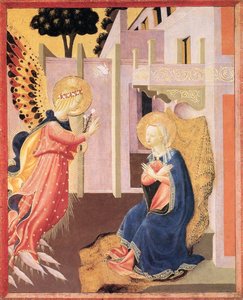
      The Annunciation (1442) by Zanobi Strozzi
      3

      The Annunciation

      1442 · Tempera On Panel · National Gallery, London

      The Annunciation by Zanobi Strozzi captures a suspended moment of divine interruption. Created about 1440-5, the painting depicts the Archangel Gabriel arriving to deliver a celestial message to the Virgin Mary. A single dove, representing the Holy Ghost, descends with a gilded halo above the angel's head. The scene is framed by the quiet weight of classical columns, separating the celestial messenger from the woman receiving the news.

      Hand-painted oil reproduction from $220 37 × 27 cm (14.6 × 10.6 in) Same size as the original $668 142 × 105 cm (55.9 × 41.3 in) Order at original size →
      Virgin and Child with Four Angels and the Redeemer (1450) by Zanobi Strozzi
      4

      Virgin and Child with Four Angels and the Redeemer

      1450 · Tempera On Panel · Brooklyn Museum, Brooklyn

      The air within the sacred space feels heavy with the scent of old wood and the silent weight of devotion. At the center of this celestial assembly, the Virgin Mary sits with a quiet, solemn grace, her presence anchoring the entire composition. She holds the Christ Child, whose small form is framed by the deep, ultramarine blue of her mantle and the rich crimson of her tunic. Around them, four…

      Hand-painted oil reproduction from $345 25 × 40 cm (9.8 × 15.7 in) Same size as the original $445 51 × 79 cm (20.1 × 31.1 in) Order at original size →
      Scenes from the Story of Susanna: Susanna and the Elders (1450) by Zanobi Strozzi
      5

      Scenes from the Story of Susanna: Susanna and the Elders

      1450 · Tempera On Panel · Musée du Petit Palais, Avignon

      The panel stretches wide, a long horizontal sequence of moments captured in tempera. It unfolds like a silent play, divided into three distinct stages of a biblical drama. On the far left, the heavy lines of an interior architectural setting frame the beginning of the tension. The center shifts to an outdoor garden, where a circular structure anchors the composition. Finally, the eye moves to the right, toward a landscape…

      Hand-painted oil reproduction from $770 55 × 18 cm (21.7 × 7.1 in) Same size as the original $976 170 × 43 cm (66.9 × 16.9 in) Order at original size →
      Saints Zenobius, Francis and Anthony of Padua (1450) by Zanobi Strozzi
      6

      Saints Zenobius, Francis and Anthony of Padua

      1450 · Tempera On Panel · Yale University Art Gallery, New Haven

      This Renaissance-era religious panel painting presents three saints arranged side-by-side in a vertical, frontal composition. The figures occupy a shallow space against a background of patterned gold leaf, which creates a flat, celestial setting. On the left, a figure is dressed in episcopal regalia, including a mitre, and holds a book. The central figure is depicted in a brown monastic habit with hands clasped in prayer. To the right, the…

      Hand-painted oil reproduction from $245 25 × 40 cm (9.8 × 15.7 in) Same size as the original $330 47 × 77 cm (18.5 × 30.3 in) Order at original size →
      Altarpiece of Saint Jerome (1460) by Zanobi Strozzi
      7

      Altarpiece of Saint Jerome

      1460 · Tempera On Panel · Musée du Petit Palais, Avignon

      The Altarpiece of Saint Jerome is a significant work by the Florentine painter Zanobi Strozzi. Created about 1460, this large-scale panel was originally commissioned for the convent of San Girolamo in Fiesole. The commission for this religious work was awarded by the Medici, reflecting the close ties between the artist and the influential family during the Quattrocento.

      Hand-painted oil reproduction from $520 34 × 29 cm (13.4 × 11.4 in) Same size as the original $1576 217 × 156 cm (85.4 × 61.4 in) Order at original size →
      The Last Judgement (1456) by Zanobi Strozzi
      8

      The Last Judgement

      1456 · Tempera On Panel · Gemäldegalerie, Berlin

      The Last Judgement, also known as Das Jüngste Gericht, is a work by Zanobi Strozzi. Created in 1456, the painting emerged from the hands of Zanobi di Benedetto di Caroccio degli Strozzi. This Florentine artist, born in Florence, Italy, brought a specific precision to the panel. The wood of the support is poplar.

      Hand-painted oil reproduction from $1520 37 × 27 cm (14.6 × 10.6 in)
      The Annunciation (1453) by Zanobi Strozzi
      9

      The Annunciation

      1453 · Tempera On Panel · Philadelphia Museum of Art, Philadelphia

      The artwork depicts the Annunciation scene, a sacred moment of divine communication. The composition centers on two figures: an angel presenting lilies to Mary, who is seated in a state of prayer and sudden awareness. The angel's pink gown features the gold-lettered greeting "Ave Maria" within its folds. Mary is characterized by the deep blue of her mantle and a posture of stillness. A single dove, representing the Holy Spirit,…

      Hand-painted oil reproduction from $220 28 × 35 cm (11 × 13.8 in) Same size as the original $224 30 × 37 cm (11.8 × 14.6 in) Order at original size →
      The Nativity (1436) by Zanobi Strozzi
      10

      The Nativity

      1436 · Tempera On Panel · Metropolitan Museum of Art, New York

      The Nativity is a painting by Zanobi Strozzi, an artist born in 1412 in Florence, Italy. He remained in Florence until his death in 1468. This specific work is attributed to Strozzi and is also identified by the alternative title, Adoration of the Child.

      Hand-painted oil reproduction from $245 27 × 36 cm (10.6 × 14.2 in)

      More Zanobi Strozzi canvases, 11 to 25

      St Agnes (1448) by Zanobi Strozzi
      #17

      St Agnes

      1448 · Convent of San Marco

      The tempera panel painting, “St Agnes,” attributed to Zanobi Strozzi and completed in 1448, is more than simply a depiction of a saint; it's a meticulously crafted window…

      Bring this light home from $195 →
      The Nativity (1433) by Zanobi Strozzi
      #22

      The Nativity

      1433 · Metropolitan Museum of Art

      The Nativity is a painting by Zanobi Strozzi. This work, also identified by the alternative title Adoration of the Child, captures a quiet moment of devotion. The artist…

      Order this canvas from $195 →

      Zanobi Strozzi's canvases, period by period

      What Zanobi Strozzi painted most

      The four subjects that return most often on these canvases, each with its best-loved example.

      Where Zanobi Strozzi's canvases hang

      The 8 museums that hold the most of the paintings on this page.

      Museum City Works by Zanobi Strozzi Paintings from this list
      National Gallery, LondonNational Gallery London 3 The Annunciation, The Adoration of the Magi, The Abduction of Helen
      Metropolitan Museum of Art, New YorkMetropolitan Museum of Art New York 3 The Nativity, Initial B with David in Prayer, The Nativity
      Convent of San Marco, FlorenceConvent of San Marco Florence 2 Madonna and Child with Angels, St Agnes
      Musée du Petit Palais, AvignonMusée du Petit Palais Avignon 2 Scenes from the Story of Susanna: Susanna and the Elders, Altarpiece of Saint Jerome
      Walters Art Museum, BaltimoreWalters Art Museum Baltimore 2 Book of Hours for the Use of Rome (Folios 169v-170r), Book of Hours for the Use of Rome (Folios 14v-15r)
      Brooklyn Museum, BrooklynBrooklyn Museum Brooklyn 1 Virgin and Child with Four Angels and the Redeemer
      Yale University Art Gallery, New HavenYale University Art Gallery New Haven 1 Saints Zenobius, Francis and Anthony of Padua
      Gemäldegalerie, BerlinGemäldegalerie Berlin 1 The Last Judgement

      Zanobi Strozzi's best-loved canvas of each decade

      1. 1430s
        Madonna and Child with Angels (1434) by Zanobi Strozzi
        Ranked 1 of 25

        Madonna and Child with Angels

        Age 18 – 27 · Convent of San Marco

        A Vision of Divine Grace: Zanobi Strozzi's Madonna and Child with Angels To gaze upon this masterpiece by Zanobi Strozzi is to step directly into the luminous heart…

      2. 1440s
        The Annunciation (1442) by Zanobi Strozzi
        Ranked 3 of 25

        The Annunciation

        Age 28 – 37 · National Gallery

        The Annunciation by Zanobi Strozzi captures a suspended moment of divine interruption. Created about 1440-5, the painting depicts the Archangel Gabriel arriving to deliver a celestial message to…

      3. 1450s
        Camaldolese Friars in Choir (1450) by Zanobi Strozzi
        Canvas 2 of 25

        Camaldolese Friars in Choir

        Age 38 – 47

        In this 1450 composition, we find ourselves drawn into a quiet, sacred space where time seems to have slowed. A group of Camaldolese friars is gathered in a…

      4. 1460s
        Altarpiece of Saint Jerome (1460) by Zanobi Strozzi
        Ranked 7 of 25

        Altarpiece of Saint Jerome

        Age 48 – 56 · Musée du Petit Palais

        The Altarpiece of Saint Jerome is a significant work by the Florentine painter Zanobi Strozzi. Created about 1460, this large-scale panel was originally commissioned for the convent of…

      About Zanobi Strozzi's canvases: your questions answered

      What is the best-known painting by Zanobi Strozzi?Read the answer

      Madonna and Child with Angels (1434), Convent of San Marco, Florence. Camaldolese Friars in Choir (1450) and The Annunciation (1442) follow.

      What age was Zanobi Strozzi when Madonna and Child with Angels was painted?Read the answer

      Zanobi Strozzi, born in 1412, was 22 years old: Madonna and Child with Angels dates from 1434.

      What are the 10 most famous paintings by Zanobi Strozzi?Read the answer

      Madonna and Child with Angels, Camaldolese Friars in Choir, The Annunciation, Virgin and Child with Four Angels and the Redeemer, Scenes from the Story of Susanna: Susanna and the Elders, Saints Zenobius, Francis and Anthony of Padua, Altarpiece of Saint Jerome, The Last Judgement, The Annunciation and The Nativity. Each canvas in the ranking above comes with its year and its museum.

      How many works did Zanobi Strozzi paint in all?Read the answer

      26 works by Zanobi Strozzi are in our catalogue, dated 1433 to 1463.

      Where can I see Zanobi Strozzi's most famous canvases?Read the answer

      Mostly in National Gallery (London), Metropolitan Museum of Art (New York) and Convent of San Marco (Florence); the list above names each museum and its canvases.

      When did Zanobi Strozzi paint the best-loved canvases?Read the answer

      In 1450s, which gave 9 of the 25 works on this page, Camaldolese Friars in Choir among them.

      Which are Zanobi Strozzi's earliest and latest famous canvases?Read the answer

      The earliest canvas here is The Nativity (1433); the latest is Book of Hours for the Use of Rome (1463).

      What did Zanobi Strozzi paint most often?Read the answer

      Woman (10), People (7) and Angels (6), across the 25 works on this page.

      Which medium did Zanobi Strozzi paint in most often?Read the answer

      Tempera On Panel, used in 19 of the 25 works on this page.

      Which movement is Zanobi Strozzi's painting part of?Read the answer

      Early renaissance, as the canvases on this page show.

      Which Zanobi Strozzi canvases hang at the National Gallery?Read the answer

      The National Gallery, London holds 3 of the works on this page, among them The Annunciation, The Adoration of the Magi and The Abduction of Helen.

      Can I buy a reproduction of a Zanobi Strozzi canvas?Read the answer

      Yes. Every painting on this page can be ordered from its own page as an oil reproduction painted by hand, or as a fine art print, in the size you choose.

      Zanobi Strozzi: a life in paint

      The Florentine Visionary: The Life and Legacy of Zanobi Strozzi

      In the golden era of the Florentine Renaissance, where light and shadow began to dance with newfound humanistic depth, the name Zanobi Strozzi emerged as a vital thread in the city's artistic tapestry. Born in 1412 into the illustrious Strozzi family, Zanobi’s early life was shaped by the profound political shifts of Florence. Though his lineage connected him to nobility, the untimely death of his father when Zanobi was only fifteen years old thrust him toward a different kind of destiny. This period of personal loss led him into the transformative embrace of an apprenticeship under Battista di Biagio Sanguigni, a mentorship that would eventually refine his hand and instill in him the technical precision required to master the delicate art of manuscript illumination and panel painting.

      Strozzi’s artistic evolution was deeply intertwined with the spiritual and aesthetic currents of his time. His most significant connection, however, was his association with the revered Fra Angelico. As a pupil within this influential circle, Strozzi did not merely mimic the master; he absorbed a profound sense of devotion and a luminous approach to color that would become hallmarks of his own style. This relationship allowed for a beautiful stylistic convergence, where the ethereal, divine light characteristic of Fra Angelico met Strozzi’s meticulous attention to detail. His work often bridged the gap between the intimate, miniature worlds of illuminated manuscripts and the grand, emotive presence of religious altarpieces.

      Mastery of Detail and Devotional Beauty

      The breadth of Strozzi’s talent is most evident in his ability to navigate diverse mediums with equal grace. He was a master of tempera on panel, a medium that demanded immense patience and a steady hand to achieve the vibrant, jewel-like tones seen in his religious works. His repertoire included several significant altarpieces and poignant depictions of the Virgin and Child, pieces designed to evoke deep spiritual reflection in the viewer. In these works, Strozzi utilized the Florentine Early Renaissance style to weave narratives of faith, using soft transitions and intricate patterns to breathe life into sacred figures.

      Beyond the larger panels, Strozzi achieved legendary status through his contributions to manuscript illumination. His ability to command small spaces allowed him to create miniature worlds of breathtaking complexity. Some of his most notable artistic achievements include:

      • Sts Cosmas and Damian Saved from Drowning: A 1435 masterpiece that captures a poignant moment of divine intervention, showcasing his skill in depicting communal faith and dramatic movement.
      • St Agnes: Created in 1448, this work exemplifies his ability to render serene, profile portraits set against swirling, decorative patterns that highlight the elegance of the period.
      • Book of Hours for the Use of Rome: A testament to his prowess as an illuminator, where every folio serves as a window into the meticulous craftsmanship of the Florentine scriptorium.

      A Lasting Impression on the Renaissance

      The historical significance of Zanobi Strozzi lies in his role as a bridge between the medieval tradition of decorative illumination and the burgeoning Renaissance focus on human emotion and naturalism. While much of his work was destined for private devotion within the grand residences of Florence, his influence rippled through the workshops of the city. He helped disseminate a specific brand of Florentine beauty—one that was both intellectually rigorous and emotionally accessible. Through his hands, the sacred stories of the saints and the Virgin were rendered with a clarity and vibrancy that captured the very essence of the Quattrocento spirit.

      Though he passed away in 1468, leaving behind a legacy etched in gold leaf and tempera, Strozzi remains a symbol of the artist's ability to find profound meaning within the minute. His life, marked by the transition from a noble orphan to a celebrated master, mirrors the very transformation of Florence itself: a journey from the structured traditions of the past toward the luminous, human-centered brilliance of the Renaissance.