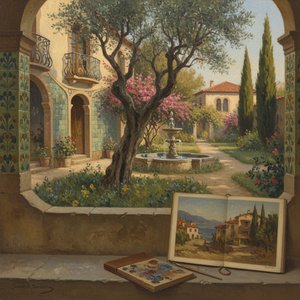
Isidoro Marín Garés: Granada’s Watercolorist and Echoes of Impressionism
Isidoro Marín Garés (1863 – 1926) stands as a quiet yet significant figure in Spanish art history, primarily recognized for his masterful watercolors depicting the landscapes and scenes of Granada and its surrounding region. Born in Granada, Spain, he embarked on an artistic journey shaped by influences ranging from Mariano Fortuny to the burgeoning Impressionist movement, resulting in works that capture both meticulous observation and atmospheric sensitivity. His contribution extends beyond mere visual beauty; Marín Garés was a dedicated craftsman, ceramicist, and art restorer who actively participated in Granada’s cultural life.
Early Life and Artistic Training
Marín Garés received his formative artistic education at the Escuela de Bellas Artes de Granada, where he honed his skills under the tutelage of prominent instructors. Although he exhibited only once outside of Granada – namely at the Barcelona Universal Exposition of 1888 – this single appearance signaled an ambition to transcend regional boundaries and engage with broader artistic dialogues. The exposition provided him with invaluable exposure to international trends, notably Impressionism, which profoundly impacted his stylistic choices. He was a son of Isidoro Marín Molinos, natural de Villanueva de Cameros y de Teresa Gares Arantave, natural de Granada, born on July 14th, 1863. His artistic formation took place at the Escuela de Bellas Artes de Granada alongside Julián Sanz del Valle and Eduardo García Guerra.
Influences and Artistic Style
Mariano Fortuny’s meticulous technique and use of color served as a cornerstone for Marín Garés' approach. Like Fortuny, he prioritized capturing the subtleties of light and shadow, striving to convey not just what was seen but also how it felt. This dedication to realism combined with Impressionistic principles—particularly broken brushstrokes and vibrant hues—produced watercolors imbued with an ethereal quality that distinguishes them from more conventional depictions. His landscapes are characterized by a careful attention to detail, capturing the textures of stone, foliage, and water with remarkable precision. He absorbed Fortuny’s influence deeply, mirroring his dedication to precise color palettes and textural rendering.
Notable Works and Artistic Contributions
Marín Garés’ oeuvre comprises numerous watercolor paintings showcasing Granada's iconic vistas—particularly La Vega, the city’s agricultural heartland—and scenes from everyday life. These works exemplify Costumbrista painting, a genre focused on portraying authentic Spanish customs and traditions. He was also an active member of the Centro Artístico Literario y Científico de Granada and the Avellano Brotherhood, demonstrating his commitment to artistic collaboration and cultural engagement. Furthermore, he co-founded the local watercolorists’ society, fostering camaraderie amongst fellow artists and promoting the dissemination of watercolor techniques. Among his most celebrated pieces are “Village Corner” and “Bend in the River Epte,” which exemplify his masterful command of light and color. He served as conservator of the Alhambra, safeguarding Granada's architectural heritage.
Legacy and Historical Significance
Isidoro Marín Garés’ legacy resides in his contribution to Granada’s artistic heritage and his embodiment of Impressionistic ideals within Spanish painting. His watercolors continue to resonate with viewers today, offering a glimpse into a bygone era while simultaneously celebrating the enduring beauty of the Andalusian landscape. He represents an important link between academic tradition and modern artistic experimentation—a testament to the transformative power of observation and skillful execution. He is remembered as a symbol of Granada’s artistic spirit during the late nineteenth and early twentieth centuries, marking a pivotal moment in Spanish art history.