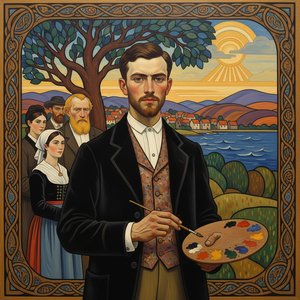
Jacques Alexandre Antoine Bernard (Camille Boiry): A Painter of Faithful Reality
Jacques Alexandre Antoine Bernard, better known as Camille Boiry, emerged from the vibrant artistic landscape of Paris in 1888, inheriting a lineage steeped in royal heritage – his father, Laure-Theresa Cros-Bernard, was the fourth sovereign of Araucania and Patagonia. This aristocratic upbringing undoubtedly instilled within him an appreciation for tradition and meticulous observation, qualities that would become hallmarks of his distinctive artistic style. His formal training commenced at the École Nationale des Beaux-Arts in Paris, where he honed his skills under the tutelage of Léon Bonnat and Ernest Laurent, absorbing the stylistic precepts of Impressionism and Realism alike. Bonnat’s influence championed classical ideals while Laurent encouraged experimentation with color and form—a synthesis that proved crucial to Boiry's artistic evolution. The École instilled in him a disciplined approach to technique and fostered an understanding of art history’s grand narratives. He diligently studied the works of masters like Ingres and Raphael, absorbing their compositional principles and mastering their use of chiaroscuro – techniques that would inform his own oeuvre. Boiry swiftly gained recognition at the Salon des Artistes Français, securing prestigious awards including the Prix Colonial du Maroc in 1920 and a Medal of Honor in 1922. These accolades validated his commitment to capturing the essence of observed subjects with unwavering accuracy—a characteristic that would define his oeuvre. Notably, he was placed in hors-concours, signifying recognition beyond the established Salon hierarchy, demonstrating an acceptance by critics and fellow artists who acknowledged his exceptional talent. His dedication to portraying reality with uncompromising honesty resonated deeply within the artistic community of his time. His artistic vision centered on translating nature onto canvas with remarkable fidelity. Boiry’s paintings are characterized by a meticulous attention to detail, capturing textures and nuances that convey a profound sense of presence. He excelled particularly in pastel portraits, skillfully blending delicate hues to achieve luminous effects and conveying subtle expressions of emotion. His subjects often encompassed colonial landscapes—particularly the Moroccan countryside—and portraits of prominent figures from his era, reflecting the intellectual curiosity and artistic dynamism of the Belle Époque. Boiry’s masterful use of color and light created images that were both aesthetically pleasing and emotionally resonant. Throughout his prolific career, Boiry produced a substantial body of work encompassing landscapes, portraits, and genre scenes—each piece imbued with a palpable sense of immediacy and authenticity. He continued to refine his technique, mastering the subtleties of brushwork and achieving remarkable tonal gradations. His enduring legacy resides in his contribution to French Realist painting and his ability to convey the spirit of his time—a painter who captured not merely what he saw but also what it felt like to inhabit those moments. Boiry’s work remains admired for its unwavering commitment to truthfulness and its evocative portrayal of human experience.- Notable Achievements: He received the Prix Colonial du Maroc in 1920, recognizing his artistic merit within the context of French colonial expansion.
- Influences: Bonnat’s classical training combined with Laurent’s encouragement of experimentation resulted in a distinctive artistic style characterized by both precision and expressive nuance.