Atelier — Envío gratuito a todo el mundo — Entrega en 2–6 semanas
      John French Sloan, 1871 – 1951

      John French Sloan: Las 100 pinturas más conocidas

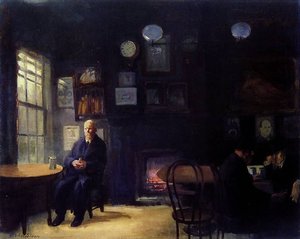
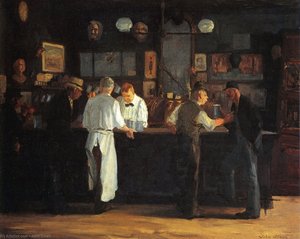
      De todas las pinturas de John French Sloan, McSorley's Bar (1912) es la más famosa; se encuentra en el Detroit Institute of Arts, Detroit. Justo detrás se encuentran The Lafayette (1927) y Estela del transbordador (1907). De las 238 obras de John French Sloan en nuestro catálogo, estas 100 son las más célebres, cada una presentada con su fecha, su museo y su historia.

      Clasificado según nuestra puntuación de popularidad, que combina las búsquedas, visitas y pedidos de cada obra. Actualizado octubre 2026. Cada pintura de esta página puede pedirse como una reproducción al óleo pintada a mano sobre lienzo de lino, o como una impresión de bellas artes, fabricada al tamaño que elija.

      Retrato de John French Sloan
      John French Sloan · 1871 – 1951
      Nacimiento · fallecimiento
      1871 – 1951, Lock Haven
      Movimiento
      Escuela ashcan
      Obras de nuestro catálogo
      238
      Las más famosas
      McSorley's Bar (1912)
      Más obras en
      The Phillips Collection

      Las 10 pinturas más célebres de John French Sloan

      McSorley's Bar (1912) de John French Sloan
      1

      McSorley's Bar

      1912 · Óleo sobre lienzo · Detroit Institute of Arts, Detroit

      El artista y su obra John Sloan, un destacado artista estadounidense, fue miembro fundador de The Eight, un grupo de pintores reconocidos por sus representaciones realistas de la vida urbana. Desempeñó un papel fundamental en la Escuela Ashcan de artistas realistas, cuyo objetivo era capturar la esencia de la ciudad de Nueva York y de sus habitantes durante los inicios del siglo XX. La pintura: McSoriente's Bar McSorley's Bar, pintada…

      Hand-painted oil reproduction from $253 35 × 28 cm
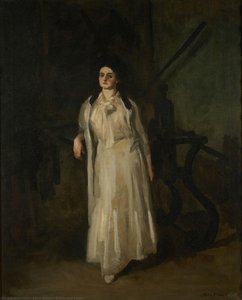
      The Lafayette (1927) de John French Sloan
      2

      The Lafayette

      1927 · Óleo sobre lienzo

      La pintura The Lafayette de John Sloan, creada en 1927, constituye una representación quintesencial de la vida urbana durante los albores del siglo XX. Esta obra al óleo sobre lienzo, que mide 77 x 91 cm, se encuentra actualmente custodiada en The Metropolitan Museum of Art en la ciudad de Nueva York.

      Hand-painted oil reproduction from $253 35 × 29 cm Same size as the original $436 91 × 77 cm Order at original size →
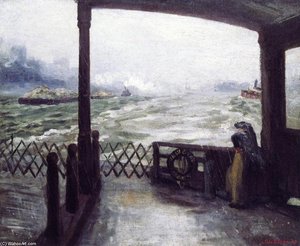
      Estela del transbordador (1907) de John French Sloan
      3

      Estela del transbordador

      1907 · Óleo sobre lienzo · Detroit Institute of Arts, Detroit

      Estar frente a Estela del transbordador es cruzar un umbral hacia un momento suspendido entre mundos: un suspiro silencioso capturado sobre la vasta e indiferente extensión del agua. Esta pintura no clama su drama; más bien, susurra secretos transportados por la bruma. La escena, capturada desde la cubierta de un transbordador, envuelve de inmediato al espectador en una atmósfera de contemplación contenida. Se puede sentir la humedad fría que emana…

      Hand-painted oil reproduction from $178 35 × 29 cm
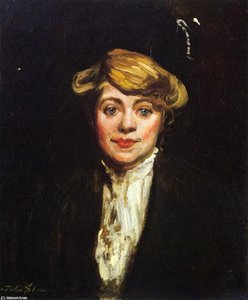
      Chica con sombrero de piel (1909) de John French Sloan
      4

      Chica con sombrero de piel

      1909 · Óleo sobre lienzo · New Britain Museum of American Art, New Britain

      Una joven emerge de una oscuridad profunda y aterciopelada, con su presencia definida por la manera en que la luz acaricia las suaves texturas de su atuendo. Se encuentra sumida en un momento de quietud, con la mirada vuelta hacia su interior, como si estuviera perdida en un pensamiento privado. La luz cae sobre su rostro con un toque suave y direccional, iluminando la calidez de su piel y los…

      Hand-painted oil reproduction from $178 28 × 35 cm
      La Cuna (1907) de John French Sloan
      5

      La Cuna

      1907 · Óleo

      En la tranquila intimidad de un dormitorio, una mujer se sienta en el borde de su cama en La Cuna. Pintada por John Sloan alrededor de 1907, la escena captura un momento privado de quietud. Ella mira hacia abajo, con la atención fija en algo invisible, mientras las suaves texturas de las sábanas blancas y las almohadas la envuelven. La atmósfera se siente cargada con el peso de un espacio…
      Hand-painted oil reproduction from $178 29 × 34 cm
      Edgar Varèse (1924) de John French Sloan
      6

      Edgar Varèse

      1924 · Óleo sobre lienzo · National Portrait Gallery, Washington, D.C.

      El aire en la habitación se siente pesado, denso por el aroma del aceite y el peso del pensamiento tácito. Un hombre se sienta ante nosotros, su presencia dominando el espacio a través de una gravedad silenciosa e intensa. Este es Edgar Varèse, capturado en un momento de profunda quietud que parece vibrar con un ritmo interno. Su cabello oscuro y ondulado enmarca un rostro marcado por la seriedad, un…

      Hand-painted oil reproduction from $178 29 × 35 cm Same size as the original $299 65 × 77 cm Order at original size →
      ¡Un Baa-Baa mecánico! (1906) de John French Sloan
      7

      ¡Un Baa-Baa mecánico!

      1906 · Acrílico · Amon Carter Museo de Arte Estadounidense, Fort Worth

      “¡Un Baa-Baa mecánico!” de John French Sloan no es simplemente la representación de una tienda de antigüedades; es una narrativa meticulosamente elaborada y congelada en el tiempo, que ofrece una ventana conmovedora hacia la creciente fascinación por la innovación industrial y los ritmos pausados de la vida cotidiana a principios del siglo XX. Pintada en 1906, durante su etapa como figura clave dentro del movimiento de la Escuela Ashcan —un…

      Hand-painted oil reproduction from $203 35 × 28 cm Same size as the original $213 41 × 32 cm Order at original size →
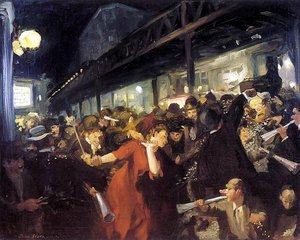
      Calle Bleecker, noche de sábado (1918) de John French Sloan
      9

      Calle Bleecker, noche de sábado

      1918 · Óleo sobre lienzo · Crystal Bridges Museum of American Art, Bentonville

      Calle Bleecker, noche de sábado es una óleo sobre lienzo pintada por John Sloan en 1918. La obra captura un momento específico de la vida urbana en un barrio de la ciudad de Nueva York. La pieza presenta una visión de la calle tal como funcionaba durante una noche de sábado, centrándose en la actividad inmediata y vibrante de la metrópolis.

      Hand-painted oil reproduction from $228 35 × 29 cm Same size as the original $361 81 × 66 cm Order at original size →

      Pinturas de John French Sloan clasificadas de 11 a 100

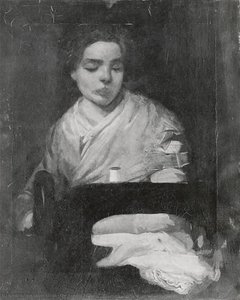
      La Costurera (1901) de John French Sloan
      #20

      La Costurera

      1901 · Metropolitan Museum of Art

      “La Mujer Cosedora” (The Sewing Woman), pintada por John French Sloan en 1901, no es simplemente una representación de una escena doméstica; es un retrato sutil y conmovedor…

      Encárgalo pintado a mano from $178 →
      Restaurante chino (1909) de John French Sloan

      Restaurante chino, de John French Sloan, pintada en 1909, es mucho más que una simple representación de una reunión; es un vibrante retrato sociológico plasmado al óleo sobre…

      Pide este lienzo from $178 →

      Los lienzos de John French Sloan, época por época

      Lo que más pintó John French Sloan

      Los cuatro temas que aparecen con mayor frecuencia en estos lienzos, cada uno con su ejemplo más emblemático.

      Dónde se exhiben los lienzos de John French Sloan

      Los 8 museos que albergan la mayoría de las pinturas de esta página.

      Museos Ciudad Obras de John French Sloan Pinturas de esta lista
      The Phillips Collection, Washington, D.C.The Phillips Collection Washington, D.C. 4 El payaso maquillándose, The Wake of the Ferry II, Six O'Clock, Winter
      Detroit Institute of Arts, DetroitDetroit Institute of Arts Detroit 3 McSorley's Bar, Estela del transbordador
      New Britain Museum of American Art, New BritainNew Britain Museum of American Art New Britain 2 Chica con sombrero de piel, Main Street, Gloucester
      Cleveland Museum of Art, ClevelandCleveland Museum of Art Cleveland 2 The Rathskeller, A Woman's Work
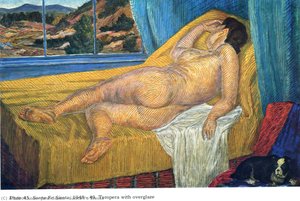
      Smithsonian American Art Museum, Washington, D.C.Smithsonian American Art Museum Washington, D.C. 2 Gwendolyn, Travelling Carnival, Santa Fe
      National Gallery of Art, WashingtonNational Gallery of Art Washington 2 Yeats at Petitpas
      National Portrait Gallery, Washington, D.C.National Portrait Gallery Washington, D.C. 1 Edgar Varèse
      Amon Carter Museo de Arte Estadounidense, Fort WorthAmon Carter Museo de Arte Estadounidense Fort Worth 1 ¡Un Baa-Baa mecánico!

      Década tras década: los lienzos más célebres de John French Sloan

      1. 1890s
      2. 1900s
        Estela del transbordador (1907) de John French Sloan
        Puesto 3 de 100

        Estela del transbordador

        Edad 29 – 38 · Detroit Institute of Arts

        Estar frente a Estela del transbordador es cruzar un umbral hacia un momento suspendido entre mundos: un suspiro silencioso capturado sobre la vasta e indiferente extensión del agua.…

      3. 1910s
        McSorley's Bar (1912) de John French Sloan
        1 de 100

        McSorley's Bar

        Edad 39 – 48 · Detroit Institute of Arts

        El artista y su obra John Sloan, un destacado artista estadounidense, fue miembro fundador de The Eight, un grupo de pintores reconocidos por sus representaciones realistas de la…

      4. 1920s
        The Lafayette (1927) de John French Sloan
        Puesto 2 de 100

        The Lafayette

        Edad 49 – 58

        La pintura The Lafayette de John Sloan, creada en 1927, constituye una representación quintesencial de la vida urbana durante los albores del siglo XX. Esta obra al óleo…

      5. 1930s
      6. 1940s
      7. 1950s

      Sus preguntas sobre las pinturas de John French Sloan, respondidas

      ¿Cuál es la pintura más célebre de John French Sloan?Leer la respuesta

      McSorley's Bar (1912), Detroit Institute of Arts, Detroit. Le siguen The Lafayette (1927) y Estela del transbordador (1907).

      ¿Qué edad tenía John French Sloan en el momento de McSorley's Bar?Leer la respuesta

      John French Sloan, nacido en 1871, tenía 41 años: McSorley's Bar data de 1912.

      ¿Cuáles son las diez pinturas más famosas de John French Sloan?Leer la respuesta

      McSorley's Bar, The Lafayette, Estela del transbordador, Chica con sombrero de piel, La Cuna, Edgar Varèse, ¡Un Baa-Baa mecánico!, Yeats at Petitpas, Calle Bleecker, noche de sábado y Self-portrait. Cada lienzo del ranking anterior incluye su año y su museo.

      ¿Cuántas pinturas de John French Sloan se conocen?Leer la respuesta

      238 obras de John French Sloan se encuentran en nuestro catálogo, con fechas desde 1890 hasta 1950.

      ¿Qué museos albergan las obras más conocidas de John French Sloan?Leer la respuesta

      Principalmente en The Phillips Collection (Washington, D.C.), Detroit Institute of Arts (Detroit) y New Britain Museum of American Art (New Britain); la lista anterior indica cada museo y sus lienzos.

      ¿En qué años pintó John French Sloan sus lienzos más célebres?Leer la respuesta

      En 1910s, que comprende 22 de las 100 obras de esta página, McSorley's Bar entre ellas.

      ¿Cuáles son la primera y la última de las famosas obras de John French Sloan?Leer la respuesta

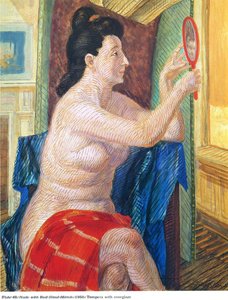
      El lienzo más antiguo aquí es Self-portrait (1890); el más reciente es Nude with Red Hand Mirror (1950).

      ¿Qué temas aparecen con más frecuencia en las pinturas de John French Sloan?Leer la respuesta

      American art (6), People (6) y Urban scene (6), en las 100 obras de esta página.

      ¿Con qué solía pintar John French Sloan?Leer la respuesta

      Óleo sobre lienzo, utilizado en 13 de las 100 obras de esta página.

      ¿A qué movimiento artístico pertenece John French Sloan?Leer la respuesta

      Escuela ashcan, como muestran los lienzos de esta página.

      ¿Qué puedo ver de John French Sloan en el The Phillips Collection?Leer la respuesta

      El The Phillips Collection, Washington, D.C. alberga 3 de las obras de esta página, entre ellas El payaso maquillándose, The Wake of the Ferry II y Six O'Clock, Winter.

      ¿Puedo encargar una copia pintada a mano de una obra de John French Sloan?Leer la respuesta

      Sí. Cada pintura de esta página puede pedirse desde su propia página como una reproducción al óleo pintada a mano, o como una impresión de bellas artes, en el tamaño que elija.

      John French Sloan: la historia del pintor

      Early Life and Artistic Awakening

      John French Sloan, born August 2, 1871, in Lock Haven, Pennsylvania, emerged from humble beginnings that profoundly shaped his artistic vision. His childhood was marked by a familial need for support; his father’s struggles with mental health necessitated young John taking on responsibilities beyond his years. This early exposure to the realities of working-class life—a world often overlooked by the established art circles—would become a defining characteristic of his oeuvre. He moved with his family to Philadelphia, where he honed his skills initially not through formal academic training, but as an assistant cashier at Porter and Coates, a bookstore brimming with prints and illustrations. This environment proved formative; it allowed him to study masters like Dürer and Rembrandt, fostering a deep appreciation for draftsmanship and etching techniques. It was here, amidst the commerce of printed images, that Sloan began creating his own art, quietly developing a style rooted in observation and meticulous detail. His early work wasn’t born from privilege or leisure, but from necessity and a keen eye for the world around him—a foundation upon which he would build a remarkable career.

      The Ashcan School and Urban Realism

      Sloan's trajectory shifted dramatically with his encounter with Robert Henri, a charismatic painter who championed artistic independence and a commitment to portraying everyday life. This connection led Sloan to the heart of what became known as the Ashcan School—a group of artists dedicated to depicting the gritty realities of turn-of-the-century New York City. Alongside William Glackens, George Luks, Everett Shinn, and others, Sloan rejected the idealized landscapes and portraits favored by many of their contemporaries, instead turning their attention to the bustling streets, crowded tenements, and vibrant social life of the city’s poorer neighborhoods. His work became a visual chronicle of this often-ignored world—capturing scenes from McSorley's Bar to women drying their hair on rooftops. Sloan wasn’t merely documenting; he was imbuing these scenes with a sense of empathy and dignity, elevating the lives of ordinary people onto the canvas. He possessed an uncanny ability to capture the *essence* of neighborhood life, the subtle gestures and fleeting moments that revealed the character of a place and its inhabitants. This commitment to realism wasn’t simply aesthetic; it was also informed by his socialist leanings, though he always maintained a distinction between his art and his political beliefs.

      Style and Influences

      Sloan's artistic style is characterized by a distinctive blend of influences. While rooted in realism, his work wasn’t devoid of stylistic nuance. He employed dark, rich hues—often emphasizing the contrast between light and shadow—to create a sense of drama and atmosphere. His compositions were carefully constructed, often utilizing strong diagonals to draw the viewer's eye into the scene. The influence of etching is evident in his precise linework and attention to detail, even in his paintings. Beyond Henri, Sloan drew inspiration from European masters like Edgar Degas and Honoré Daumier, admiring their ability to capture movement and social commentary. However, he forged a uniquely American voice, one that resonated with the energy and dynamism of New York City. His work wasn’t about grand narratives or historical events; it was about the small moments, the everyday experiences that constituted the fabric of urban life. He found beauty in the mundane, transforming ordinary scenes into compelling works of art. Wake of the Ferry, for example, exemplifies his ability to imbue a seemingly simple scene with emotional depth and symbolic resonance.

      Legacy and Lasting Impact

      John French Sloan’s legacy extends far beyond his contributions to the Ashcan School. He was a prolific artist who worked in various mediums—painting, etching, lithography, drawing—and consistently explored themes of urban life, social justice, and human connection. His commitment to portraying the realities of working-class America paved the way for future generations of artists who sought to challenge conventional artistic norms and engage with social issues. He was a dedicated teacher, sharing his knowledge and passion with countless students throughout his career. Even as artistic tastes evolved, Sloan remained true to his vision, continuing to paint scenes that reflected his deep connection to New York City and its people. His work continues to resonate today, offering a poignant glimpse into a bygone era and reminding us of the enduring power of art to illuminate the human condition. His paintings are not merely historical documents; they are timeless portraits of life, love, and loss. Sloan’s influence can be seen in the works of subsequent realist painters and continues to inspire artists who seek to find beauty and meaning in the everyday world.