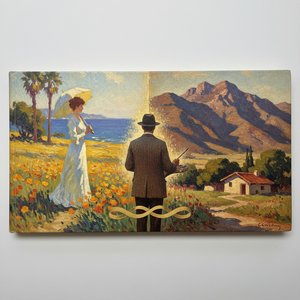
Winslow Homer: The Soul of California Landscape
Ransome Gillett Holdredge, born in San Francisco in 1836, stands as a cornerstone of the American Realist movement and particularly revered for his masterful depictions of Northern Californian landscapes. His artistic journey began amidst the burgeoning artistic fervor of the late Victorian era, shaping him into one of the most distinctive voices of his time—a painter who captured not merely visual impressions but profound emotional resonance within his canvases.
Holdredge’s formative years were steeped in the spirit of San Francisco's bohemian culture, where he befriended luminaries like Charles Warren Stowdard and Robert Louis Stevenson. This environment fostered an appreciation for observation, experimentation, and a willingness to confront difficult truths about human experience—qualities that would permeate his oeuvre throughout his life. Notably, he was involved in the establishment of the San Francisco Art Association, demonstrating a commitment to artistic collaboration and furthering the advancement of Californian art.
A pivotal moment arrived in 1874 when Holdredge embarked on a transformative expedition to Paris, fueled by ambition and guided by influential mentors. During his two-year sojourn, he immersed himself in European artistic traditions—particularly the Barbizon School and Hudson River School—absorbing techniques that would profoundly impact his subsequent style. The influence of Eugène Boudin, whose seascapes championed atmospheric perspective and a sensitivity to natural light, proved especially significant, establishing Holdredge’s enduring fascination with maritime subjects and informing his distinctive approach to landscape painting. He meticulously studied the works of Gustave Courbet and Jean-François Millet, absorbing their unflinching realism and commitment to portraying everyday life—principles that would become central to Homer's artistic vision.
Returning to America with renewed artistic vigor, Holdredge dedicated himself to documenting the rugged beauty of the Western United States. From Utah’s towering peaks to Yosemite Valley’s majestic granite cliffs and the sprawling expanse of the Sierra Nevada mountains, he tirelessly traveled across the region, meticulously observing and translating its grandeur onto canvas. His expeditions weren't merely aesthetic pursuits; they were undertaken with a deep respect for Native American cultures—Holdredge often lived alongside tribes like the Paiute and Washoe, gaining invaluable insight into their traditions and incorporating elements of their worldview into his artwork. He sought to convey not just what he saw but also how it felt—the solitude of the wilderness, the challenges faced by pioneers, and the enduring spirit of resilience.
Holdredge's artistic output spanned decades, producing iconic paintings that continue to captivate audiences today. Works such as “Undertow,” “Canoe in the Rapids,” and “Hunter in the Adirondacks” exemplify his signature style—characterized by bold brushstrokes, luminous color palettes, and a masterful rendering of texture and light. He skillfully employed techniques honed during his Parisian studies, prioritizing atmospheric perspective and capturing fleeting moments of natural drama with unparalleled immediacy. His paintings are held in prestigious collections across the nation, including the Shumate Collection of California Art, the de Young Museum, and the Harrison Gray Otis Huntington Gallery, cementing his legacy as a pivotal figure in American art history. Holdredge’s enduring influence can be seen not only in his own artistic achievements but also in the broader trajectory of landscape painting—inspiring generations of artists to strive for authenticity and emotional depth.