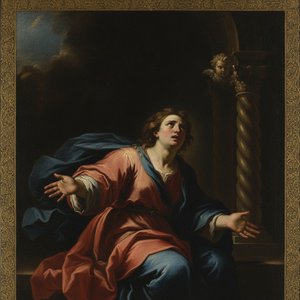
Francisco de Zurbarán (1598-1664): The Spanish Caravaggio
Francisco de Zurbarán stands as one of Spain’s most compelling Baroque masters, a painter whose austere vision and dramatic use of light transformed religious subjects into profound meditations on faith and devotion. Baptized on November 7, 1598, in Fuente de Cantos, Extremadura, and passing on August 27, 1664, in Madrid, Zurbarán earned the nickname “Spanish Caravaggio” for his masterful command of chiaroscuro—a technique borrowed from Michelangelo Caravaggio that employed dramatic contrasts between light and shadow to create a sense of drama and emphasize the emotional intensity of his subjects. His paintings of monks, nuns, martyrs, and saints, and for his striking still lifes, capture the spiritual fervor of Spain’s Golden Age with an immediacy that continues to resonate with collectors today.
Early Life and Artistic Formation
Born in Fuente de Cantos, Extremadura, to Luis de Zurbarán, a haberdasher, and Isabel Márquez, young Francisco showed artistic inclination from childhood, imitating objects with charcoal. Recognizing his son’s talent, his father sent him to Seville in 1614 to apprentice for three years with Pedro Díaz de Villanueva, an artist of whom very little is known today.
The Seville Period: Establishing a Singular Style
By 1614, Zurbarán had established himself in Seville, a vibrant cultural hub and the gateway to Spain’s vast American colonies. He quickly rose to prominence, establishing a successful workshop and attracting numerous commissions, primarily for religious paintings intended for churches, monasteries, and private devotional use. This period witnessed the full flowering of his signature style—a compelling blend of stark realism and intense spirituality. His early works already showcased a masterful command of *tenebrism*, employing dramatic contrasts between light and shadow to create a sense of drama and emphasize the emotional intensity of his subjects. The influence of Juan Sánchez Cotán, known for his austere still lifes and precise realism, is also evident in Zurbarán’s formative years—a testament to the artistic traditions prevalent in Seville at the time.
Master of Tenebrism and Religious Devotion
Zurbarán's artistic prowess lay in his ability to transform religious narratives into powerfully moving visual experiences. He became renowned for his depictions of monks, nuns, martyrs, and saints—figures often portrayed in moments of profound contemplation or suffering. His *Immaculate Conception* (c. 1635), housed in the Museo de Bellas Artes in Bilbao, exemplifies this mastery; the Virgin Mary is depicted with serene dignity, bathed in ethereal light against a dark background, conveying both purity and divine grace. Similarly, his *Agnus Dei* (c. 1640), now part of the Metropolitan Museum of Art collection, presents a poignant image of Christ as the sacrificial lamb, radiating an aura of solemnity and sacrifice. The *Sudarium of St Veronica*, with its haunting depiction of the veil bearing the imprint of Christ’s face, showcases his exceptional control over tenebrism and emotional depth.
Royal Patronage and Lasting Legacy
Around 1630, Zurbarán achieved a significant milestone in his career when he became a court painter to Philip IV. This appointment brought him increased recognition and access to royal commissions, further solidifying his reputation as one of Spain’s leading artists. However, despite this success, his popularity waned somewhat in later years with the rise of different artistic tastes. The economic hardships facing Spain during the mid-17th century also impacted his ability to secure large-scale projects. Nevertheless, Zurbarán continued to work diligently, adapting his style and exploring new themes. His influence on Spanish Baroque art is undeniable; his dramatic use of chiaroscuro and his focus on religious subjects inspired generations of artists. A circle of followers, known as the “Zurbaranistas,” emerged, continuing to push the boundaries of tenebrism and explore the expressive possibilities of light and shadow. Though he passed away in 1664, Francisco de Zurbarán left behind a rich artistic legacy that continues to be celebrated today—a master of religious art whose works continue to resonate with viewers centuries later.



 Eelvaade
 Lülita trükile
 Saada
Saada Jaga
Jaga
 Teave teose kohta

 Laadi alla
 Sarnased teosed
 Röntgenuuring
 Slaidietendus

 Loe lähemalt






































 Klaasivalik on saadaval ainult suuruses kuni 110 cm