




The 30-second answer
Impressionism is named after an insult, and a pretty vicious one at that. In 1874, a Paris art critic named Louis Leroy wrote a scathing review of an independent exhibition, mocking one painting in particular — Claude Monet's harbor scene, titled simply Impression, Sunrise — as unfinished sketchwork barely worthy of the name "painting." He sarcastically titled his review "The Exhibition of the Impressionists," meaning it as a joke at the artists' expense. The artists in that show, including Monet, Renoir, and Degas, liked the label enough to keep it, the way a boxer keeps a ring name a sports writer invented to mock him. As a technique, Impressionism means painting quickly, in visible, separate strokes of color, often outdoors and in a single sitting, to catch how a scene looks in one specific moment of light — rather than the smooth, invisible-brushwork finish that painting schools of the time demanded, like table manners for a canvas.
1. The review that named a movement
On 25 April 1874, the critic Louis Leroy published a review in the satirical Paris newspaper Le Charivari, titled "The Exhibition of the Impressionists" — a title he meant purely as a dig. Writing about Monet's painting Impression, Sunrise (1872), Leroy said, more or less: "Impression — I was certain of it. I was just telling myself that, since I was impressed, there had to be some impression in it… and what freedom, what ease of workmanship! Wallpaper in its embryonic state is more finished than that seascape."
His complaint was specific, and honestly not stupid on its own terms: the painting looked, to his eye, like a rough sketch — a first "impression" jotted down before the real work of finishing a picture had even begun. Academic painting of the time prized a smooth, polished, invisible-brushwork finish, the kind where you couldn't tell a hand had ever touched the canvas; Leroy was accusing Monet of exhibiting a homework draft and calling it the final essay.
The artists in that 1874 exhibition — which included Monet, Renoir, and Degas, none of whom had been accepted into the official state-run Salon that year — took the insult and kept it, like a nickname a bully gave you that you decide to make your own. What Leroy meant as a dismissal became the name the painters themselves adopted, and the one the world has used ever since. He tried to bury them with a word. They wore it as a uniform.
2. What the technique actually is — four things to look for
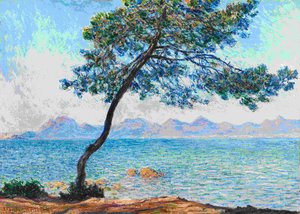
Strip away the name and the anecdote, and Impressionism describes a specific, practical way of painting, developed to solve one exact problem: how to catch the way light and color actually look at a fleeting moment, rather than how convention insisted a finished picture ought to look.
| Feature | What it looks like | Why it's there |
|---|---|---|
| Visible, separate brushstrokes | Individual dabs or strokes of color remain visible rather than blended smooth | Painted quickly, often in one sitting, with no time to blend — and left that way deliberately |
| Broken color | Colors are laid side by side rather than pre-mixed — a shadow might be dabs of blue and violet rather than one flat grey | The eye blends adjacent colors at a distance, producing a livelier, more luminous effect than a flat mixed tone |
| Everyday, unposed subjects | Ordinary landscapes, harbors, cafés, dancers rehearsing, people at leisure — not mythological or historical scenes | A deliberate break from the subjects the official Salon expected and rewarded |
| Painted outdoors, from direct observation | Landscapes and light effects painted on location, not composed from memory in a studio | The only way to catch a specific, fleeting effect of light before it changed for good |
A useful test, since it's the exact comparison Leroy was making without realizing he'd made a good one: hold an Impressionist painting at arm's length, then walk up close. From across a room, the separate strokes resolve into a coherent, often startlingly luminous scene. Up close, they resolve into what looks like a rough, unfinished sketch — precisely the effect that offended Leroy, and precisely the effect the painters intended all along. He was standing in the wrong spot, and he blamed the painting for it.
Three questions worth asking
Was Monet actually offended by being called an "Impressionist"?
No — and this is the part people get wrong. The label wasn't merely tolerated, it was adopted, embraced, worn like a badge. Leroy meant the word as mockery, but the artists in the 1874 exhibition kept it as the name for their group and every subsequent exhibition, and painters including Renoir and Degas were, by most accounts, glad to wear it. It's one of the more striking examples in all of art history of a movement naming itself after the exact word its harshest critic used to try to bury it.
Is there a difference between "Impressionism" and just "loose, colorful painting"?
Yes, and it's a real difference, not a technicality. Loose brushwork alone doesn't make a painting Impressionist any more than a fast tempo makes a song jazz. The defining combination is visible unblended brushstrokes plus broken, unmixed color plus an everyday or landscape subject observed directly, usually outdoors, in a specific and fleeting light. A painting can be loosely brushed and still be academic in every other respect; Impressionism is the specific technical response to the problem of catching a moment of light before it changes, not a general looseness of style you can fake with a big brush and a deadline.
How can I tell if a painting or print is genuinely in the Impressionist style versus just "pretty and colorful"?
Check for broken color first — do the shadows and midtones look like they're built from small strokes of several different hues sitting side by side, rather than one smoothly blended tone? That single feature is the most reliable technical signature there is, and the reason is simple: it's the one hardest to fake by accident. Broken color is a deliberate compositional choice, not simply a byproduct of quick or careless brushwork. Anyone can paint fast and sloppy. Not everyone is choosing to lay blue next to violet on purpose, and know why.
Related on TopImpressionists.com
- Monet's full catalogue on TopImpressionists.com — the painting that started the whole insult, and everything he made after it stuck.
- Monet's Water Lilies — broken color at its most patient, decades past the harbor scene that got him mocked.
- Renoir on TopImpressionists.com — same insult, same exhibition, no hard feelings.
- Degas on TopImpressionists.com — the one who fought for white frames while everyone else fought for gold.
- Impressionism's Masterpieces: 10 Paintings That Defined a Movement — the technique from this article, applied across a whole movement.
- Impressionism vs. Post-Impressionism — for once you've mastered the insult and want the sequel.
Sources
- Louis Leroy — Wikipedia
- Impression, Sunrise — Wikipedia
- Impression, Sunrise — Claude Monet, Its Historical Significance — Art in Context
- Pictorial: Louis Leroy's scathing review of the First Exhibition of the Impressionists — Arthive
- Impression, Sunrise: the story of a legendary painting — Normandy Tourism
- Impression, Sunrise — painting by Claude Monet — Britannica


