Atelier — Ilmainen toimitus ympäri maailman — Toimitusaika 2–6 viikkoa
      Emil Nolde, 1867 – 1956

      The 100 Most Famous Emil Nolde Paintings, Ranked

      The best-loved painting by Emil Nolde is Sunset. Sea with Red Sky and Couple on the beach (1903) come next among the canvases readers know best. Our catalogue holds 394 works by Emil Nolde: here are the 100 most famous, each with its year, its museum and what makes it memorable.

      Sijoitus perustuu suosiotulokseemme, joka yhdistää kunkin teoksen hakuja, vierailuja ja tilauksia. Päivitetty lokakuu 2026. Each painting on this page can be ordered as an oil reproduction painted by hand on linen canvas, or as a fine art print, made to the size you choose.

      Emil Nolde muotokuva
      Emil Nolde · 1867 – 1956
      Syntynyt · kuollut
      1867 – 1956, Nolde
      Taidesuuntaus
      German expressionism
      Teokset valikoimassamme
      394
      Tunnetuimmat
      Sunset
      Eniten teoksia kohteessa
      Bavarian State Painting Collections

      Top 10 Emil Nolde paintings: the canvases everyone knows

      Sunset tekijä Emil Nolde
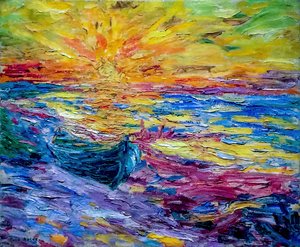
      1

      Sunset

      Oil On Canvas

      The sun hangs as a heavy, bright circle at the center of the sky, a singular eye watching the descent of the day. Below it, the atmosphere burns with shades of yellow, orange, and red, bleeding into one another to create a warm, thick air. The ocean receives this light, its waves rolling gently toward the shore in a rhythmic, quiet motion. A lone boat floats upon the water, a…

      Sea with Red Sky tekijä Emil Nolde
      2

      Sea with Red Sky

      Oil

      Sea with Red Sky is an expressionist painting by Emil Nolde. The canvas captures a moment of intense color, where the sky burns with a deep, saturated red. This work belongs to the early movements of expressionism, a style that prioritizes the internal pulse of a subject over its literal likeness. The artist sought to translate raw sensation into pigment, moving beyond the surface of the natural world to reach…

      Couple on the beach (1903) tekijä Emil Nolde
      3

      Couple on the beach

      1903 · Oil

      In "Couple on the beach" by Emil Nolde, painted about 1903, the arrangement of figures creates a quiet sense of intimacy against a vast landscape. At the center of the composition, a man and a woman stand close together. He has his arm around her, and she is dressed in a long dress. Their bodies are oriented toward the water, their gazes fixed on the horizon. This shared focus directs…

      Masks (1911) tekijä Emil Nolde
      4

      Masks

      1911 · Acrylic On Canvas · Nelson-Atkins Museum of Art, Kansas City

      Emil Nolde's "Masks," painted in 1911, isn’t merely a depiction of carnival revelry; it’s a profound exploration of identity, hidden desires, and the unsettling duality inherent within human nature. Created during his time as a key member of Die Brücke – “The Bridge” – a group pushing the boundaries of German Expressionism in Dresden and Berlin, the painting embodies the movement's core tenets: a rejection of academic realism in favor…

      Christ among the Children tekijä Emil Nolde
      5

      Christ among the Children

      Oil On Canvas

      Emil Nolde’s “Christ Among the Children” is not merely a depiction of a biblical scene; it’s an immersive experience, a visceral outpouring of emotion rendered with the raw energy characteristic of his mature style. This large-scale painting captures a moment of profound intimacy – Christ surrounded by children – yet it vibrates with a primal intensity that speaks to the core of human connection and faith. The photograph reveals a…

      The Great Gardener tekijä Emil Nolde
      6

      The Great Gardener

      The Great Gardener emerges from the brush of Emil Nolde, a man whose very name carries the weight of his birthplace. Born in 1867 in Nolde, Denmark, the artist carries the essence of his origins into every stroke. He moves through the world of color with a sense of purpose, much like the subject of this work. The painting, titled The Great Gardener, captures a moment of quiet connection within…

      Light-flooded Sea (Green) tekijä Emil Nolde
      7

      Light-flooded Sea (Green)

      Watercolor

      Light-flooded Sea (Green) is a work by Emil Nolde. This piece presents a highly stylized and abstracted seascape, stripping the horizon of its literal boundaries. The subject matter focuses on the meeting of water and sky, rendered through a lens of intense, personal feeling rather than precise representation.

      Marshy Landscape under the Evening Sky tekijä Emil Nolde
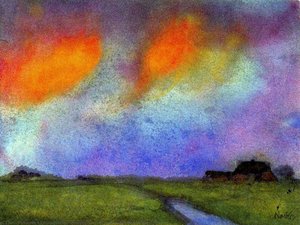
      8

      Marshy Landscape under the Evening Sky

      Watercolor

      The scene unfolds in Marshy Landscape under the Evening Sky, a work that carries the unmistakable hand of the artist Emil Nolde. This piece captures a specific, quiet moment where the land meets a heavy, atmospheric sky. The artist, Emil Nolde, was born in Nolde, Denmark, in 1867, and his connection to the natural world remains palpable in the way he approaches the canvas. He lived until 1956, leaving behind…

      Animal and Figures (1912) tekijä Emil Nolde
      9

      Animal and Figures

      1912 · Black and White Photography · Bavarian State Painting Collections, München

      A monochrome stillness settles over the scene. Two men stand in the rigid geometry of early 20th-century military attire, their forms anchored against a dark, featureless void. They are framed by a slender pedestal that divides the composition with mathematical precision. On the left, a hand rests firmly on a hip; on the right, a hand finds rest upon the stand. The fabric of their tunics, the heavy weave of…

      Anna Wieds Garden tekijä Emil Nolde
      10

      Anna Wieds Garden

      Acrylic

      Emile Nolde, a prominent German-Danish painter and printmaker, is renowned for his vibrant and expressive works of art. One of his notable pieces, Anna Wieds Garden, exemplifies the essence of Expressionism, a modernist movement that emerged in the early 20th century. This captivating oil painting is a testament to Nolde's unique style, which blends elements of Expressionism with a deep appreciation for nature. The Expressionist Style Expressionism, as described by…

      More Emil Nolde canvases, 11 to 100

      Festival Girls (1918) tekijä Emil Nolde
      #11

      Festival Girls

      1918 · Bavarian State Painting Collections

      Festival Girls is a painting by Emil Nolde, executed in 1918. The work measures 67 x 58.5 cm and is rendered on canvas. This piece was created during…

      Order this canvas →
      Nordermühle (1932) tekijä Emil Nolde
      #14

      Nordermühle

      1932 · Bavarian State Painting Collections

      is a studio portrait by the German artist Emile Nolde, dating to 1932. The work captures four individuals in a formal arrangement, presented as a monochromatic study of…

      Order this canvas →
      untitled (1534) tekijä Emil Nolde
      #15

      untitled (1534)

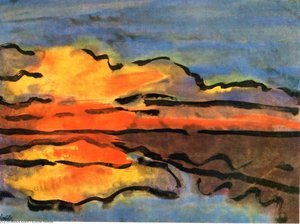
      The horizon is a wound of orange and red. Light bleeds through heavy, dark silhouettes of clouds, casting a warm glow over the quiet landscape. Below, the sand…

      Order this canvas →
      Shivering Russians (1914) tekijä Emil Nolde
      #16

      Shivering Russians

      1914 · Statens Museum for Kunst

      The painting presents two figures in a tight, cropped composition, focusing on their upper bodies as they huddle together. They are enveloped in thick, heavy clothing that obscures…

      Bring this light home →
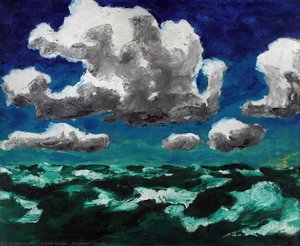
      Summer Clouds tekijä Emil Nolde
      #17

      Summer Clouds

      Summer Clouds is an expressionist work by Emil Nolde. Born in 1867 in Nolde, Denmark, the artist developed a visual language centered on intense, personal feeling and the…

      Order this canvas →
      Wild Animals (1921) tekijä Emil Nolde
      #24

      Wild Animals

      1921 · Bavarian State Painting Collections

      The work belongs to a period of intense experimentation. It reflects a shift toward the subjective, where the internal world dictates the external appearance. The textures are thick…

      Have it painted by hand →
      Autumn Sea tekijä Emil Nolde
      #25

      Autumn Sea

      Emile Nolde’s “Autumn Sea” is not merely a depiction of a seascape; it’s an immersion into the raw, untamed heart of nature itself. Painted during his most intensely…

      Have it painted by hand →
      Mills (1924) tekijä Emil Nolde
      #33

      Mills

      1924 · Bavarian State Painting Collections

      In the large-scale black and white group portrait titled "Mills" by Emil Nolde, a dense assembly of men is positioned in front of a wooden structure. The composition…

      Bring this light home →
      Robbers at Bombüll (1917) tekijä Emil Nolde
      #34

      Robbers at Bombüll

      1917 · Statens Museum for Kunst

      Robbers at Bombüll is a painting by the German artist Emile Nolde. Created in 1917, this work belongs to the Expressionist movement. The piece focuses on a group…

      Have it painted by hand →
      Mask Still Life III, (1911) tekijä Emil Nolde
      #35

      Mask Still Life III,

      1911

      The painting features five different faces on masks, each displaying unique expressions. These masks are arranged across the canvas in a specific configuration: the first face is in…

      Order this canvas →
      Kristuksen pilkkaaminen (1909) tekijä Emil Nolde
      #36

      Kristuksen pilkkaaminen

      1909

      Emil Nolden vuoden 1909 maalaus ”Kristuksen pilkkaus” ei ole pelkkä historiallinen esitys, vaan syvällinen sukellus ihmisen kärsimyksen ja psykologisen ahdingon ytimeen. Vaikka teos usein tulkitaan Raamatun kertomuksen kuvauksena,…

      Have it painted by hand →
      Kukkapaljun Poika Ja Pesijä (1908) tekijä Emil Nolde
      #37

      Kukkapaljun Poika Ja Pesijä

      1908 · Museum Kunstpalast

      Emil Nolden 1908 maalattu "Kukkamaa (Tyttö ja pesu)" on enemmän kuin pelkkä maisema; se on tunteiden ja aistien syvä immersio. Maalaus kutsuu katsojan matkustamaan eloisan kukkamaaston sydämeen, maailmaan…

      Order this canvas →
      The Blacksmith (1912) tekijä Emil Nolde
      #38

      The Blacksmith

      1912 · Statens Museum for Kunst

      is an oil painting by Emil Nolde, executed in 1912. The work emerged during a period of significant artistic transition for the creator, who was establishing a distinct…

      Have it painted by hand →
      Young Women (1947) tekijä Emil Nolde
      #69

      Young Women

      1947 · Statens Museum for Kunst

      In this work, titled Young Women, we encounter a significant piece from the later period of Emil Nolde. Painted in 1947, the canvas reflects the artist's continued engagement…

      Bring this light home →
      Large Sunflowers (1928) tekijä Emil Nolde
      #70

      Large Sunflowers

      1928 · Metropolitan Museum of Art

      The Presence of the Bloom In this 1928 oil painting on wood, the sunflowers emerge with a heavy, physical presence. There is no attempt at delicate botanical precision…

      Have it painted by hand →
      Figures and Dahlias (1919) tekijä Emil Nolde
      #71

      Figures and Dahlias

      1919 · Statens Museum for Kunst

      Emile Nolde produced Figures and Dahlias in 1919. The artist, born in 1867 in Nordel, Germany, developed a practice centered on the physical properties of his materials. His…

      Bring this light home →
      Garden path tekijä Emil Nolde
      #72

      Garden path

      A Symphony of Red: Exploring Emile Nolde’s “Garden Path” “Garden Path” by German-Danish Expressionist painter Emile Nolde is a captivating oil painting that plunges the viewer into an…

      Bring this light home →
      Masks (1911) tekijä Emil Nolde
      #79

      Masks

      1911 · Nelson-Atkins Museum of Art

      In the evocative realm of German Expressionism, few works capture the raw, unbridled energy of the human psyche quite like Emil Nolde’s Masks. Painted in 1911, this masterpiece…

      Have it painted by hand →
      Mother and Child tekijä Emil Nolde
      #80

      Mother and Child

      Mother and Child, also known by the German title Mutter und Kind, is a work by the German artist Emil Nolde. Born in 1867, Nolde remained a significant…

      Order this canvas →
      In the coffee tekijä Emil Nolde
      #82

      In the coffee

      In the coffee is a genre painting by Emil Nolde. Created in 1911, the work captures a social gathering within a cafe setting. The canvas holds a moment…

      Have it painted by hand →
      Child and Large Bird (1912) tekijä Emil Nolde
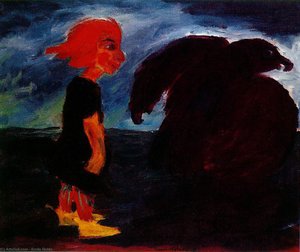
      #100

      Child and Large Bird

      1912 · Statens Museum for Kunst

      The painting Child and Large Bird by Emile Nolde is a captivating work of art that showcases the artist's unique style and technique. Created in 1912, this oil…

      Have it painted by hand →

      Emil Nolde's canvases, period by period

      What Emil Nolde painted most

      The four subjects that return most often on these canvases, each with its best-loved example.

      Where Emil Nolde's canvases hang

      Tämän sivun teoksista eniten sisältävät 7 museota.

      Museo Kaupunki Emil Nolde teokset Tämän listan maalaukset
      Bavarian State Painting Collections, MünchenBavarian State Painting Collections München 10 Animal and Figures, Festival Girls, Nordermühle
      Statens Museum for Kunst, KööpenhaminaStatens Museum for Kunst Kööpenhamina 10 Shivering Russians, Robbers at Bombüll, The Blacksmith
      Nelson-Atkins Museum of Art, Kansas CityNelson-Atkins Museum of Art Kansas City 2 Masks, Masks
      Staatliche Kunsthalle Karlsruhe, KarlsruheStaatliche Kunsthalle Karlsruhe Karlsruhe 4 At the Fountain
      Brücke Museum, BerliiniBrücke Museum Berliini 2 Ridicule (Verspottung)
      Museum Kunstpalast, DüsseldorfMuseum Kunstpalast Düsseldorf 1 Kukkapaljun Poika Ja Pesijä
      Metropolitan Museum of Art, New YorkMetropolitan Museum of Art New York 1 Large Sunflowers

      Emil Nolde's best-loved canvas of each decade

      1. 1900s
        Couple on the beach (1903) tekijä Emil Nolde
        Canvas 3 of 100

        Couple on the beach

        Ikä 33–42

        In "Couple on the beach" by Emil Nolde, painted about 1903, the arrangement of figures creates a quiet sense of intimacy against a vast landscape. At the center…

      2. 1910s
        Masks (1911) tekijä Emil Nolde
        4 of 100

        Masks

        Ikä 43–52 · Nelson-Atkins Museum of Art

        Emil Nolde's "Masks," painted in 1911, isn’t merely a depiction of carnival revelry; it’s a profound exploration of identity, hidden desires, and the unsettling duality inherent within human…

      3. 1920s
        Wild Animals (1921) tekijä Emil Nolde
        Canvas 24 of 100

        Wild Animals

        Ikä 53–62 · Bavarian State Painting Collections

        The work belongs to a period of intense experimentation. It reflects a shift toward the subjective, where the internal world dictates the external appearance. The textures are thick…

      4. 1930s
        Nordermühle (1932) tekijä Emil Nolde
        14 of 100

        Nordermühle

        Ikä 63–72 · Bavarian State Painting Collections

        is a studio portrait by the German artist Emile Nolde, dating to 1932. The work captures four individuals in a formal arrangement, presented as a monochromatic study of…

      5. 1940s
        Young Women (1947) tekijä Emil Nolde
        Ranked 69 of 100

        Young Women

        Ikä 73–82 · Statens Museum for Kunst

        In this work, titled Young Women, we encounter a significant piece from the later period of Emil Nolde. Painted in 1947, the canvas reflects the artist's continued engagement…

      About Emil Nolde's canvases: your questions answered

      What is the best-known painting by Emil Nolde?Read the answer

      Sunset, followed by Sea with Red Sky and Couple on the beach (1903).

      What are the 10 most famous paintings by Emil Nolde?Read the answer

      Sunset, Sea with Red Sky, Couple on the beach, Masks, Christ among the Children, The Great Gardener, Light-flooded Sea (Green), Marshy Landscape under the Evening Sky, Animal and Figures ja Anna Wieds Garden. Each canvas in the ranking above comes with its year and its museum.

      How many works did Emil Nolde paint in all?Read the answer

      394 works by Emil Nolde are in our catalogue, dated 1903 to 1947.

      Where can I see Emil Nolde's most famous canvases?Read the answer

      Mostly in Bavarian State Painting Collections (München), Statens Museum for Kunst (Kööpenhamina) ja Nelson-Atkins Museum of Art (Kansas City); the list above names each museum and its canvases.

      When did Emil Nolde paint the best-loved canvases?Read the answer

      In 1910s, which gave 22 of the 100 works on this page, Masks among them.

      Which are Emil Nolde's earliest and latest famous canvases?Read the answer

      The earliest canvas here is Couple on the beach (1903); the latest is Young Women (1947).

      What did Emil Nolde paint most often?Read the answer

      Sky (10), Sea (10) ja Clouds (10), across the 100 works on this page.

      Which medium did Emil Nolde paint in most often?Read the answer

      Oil On Canvas, used in 14 of the 100 works on this page.

      Which movement is Emil Nolde's painting part of?Read the answer

      German expressionism, as the canvases on this page show.

      Which Emil Nolde canvases hang at the Bavarian State Painting Collections?Read the answer

      The Bavarian State Painting Collections, München holds 7 of the works on this page, among them Animal and Figures, Festival Girls ja Nordermühle.

      Can I buy a reproduction of a Emil Nolde canvas?Read the answer

      Yes. Every painting on this page can be ordered from its own page as an oil reproduction painted by hand, or as a fine art print, in the size you choose.

      Emil Nolde: a life in paint

      Emil Nolden elämä ja identiteetti

      Hans Emil Hanseninä 7. elokuuta 1867 syntynyt mies, joka tulisi tuntemaan maailman nimellä Emil Nolde, kasvoi Schleswigin herttuakunnan Nolden kylän läheisyydessä. Hänen varhaislapsuutensa ja nuoruutensa muovautuivat hänen perheensä maaseutumaisten ja maatalousvaltaisten elämänrytmien tahdissa. Lopulta hän kuitenkin kääntyi pois tästä polusta ja valitsi urakseen puunveiston ja huonekalujen koristelun. Tämä aistillinen ja fyysinen työ loi pohjan, jolle hänen myöhempi siirtymänsä maalaamiseen ja grafiikkaan perustui. Hän otti taiteellisen nimensä suojaksi ja keinona rakentaa oma, erillinen identiteetti, joka vapautui perheensä asettamista odotuksista.

      Hänen vaikutuksensa 1900-luvun alussa oli merkitty siirtymällä kohti sisäistä ja subjektiivista kokemusta. Yhtenä ensimmäisistä ekspressionisteista hän pyrki katsomaan pintaa syvemmälle. Hänestä tuli osa Die Brücke -ryhmää, kollektiivia, jonka tavoitteena oli murtautua akateemisten perinteiden kahleista. Nolden teokset keskittyivät usein psykologiseen ja alkukantaiseen; hän käytti väriä ja muotoa tavoittaakseen jotakin paljon pelkkää ulkoista muotokuvaa syvempää. Hän oli taiteilija, joka tarkasteli maailmaa intensiivisen, henkilökohtaisen tunteen linssin läpi.

      Varhaiset vuodet ja taiteelliset alkuajat

      Syntyessään Hans Emil Hansenina hän kasvoi maatilalla Schleswigin herttuakunnassa. Hänen vanhempansa olivat tanskalaisia ja friisilisiä talonpoikia, ja maaseudun elämän rytmit muovasivat hänen varhaisia vuosiaan. Lopulta hän ymmärsi, ettei maanviljelijän elämä ollut hänen kohtalonsa. Maan raskas ja toistuva työ tuntui vieraalta hänen sielulleen; aaron sijasta, jota aura edustaa, hänen kätensä alkoivat etsiä puun syitä.

      Hän kääntyi puunveiston ammatin pariin, työskennellen materiaalin kanssa tavalla, joka vaati vakaata ja aistillista yhteyttä. Tämä fyysinen työvaihe ei ollut vain sivupolku, vaan se loi pohjan hänen tulevalle taiteelleen. Myöhemmin hän siirtyi opiskelemaan Karlsruhen ja Münchenin oppilaitoksiin, vaikka näiden instituutioiden akateemiset rajoitukset tuntuivatkin usein tukahduttavilta. Lopulta hän otti käyttöön nimen Emil Nolde – valinta, joka merkitsi irtautumista perheensä odotuksista ja ensimmäistä askelta kohti omaa, ainutlaatuista identiteettiään.

      Taiteellinen kehitys ja vaikutteet

      Hänen tapansa lähestyä kangasta oli muovautunut syvän yhteyden myötä jälkimimpressionistiseen tyyliin. Hän kääntyi Paul Gauguinin työn suuntaan ja löysi keinon liikkua pelkän esittävän kuvauksen ohi. Tämä muutos antoi hänelle mahdollisuuden keskittyä kohteen sisäiseen painoon ulkoisen ulkonäön sijaan. Hänen kiinnostuksensa luonnon maailmaa kohtaan ilmeni usein pakkomielitteisenä kukkien tutkimisena, mikä heijasti Vincent van Goghin vaikutusta. Hän ei ainoastaan maalannut puutarhaa; hän etsi sykettä terälehtien sisältä.

      Hänen polkunsa ei ollut koskaan suora viiva. Vaikka hän löysi paikkansa Die Brücke -ryhmän taiteilijoiden joukosta, hänen kiinnostuksensa vetivät häntä usein kohti erilaisia piirejä. Vuonna 1912 hän esitteli teoksiaan yhdessä Wassily Kandinskyn Der Blaue Reiter -ryhmän jäsenten kanssa. Hänen elämänsä tätä vaihetta leimasi jatkuva etsintä visuaalista kieltä, joka kykenisi kantamaan hänen havaintojensa intensiteetin. Hän vaelsi värin tutkimisen ja muodon tutkimisen välillä, etsien jatkuvasti tapaa saada maalin puhumaan jostakin muusta kuin maailman pinnasta.

      Jäsenyys Die Brücke -ryhmässä

      Vuoden 1906 alussa Emil Nolden taiteellisessa elämässä tapahtui merkittävä käännekohta, kun hänen teoksiaan esiteltiin Dresdenissä Arnoldin galleriassa. Tämä kohtaaminen avasi oven, joka johti kutsuun liittyä kuuluisaan Die Brücke -taiteilijaryhmään. Hän pysyi osana tätä kollektiivia helmikuusta 1906 aina marraskuuhun 1907 saakka. Itse ryhmä oli ollut aktiivinen Dresdenissä jo vuodesta 1905 lähtien, ja sen jäsenet pyrkivät murtamaan akateemisten perinteiden kahleet etsiessään täysin uutta ja vapaata kuvallista kieltä.

      Nolden aika ryhmän parissa oli vahvasti kytköksissä jälkimimpressionistisiin vaikutteisiin. Vaikka ryhmän jäseniä yhdisti yhteinen tavoite irtautua vakiintuneista normeista, Nolden oma taiteellinen polku säilyi omana ja erottuvana. Hän toi ryhmän yhteisiin tutkimuksiin kotiseutuunsa, Schleswig-Holsteiniin, liittyvän erityisen kiinnostuksen primitiivisten maskien ja kaiverrusten ilmaisukykyä kohtaan. Tämä Dresdenin vuosi oli ratkaiseva vaihe, joka muovasi hänen varhaista lähestymistapaansa väriin ja muotoon ennen kuin hän siirtyi kohti entistä itsenäisempää ja omaleimaisempaa taiteellista suuntaa.

      Tekniikka ja ekspressiivinen tyyli

      Nolden siveltimenjälki paljastaa syvän kiinnostuksen värin välittömään aistimukseen. Hän oli yksi 1900-luvun alun ensimmäisistä öljyväri- ja vesivärimaalareista, jotka rikkoivat rajoja siinä, miten väriä voitiin käyttää taiteellisena voimana. Hänen palettinsa nojaa usein raskaisiin, kultaisiin keltaisiin ja syviin punaisiin sävyihin. Nämä valinnat antavat maalauksen pinnalle tiettyä painoa ja läsnäoloa, tehden väreistä eläviä elementtejä pelkän koristeellisuuden sijaan. Hän ei tyytynyt aiemmissa taideperinteissä nähtyihin valon hienovaraisiin vaihteluihin, vaan valitsi suoruuden, joka asettaa kohteen tunneilmauksen sen kirjaimellisen muodon edelle.

      Vesiväristä tuli Noldelle ensisijainen väline 1930-luvulta aina kuolemaansa saakka. Hän huomasi, että tämä medium antoi hänelle mahdollisuuden siirtää ajatuksensa ja konseptinsa paperille paljon nopeammin kuin öljyväri. Tämä nopeus näkyy tavassa, jolla hän käsitteli pigmenttiä: hän loi eloisia, pohdiskelevia myrskyisiä maisemia ja loistavia kukkakuvioita. Maali liikkuu kankaalla usein kiireellisellä tavalla, vangiten valon tai sään tietyn hetken ennen sen muuttumista. Hänen maisemissaan väri ei ole vain kerros muodon päällä; se on itse muodon olemus.

      Persecution and the Nazi Regime

      Nolden ja natsihallinnon välinen suhde oli monimutkainen ja ristiriitainen. Vaikka hän oli natsipuolueen jäsen, hänen omat maalauksensa tuomittiin valtiossa. Hallinto leimasi hänen työnsä ”rappeutuneeksi taiteeksi”, mikä johti suoraan konfliktiin hänen poliittisten kantaidensa ja luovan tuotantonsa välillä. Tämä jännite johti siihen, että natsipuolue poisti museoista peräti 1 052 hänen teostaan.

      Taiteellisen toiminnan rajoitukset kiristyivät vuosien kuluessa. Vuoden 1941 jälkeen hänelle kiellettiin maalaaminen. Tämän hiljaisuuden aikana hän etsi muita keinoja pitääkseen visionsa elossa. Hän loi satoja vesivärimaalauksia, jotka hän piti piilossa, ja joihin viitataan usein nimellä ”maalaamattomat kuvat”. Nämä teokset pysyivät maailmalta piilossa samalla, kun virallinen taidemaailma kääntyi hänen tyylinsä puoleen.

      Merkittävät teokset ja taiteelliset saavutukset

      Emil Nolden siveltimenjälki tavoitteli usein kohteen olemusta suoraviivaisen ja intensiivisen värien käytön kautta. Vuonna 1912 hän loi teoksen Man, Woman and Cat, joka heijastaa hänen kiinnostustaan esineiden ja hahmojen muotoihin. Vuoteen 1917 tultaessa hänen katseensa kääntyi luonnon maailman äärelle teoksessa Blumengarten (Utenwarf). Nämä työt todistavat hänen vakaata omistautumistaan omalle, ainutlaatuiselle tapaarsitelleen maailmaa; hän käytti paksuja maalikerroksia rakentaakseen kankaalle elävän ja tekstuurisen pinnan.

      Vuosien kuluessa hänen suhteensa taiteelliseen välineeseensä muuttui. 1930-luvulta aina kuolemaansa saakka vesiväri muodostui hänen ensisijaiseksi tekniikakseen, mikä mahdollisti ajatusten siirtämisen paperille huomattavasti nopeammin kuin öljyvärillä. Tämä eloisuus on käsin kosketeltavissa vuoden 1930 vesivärimaalauksessa Stormy Sea, jossa veden liike on vangittu nopeilla ja ilmaisukkailla vedoilla. Vaikka hänet kiellettiin maalaamasta julkisesti, hän jatkoi työtään yksityisyydessä, luoden satoja salaisia vesiväriteoksia, joita hän kutsui "maalaamattomiksi kuviksi".

      Hänen myöhemmät vuotensa olivat jatkuvaa tutkimusmatkaa ihmismuodon ja muotokuvan psykologisen painoarvon äärelle. Vuonna 1937 hän loi Doppelbildnis-teoksen, kaksoismuotokuvan, joka syntyi hänen vesiväriharjoitustensa sarjasta. Nolden tuotanto säilyy todistuksena miehestä, joka käytti väriä tavoittaakseen jotakin hyvin erityistä ja sisäistä totuutta.

      • Man, Woman and Cat (1912)
      • Blumengarten (Utenwarf) (1917)
      • Stormy Sea (1930)
      • Doppelbildnis (1937)

      Perintö ja historiallinen vaikutus

      Hänen vaikutuksensa painoarvo tuntuu siinä tavassa, jolla väri sai luvan liikkua pelkän kuvailun ulkopuolelle. Murskaamalla rajoja sille, mitä kankaan pinta voi kantaa, hän oli mukana muovaamassa ekspressionismin suuntaa. Hänen työnsä irtautui menneisyyden akateemisista säännöistä ja suosi suoruutta, joka asetti sisäisen tilan ulkoisen olemuksen edelle. Tämä muutos avasi oven uudellelaiselle visuaaliselle kielelle, jossa maalin levittäminen ja sävyjen valinta palvelivat raa’an ja välittömän olemisen tunteen välittämistä.

      Hänen läsnäolonsa 1900-luvun alkuvuosikymmenten taide-elämässä auttoi luomaan esikuvan taiteilijasta yksilöllisenä äänenä, joka oli usein ristiriidassa vallitsevan poliittisen tai sosiaalisen ilmapiirin kanssa. Vaikka hänen teoksensa poistettiin julkisesta näkyvyydestä ja leimattiin "kuten" taiteeksi, hän jatkoi taiteen tuottamista yksityisesti. Tämä periksiantamattomuus varmisti, että hänen ainutlaatuinen lähestymistapansa väriin ja muotoon tunnustettaisiin lopulta merkittävänä panoksena modernille taiteelle. Hän jätti jälkeensä teoskannan, jota tutkitaan edelleen sen intensiivisyyden ja kieltäytyvyyden vuoksi mukautua aikansa odotuksiin.

      • The Mocking of Christ
      • Autumn Sea
      • Masks

      Missä hänen teoksiaan voi nähdä tänään

      Hänen jälkensä julkisissa kokoelmissa on hajanainen, mutta merkittävä polku, joka vie katsojan läpi Euroopan taidehistoriaa. Hannoverissa Sprengel Museum kätkee sisäänsä hänen vesivärilamellunsa, Stormy Sea. Matkustaessa pohjoiseen Tuksuun, Ruotsiin, Moderna Museetista löytyy teos Blumengarten (Utenwarf). Nämä teokset tarjoavat ainutlaatuisen mahdollisuuden todistaa, kuinka taiteilijan käden jälki muuntuu ja elää eri alustojen ja aiheiden välillä.

      Bremessä sijaitseva Böttcherstraße Museums säilyttää myös hänen teoksiaan, pitäen hänen läsnäolonsa elävänä saksalaisessa taidemaisemassa. Niille, jotka etsivät syvällisempää ja keskittyneempää näkymää hänen elämäänsä ja tuotantoonsa, on perustettu Nolde Stiftung Seebüll vuonna 1956. Tämä säätiö on säilynyt keskeisenä kiintopisteenä hänen perinnölleen.

      • Stormy Sea
      • Blumengarten (Utenwarf)
      Kaikki 394 teosta taiteilijalta Emil Nolde →