Atelier — Ilmainen toimitus ympäri maailman — Toimitusaika 2–6 viikkoa
      Henry Scott Tuke, 1858 – 1929

      Henry Scott Tuke's 100 Most Famous Paintings

      The Critics (1927) is the painting Henry Scott Tuke is best remembered for. Morning splendour (1921) and Summer Dreams (sketch) complete the trio of best-loved canvases. Our catalogue counts 204 works by Henry Scott Tuke. Here are the 100 most famous, with the year, the museum and the story of each canvas.

      Sijoitus perustuu suosiotulokseemme, joka yhdistää kunkin teoksen hakuja, vierailuja ja tilauksia. Päivitetty lokakuu 2026. Each painting on this page can be ordered as an oil reproduction painted by hand on linen canvas, or as a fine art print, made to the size you choose.

      Henry Scott Tuke muotokuva
      Henry Scott Tuke · 1858 – 1929
      Syntynyt · kuollut
      1858 – 1929, York
      Taidesuuntaus
      Impressionism
      Teokset valikoimassamme
      204
      Tunnetuimmat
      The Critics (1927)
      Eniten teoksia kohteessa
      Royal Cornwall Polytechnic Society

      The ten best-loved paintings by Henry Scott Tuke

      The Critics (1927) tekijä Henry Scott Tuke
      1

      The Critics

      1927 · Oil

      In this 1927 work, we find ourselves on the shores of Falmouth, caught in a quiet, luminous afternoon. The scene is one of profound stillness, where the heat of the sun seems to settle heavily upon the sand. Two young men recline on the beach, their backs to us, anchored by the sheer weight of their relaxation. They gaze toward the horizon, lost in a shared moment of repose. From…

      Morning splendour (1921) tekijä Henry Scott Tuke
      2

      Morning splendour

      1921 · Oil On Canvas

      “Morning Splendour,” painted in 1921 by the esteemed English artist Henry Scott Tuke, is a captivating depiction of youthful exuberance and seaside tranquility. This artwork transports viewers to a sun-drenched coastal scene where figures engage in leisurely activities – swimming, rowing, and simply enjoying the warmth of the morning light. More than just a picturesque view, "Morning Splendour" embodies Tuke's signature style and offers a window into early 20th-century British…

      Summer Dreams (sketch) tekijä Henry Scott Tuke
      3

      Summer Dreams (sketch)

      Oil On Panel

      Summer Dreams (sketch) is an oil on panel work by Henry Scott Tuke. This piece is categorized as a sketch, capturing a specific moment of repose. The artist, Henry Scott Tuke, was a British painter known for his figurative works and his ability to render the human form within natural settings.

      Nude Boy on Rocks (1907) tekijä Henry Scott Tuke
      4

      Nude Boy on Rocks

      1907 · Oil On Canvas

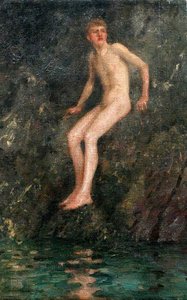
      Nude Boy on Rocks is an oil on canvas painting created by Henry Scott Tuke in 1907. The work depicts a single nude boy positioned upon rocks situated within a body of water. The subject is seated in a natural setting, appearing to look toward something located off-camera. This posture leaves the figure exposed to the elements of the coastal environment.

      Green and Gold (1920) tekijä Henry Scott Tuke
      5

      Green and Gold

      1920 · Oil On Canvas

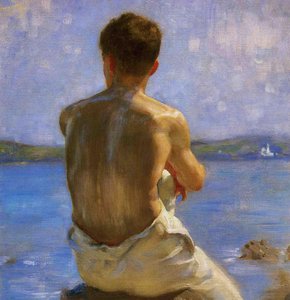
      In the gentle embrace of Henry Scott Tuke’s 1920 masterpiece, "Green and Gold," the viewer is invited to step away from the frantic pace of modern life and into a realm of profound stillness. The painting presents a scene of quiet contemplation, centered around a solitary figure seated upon rugged rocks at the water's edge. With his back turned toward us, the man becomes an avatar for the viewer’s own…

      Reefing the Mainsail (sketch) (1903) tekijä Henry Scott Tuke
      6

      Reefing the Mainsail (sketch)

      1903 · Oil

      The sea is never still, and here, the water churns in restless, muted blues and browns. A small fishing boat tosses upon the waves, caught in a moment of heavy labor under a thick, overcast sky. Onboard, a fisherman and a young boy move with the rhythmic necessity of those who live by the tides. They are focused on the task at hand, perhaps repairing equipment or securing the vessel…

      Under the Western Sun (1917) tekijä Henry Scott Tuke
      7

      Under the Western Sun

      1917 · Oil

      Under the Western Sun is a painting by Henry Scott Tuke, created in 1917. The work captures a quiet moment on a beach near the ocean, where the light of the early 20th century settles upon the shore. Two naked men occupy the scene, their forms grounded by the salt and the sand. One man stands while holding a towel, while the other is seated nearby. They exist in a…

      Nude Boy (1881) tekijä Henry Scott Tuke
      8

      Nude Boy

      1881 · Oil

      Henry Scott Tuke produced Nude Boy in 1881. This work emerged during a period when the artist was traveling through Italy, a journey that followed his formal training at the Slade School of Art in London. The piece reflects the early development of his technical approach to the human form and natural light.

      Dinner Time Ambrose Rouffignac in the Sail Loft (1883) tekijä Henry Scott Tuke
      9

      Dinner Time Ambrose Rouffignac in the Sail Loft

      1883 · Oil · Penlee House, Penzance

      The oil painting titled Dinner Time Ambrose Rouffignac in the Sail Loft was created by the artist Henry Scott Tuke. This work dates to 1883. The subject of the piece is a young boy positioned within a maritime setting. He is dressed in a blue sweater and brown pants, seated upon a wooden bench. The boy holds a small object in his hands while looking toward the viewer.

      A Holiday (1914) tekijä Henry Scott Tuke
      10

      A Holiday

      1914 · Watercolor

      Created in 1914, A Holiday is a watercolour by Henry Scott Tuke. This work captures a sense of serenity within a seaside setting, focusing on the quietude of the coast. Through his delicate application of the medium, Tuke explores the subtle nuances of light and the natural environment.

      Henry Scott Tuke: canvases 11 to 100 of the ranking

      A Bathing Group (1914) tekijä Henry Scott Tuke
      #17

      A Bathing Group

      1914 · Royal Academy of Arts

      is an oil on canvas painting by Henry Scott Tuke, executed in 1914. The work captures two young adult males positioned upon a sunlit, rocky shore. This landscape,…

      Order this canvas →
      Lord Ronald Sutherland Gower (1897) tekijä Henry Scott Tuke
      #27

      Lord Ronald Sutherland Gower

      1897 · National Portrait Gallery

      Henry Scott Tuke’s 1897 painting, “Lord Ronald Sutherland Gower,” isn't merely a likeness; it’s a carefully constructed tableau of late Victorian society. The subject himself, Lord Ronald Charles…

      Have it painted by hand →
      A sailor's yarn (1887) tekijä Henry Scott Tuke
      #44

      A sailor's yarn

      1887 · Art Gallery of New South Wales

      The oil painting titled A sailor's yarn is a work by the artist Henry Scott Tuke. This piece is also identified by the name Crotos. It was executed…

      Have it painted by hand →
      Mrs Florence Humphris (1892) tekijä Henry Scott Tuke
      #45

      Mrs Florence Humphris

      1892 · Tate Gallery

      Henry Scott Tuke's “Mrs Florence Humphris,” painted in 1892, is more than just a portrait; it’s a carefully constructed tableau of Victorian sensibility and subtle emotional depth. The…

      Have it painted by hand →
      Hermes at The Pool (sketch) (1900) tekijä Henry Scott Tuke
      #47

      Hermes at The Pool (sketch)

      1900 · Royal Cornwall Polytechnic Society

      The sun hangs heavy over a rugged, rocky landscape, casting a warm glow upon a solitary figure. A naked man sits by the edge of the water, his…

      Order this canvas →

      Henry Scott Tuke's canvases, period by period

      Late Period

      1884 – 1927 · 3 teosta tässä luettelossa

      What Henry Scott Tuke painted most

      The four subjects that return most often on these canvases, each with its best-loved example.

      Where Henry Scott Tuke's canvases hang

      Tämän sivun teoksista eniten sisältävät 8 museota.

      Museo Kaupunki Henry Scott Tuke teokset Tämän listan maalaukset
      Royal Cornwall Polytechnic Society, FalmouthRoyal Cornwall Polytechnic Society Falmouth 4 Hermes at The Pool (sketch), Jack Rolling
      Royal Academy of Arts, LontooRoyal Academy of Arts Lontoo 2 A Bathing Group
      Penlee House, PenzancePenlee House Penzance 1 Dinner Time Ambrose Rouffignac in the Sail Loft
      National Portrait Gallery, LontooNational Portrait Gallery Lontoo 1 Lord Ronald Sutherland Gower
      Yale Center for British Art, New HavenYale Center for British Art New Haven 1 Portrait of a Young Man with Open Collar
      Bavarian State Painting Collections, MünchenBavarian State Painting Collections München 1 Sailors playing cards
      Leeds Art Gallery, LeedsLeeds Art Gallery Leeds 1 The bathers
      Dublin City Gallery The Hugh Lane, DublinDublin City Gallery The Hugh Lane Dublin 1 The sun worshipper (In the morning sun)

      Henry Scott Tuke's most famous canvas, decade after decade

      1. 1870s
      2. 1880s
        Nude Boy (1881) tekijä Henry Scott Tuke
        Ranked 8 of 100

        Nude Boy

        Ikä 22–31

        Henry Scott Tuke produced Nude Boy in 1881. This work emerged during a period when the artist was traveling through Italy, a journey that followed his formal training…

      3. 1890s
        In Tow (1893) tekijä Henry Scott Tuke
        14 of 100

        In Tow

        Ikä 32–41
      4. 1900s
        Nude Boy on Rocks (1907) tekijä Henry Scott Tuke
        Canvas 4 of 100

        Nude Boy on Rocks

        Ikä 42–51

        Nude Boy on Rocks is an oil on canvas painting created by Henry Scott Tuke in 1907. The work depicts a single nude boy positioned upon rocks situated…

      5. 1910s
        Under the Western Sun (1917) tekijä Henry Scott Tuke
        7 of 100

        Under the Western Sun

        Ikä 52–61

        Under the Western Sun is a painting by Henry Scott Tuke, created in 1917. The work captures a quiet moment on a beach near the ocean, where the…

      6. 1920s
        The Critics (1927) tekijä Henry Scott Tuke
        Ranked 1 of 100

        The Critics

        Ikä 62–71

        In this 1927 work, we find ourselves on the shores of Falmouth, caught in a quiet, luminous afternoon. The scene is one of profound stillness, where the heat…

      Henry Scott Tuke's canvases, question by question

      Which canvas is Henry Scott Tuke most remembered for?Read the answer

      The Critics (1927), followed by Morning splendour (1921) and Summer Dreams (sketch).

      The Critics: how old was Henry Scott Tuke when it was painted?Read the answer

      Henry Scott Tuke, born in 1858, was 69 years old: The Critics dates from 1927.

      What are Henry Scott Tuke's ten most famous canvases?Read the answer

      The Critics, Morning splendour, Summer Dreams (sketch), Nude Boy on Rocks, Green and Gold, Reefing the Mainsail (sketch), Under the Western Sun, Nude Boy, Dinner Time Ambrose Rouffignac in the Sail Loft ja A Holiday. Each canvas in the ranking above comes with its year and its museum.

      How many paintings did Henry Scott Tuke create?Read the answer

      204 works by Henry Scott Tuke are in our catalogue, dated 1877 to 1927.

      Where do Henry Scott Tuke's most famous canvases hang today?Read the answer

      Mostly in Royal Cornwall Polytechnic Society (Falmouth), Royal Academy of Arts (Lontoo) ja Penlee House (Penzance); the list above names each museum and its canvases.

      When did Henry Scott Tuke paint the most famous canvases?Read the answer

      In 1880s, which gave 33 of the 100 works on this page, Nude Boy among them.

      Which famous Henry Scott Tuke canvas came first, and which came last?Read the answer

      The earliest canvas here is Portrait of a Youth (1877); the latest is The Critics (1927).

      Which subjects did Henry Scott Tuke paint most?Read the answer

      Water (5), Beach (5) ja Ocean (4), across the 100 works on this page.

      Which medium appears most in Henry Scott Tuke's paintings?Read the answer

      Oil On Canvas, used in 8 of the 100 works on this page.

      Which movement is Henry Scott Tuke associated with?Read the answer

      Impressionism, as the canvases on this page show.

      Which paintings by Henry Scott Tuke are held by the Royal Cornwall Polytechnic Society?Read the answer

      The Royal Cornwall Polytechnic Society, Falmouth holds 2 of the works on this page, among them Hermes at The Pool (sketch) ja Jack Rolling.

      Where can I buy a reproduction of a Henry Scott Tuke painting?Read the answer

      Yes. Every painting on this page can be ordered from its own page as an oil reproduction painted by hand, or as a fine art print, in the size you choose.

      Meet the painter: Henry Scott Tuke

      Nuoruus, perhe ja koulutus

      Henry Scott Tuke syntyi 12. kesäkuuta 1858 Yorkin Lawrence Streetille merkittävään kveekarilaiseen perheeseen. Hänen isänsä, Daniel Hack Tuke, oli arvostettu psykiatrian erikoislääkäri. Jo lapsuudesta alkaen Henry Scott Tuke sai kannustusta tarttua siveltimeen ja tutkia piirtämisen sekä maalaamisen maailmaa. Nämä varhaiset taiteelliset taipumukset alkoivat muovata hänen elämänpolkuaan jo kauan ennen varsinaista virallista taidekoulutusta.

      Vuonna 1874 muutto Lontooseen vei hänet Slade School of Art -taidekouluun, jossa hän opiskeli Alphonse Legros’n ja Sir Edward Poynter’n johdolla. Sladen opiskeluvuodet olivat teknisen osaamisen vakaata ja jatkuvaa kehittymistä. Vuoteen 1877 mennessä hän oli jo voittanut apurahaa, mikä mahdollisti opintojen jatkamisen koulussa ja avasi hänelle lopulta tien matkustaa Italiaan vuonna 1880.

      Taiteellinen kehitys Pariisissa ja Italiassa

      Lontoon alkukoulutusten jälkeen Henry Scott Tuke suuntasi kohti mannere-Eurooppaa matkustaen Italiaan vuosien 1880 ja 1881 välisenä aikana. Tämä opiskeluvuosien jakso loi vankan pohjan hänen taiteelliselle kasvulleen ennen kuin hän saapui Pariisiin vuonna 1881. Hän viipyi Ranskan pääkaupungissa aina vuoteen 1883 asti, ja tämä aika alkoi muovata syvällisesti hänen lähestymistapaansa valoon ja ulkoilmamaalaukseen. Näiden vuosien aikana hän sai opetusta ranskalaiselta historialliselta taidemaalarilta Jean-Paul Laurens.

      Asuessaan Pariisissa Tuke kohtasi Jules Bastien-Lepage -taiteilijan. Juuri tämä kohtaaminen antoi hänelle rohkeuden viedä maalaustelineensä ulos ja harjoitella en plein air -maalausta. Siirtymä suoraan luonnon äärellä tapahtuvaan maalaamiseen muutti pysyvästi tapaa, jolla hän tarkkaili ympäröivää maailmaa. Pariisin loisteliaiden vuosien aikana hän kohtasi myös amerikkalaisen taidemaalari John Singer Sargent -taiteilijan. Nämä kohtaamiset ja Pariisin ateljeista saadut opit auttoivat hienosäätämään hänen tekniikkaansa sekä syventämään ymmärrystään siitä, kuinka valo kietoutuu kohteensa ympärille ja vuorovaikuttaa sen kanssa.

      Elämä ja työnteko Newlynissä ja Falmouthissa

      Ranskan seikkailujen jälkeen Henry Scott Tuke suuntasi Cornwallin rannikolle liittyäkseen Newlyn School -taiteilijaryhmään. Tämä taiteilijayhteisö suosi en plein air -maalaamisen välitöntä luonnetta, tavoitteenaan vangita rannikon tunnelma juuri siinä hetkessä, kun se tapahtui. Vuoteen 1885 mennessä hän oli asettunut kalastajakaupunki Falmouthiin, jonka valo ja paikalliset tavat muodostuivat hänen päivittäisen elämänsä näyttämöksi. Hän jopa hankki kalastusaluksen ja muutti sen ateljeeksi – tilaksi, jossa hän saattoi työskennellä kaukana maalla sijaitsevien huoneiden perinteisistä rajoitteista.

      Meri oli läsnä Henry Scott Tuke’n elämässä jatkuvana voimana. Falmouthissa hän tutustui alastomaan merikylpyjen tapaan, käytäntöön, jota hän noudatti vielä vanhuutehinkin saakka. Tämä syvä yhteys veteen ja rannikon fyysiseen todellisuuteen muovasi hänen koko maailmankuvaansa. Hän eli kalastajien keskellä ja hengitti suolaista merisumua, löytäen oman paikkansa Cornwallin karun ja kauniin maiseman syleilystä.

      Tekniikka ja taiteellinen tyyli

      Henry Scott Tuke’n sivellin liikkuivat tietynlaisen kaksoistarkoituksen ohjaamana. Hän yhdisti impressionismin vapaan, valoa tavoittelevan siveltimenkäytön akateemisen tekniikan kurinalaisiin ja rakenteellisiin perusteisiin. Tämä lähestymistapa antoi hänelle mahdollisuuden vangita se tapa, jolla auringonvalo lankeaa iholle tai veden pintaan, menettämättä kuitenkaan aiheidensa vankkaa muotoa. Hän oli figuraalinen taiteilija, joka ymmärsi ihmiskehon painon ja massan, mutta pyrki usein sulauttamaan tämän painon osaksi ulkoilman kevyttä ilmakehää. Pariisissa vietetty aika opetti hänelle en plein air -maalaamisen arvon, tavasta, joka määritteli hänen myöhemmät vuotensa Cornwallissa.

      Hänen silmänsä ei rajoittunut vain kankaaseen. Valokuvauksena harrastavana taiteilijana hänellä oli valon ja sommittelun syvällinen ymmärrys, joka heijastui suoraan hänen maalauksiinsa. Tämä tekninen tarkkuus ulottui myös hänen merellisiin teoksiinsa. Hän oli vakiintunut meritaiteilija, joka kykeni kuvaamaan purjelaivojen ainutlaatuisia tekstuureja ja meren jatkuvaa liikettä. Olipa hän keskittynyt nuoren miehen anatomiaan tai aluksen köysistöön, hänen työnsä pysyi aina kiinni fyysisen maailman suorassa havainnoinnissa.

      Hänen tapansa käsitellä värejä heijasti usein rannikon muuttuvia olosuhteita. Hän etsi totuutta luonnonvalosta, työskennellen usein avoimessa tilassa vangitakseen kesäiltapäivän erityisen kirkkauden. Tämä keskittyminen valoon ja ihmismuotoon muodostui hänen ensisijaiseksi tavakseen nähdä maailma.

      Keskeiset teokset ja aihepiiri

      Henry Scott Tuke’n katse kohdistui usein ihmisvartaloon sen kaikkein luonnollisimmassa tilassa. Hän omisti suuren osan ajastaan alastomien poikien ja nuorten miesten maalaamiseen, sijoittaen heidät usein rannikon karuihin ja kiireettömiin maisemiin. Nämä hahmot eivät harvoin ole aseteltuja muodollisiin muotokuviin; sen sijaan heidät nähdään uimassa tai kalastamassa, joskus yksin ja joskus pienissä ryhmissä. Monet näistä aiheista esiintyvät veneissä tai rantaviivalla, ja heidän ihonsa vangitsee avoimen ilman leikkivän valon.

      Hänen työnsä tavoittaa usein hiljaisen toiminnan tunnun. Teoksista saattaa löytyä nuori mies kesken uinnin tai merimiesryhmä lepäämässä veden äärellä. Huomio pysyy ihmiskehon ja luonnonvoimien välisessä vuorovaikutuksessa – suolassa, auringossa ja meressä. Yksi hänen tunnetuimmista maalauksistaan, August Blue (noin 1893–94), ilmentää tätä valon ja nuorekkaan muodon välitöntä harmoniaa tavalla, joka määritteli suuren osan hänen tuotantoaan.

      Missä hänen teoksiaan voi nähdä tänään

      Henry Scott Tuke’n maalauksia etsiessä suuntaa kääntyy usein Lontoon merkittävien taideinstituutioiden puoleen. Tate Gallery kantaa useita hänen teoksistaan, kun taas National Portrait Gallery säilyttää hänen muotokuviaan. Nämä kokoelmat tarjoavat ainutlaatuisen mahdollisuuden nähdä, kuinka hän vangitsi ihon heijastavan valon ja meren jatkuvan liikkeen omaperäisen, lähes aistillisen linssinsä läpi.

      Cornwallissa taiteilijan läsnäolo tuntuu edelleen vahvasti paikallisissa kokoelmissa, jotka heijastavat hänen syvää yhteyttään rannikkoon. Penzancessa sijaitseva Penlee House kätkee sisäänsä teoksia, jotka kertovat hänen ajastaan tällä alueella. Hänen taidettaan voi kohdata myös Falmouthissa, Royal Cornwall Polytechnic Society -yhteisön kokoelmissa. Nämä paikat pitävät hänen ihmisvartalon ja merellisen elämän tutkimuksensa lähellä niitä ympäristöjä, jotka ne kerran inspiroivat.

      Kaikki 204 teosta taiteilijalta Henry Scott Tuke →