Atelier — Ilmainen toimitus ympäri maailman — Toimitusaika 2–6 viikkoa
      Paul Nash, 1889 – 1946

      100 kuuluisinta Paul Nash -maalausta, järjestettynä

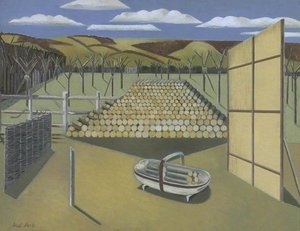
      Paul Nashn suosituin maalaus on The Separation of Light from Darkness (1924). Seuraavina listalla ovat The Stackyard (1925) ja Sunflower and sun (1942), jotka ovat lukijoiden tunnetuimpia teoksia. Katalogissamme on 111 teosta taiteilijalta Paul Nash: tässä ovat 100 kuuluisinta, jokaisesta on ilmoitettu vuosi, museo sekä se, mikä tekee teoksesta erityisen.

      Sijoitus perustuu suosiotulokseemme, joka yhdistää kunkin teoksen hakuja, vierailuja ja tilauksia. Päivitetty lokakuu 2026. Jokainen tämän sivun maalauksista on tilattavissa joko käsin maalatun öljyreproduktiona pellavalle tai valitun kokoisena taideprinttinä.

      Paul Nash muotokuva
      Paul Nash · 1889 – 1946
      Syntynyt · kuollut
      1889 – 1946, Kensington
      Taidesuuntaus
      Surrealism
      Teokset valikoimassamme
      111
      Tunnetuimmat
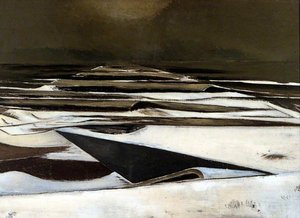
      The Separation of Light from Darkness (1924)
      Eniten teoksia kohteessa
      National Gallery of Canada

      Paul Nash parhaat 10 maalausta: teokset, jotka kaikki tuntevat

      The Separation of Light from Darkness (1924) tekijä Paul Nash
      1

      The Separation of Light from Darkness

      1924 · Woodcut

      We are looking at The Separation of Light from Darkness, a work created by Paul Nash in 1924. This piece emerged during a significant period in the artist's development, following his formative years in the United Kingdom. Nash was born in Kensington, United Kingdom, in 1889, and his perspective was shaped by the landscapes and environments of his home country.

      Landscape of the Moon's Last Phase (1944) tekijä Paul Nash
      4

      Landscape of the Moon's Last Phase

      1944 · Oil On Canvas · Walker Art Gallery, Liverpool

      Paul Nash’s Landscape of the Moon's Last Phase transports the viewer to a moment suspended between night and dawn, a breathtaking tableau dominated by the soft, yet profound, luminescence of a waning moon. This painting is more than a mere depiction of nature; it is an atmospheric meditation on cycles—the ebb and flow of light, life, and time itself. The composition draws the eye across a sweeping vista where foreground…

      Circle of the Monoliths (1938) tekijä Paul Nash
      5

      Circle of the Monoliths

      1938 · Oil On Canvas · Leeds Art Gallery, Leeds

      Paul Nash's “Circle of the Monoliths,” painted in 1938, isn’t merely a landscape; it’s a meticulously constructed dreamscape, a potent distillation of memory, myth, and the unsettling beauty of the British countryside. This remarkable work, housed at Leeds Museums and Galleries, invites viewers into a realm where familiar forms are fractured, perspectives shift, and an ancient, almost primeval energy permeates every detail. Nash, deeply influenced by William Blake’s visionary poetry…

      The Creation of the Firmament (1924) tekijä Paul Nash
      6

      The Creation of the Firmament

      1924 · Woodcut

      In this 1924 woodcut, we witness a moment of profound, almost violent transition. The work, part of a series of illustrations for the book Genesis, moves away from the figurative to explore the very mechanics of existence. It is a stark, monochromatic vision where the separation of light from darkness is rendered not as a gentle dawn, but as a rhythmic, angular tension. The composition is dominated by a series…

      The Creation of Land (1924) tekijä Paul Nash
      7

      The Creation of Land

      1924 · Woodcut

      The Creation of Land emerges from the shadows of a profound transformation. Created by Paul Nash in 1924, this work exists as a singular moment within a larger, rhythmic sequence. It belongs to a series of woodcuts that draw their strength from the biblical Genesis, capturing the very instant when the world begins to take shape through a jerky, frightening cataclysm. The landscape does not merely appear; it erupts.

      Oxford During the War (1942) tekijä Paul Nash
      8

      Oxford During the War

      1942 · Oil On Canvas · Worcester College, Oxford

      Paul Nash’s "Oxford During the War," painted in 1942, is far more than a mere depiction of an English landscape; it is a profound meditation on endurance. The canvas captures a scene steeped in the palpable tension of wartime, yet simultaneously breathes with an almost defiant tranquility. One gazes upon the foreground, drawn immediately to the imposing presence of the parked tank—a stark emblem of military reality—which anchors the composition.…

      The Diving Stage (1928) tekijä Paul Nash
      9

      The Diving Stage

      1928 · Oil On Canvas · British Council Collection, Lontoo

      The Haunting Stillness of “The Diving Stage” Paul Nash’s “The Diving Stage,” painted in 1928, isn't merely a depiction of a seaside structure; it’s a meticulously crafted tableau of isolation, anticipation, and the unsettling beauty of suspended time. Emerging from the British Council Collection, this work transcends its subject matter to become a profound meditation on human presence within a vast, indifferent landscape. The painting immediately commands attention with its…

      The Creation of the Starry Firmament (1924) tekijä Paul Nash
      10

      The Creation of the Starry Firmament

      1924 · Woodcut

      The Creation of the Starry Firmament is a significant woodcut by the British artist Paul Nash. Created in 1924, this work emerged from a period of intense creative development for the artist. It was produced as part of a series of illustrations for the book Genesis, a project that sought to visualize the biblical narrative through a modern, abstracted lens. The piece captures a moment of cosmic emergence, translating the…

      Lisää Paul Nash -kangasmaalauksia, 11–100

      Coronilla (recto) (1929) tekijä Paul Nash
      #12

      Coronilla (recto)

      1929 · Fitzwilliamin museo

      A Realm of Silent Geometry: Paul Nash’s “Coronilla (recto)” Paul Nash's "Coronilla (recto)," painted in 1929, isn’t merely a depiction of a landscape; it’s an immersion into a…

      Tuo tämä valo kotiisi →
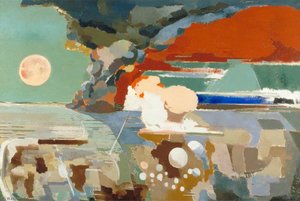
      November Moon (1942) tekijä Paul Nash
      #88

      November Moon

      1942 · Fitzwilliamin museo

      In the quietude of 1942, amidst a world gripped by the profound tensions of global conflict, Paul Nash captured a moment of profound stillness in his evocative masterpiece,…

      Tilaa tämä kangas →
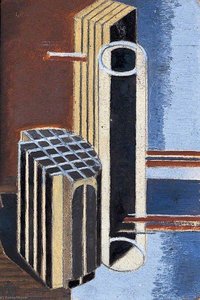
      Telecommunications (1934) tekijä Paul Nash
      #89

      Telecommunications

      1934 · Walker Art Gallery

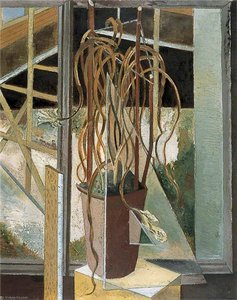
      Paul Nash’s 1934 painting, “Telecommunications,” isn’t merely a still life; it’s a carefully constructed visual argument about the burgeoning anxieties and promises of modernity. Rendered in a restrained…

      Saatko käsinmaalattuna →
      Eclipse of the Sunflower (1945) tekijä Paul Nash
      #90

      Eclipse of the Sunflower

      1945 · British Council Collection

      In the twilight of his prolific career, Paul Nash captured a moment of profound existential tension in Eclipse of the Sunflower. Created in 1945, as the shadows of…

      Tuo tämä valo kotiisi →
      Druid Landscape (1938) tekijä Paul Nash
      #91

      Druid Landscape

      1938 · British Council Collection

      Paul Nash’s Druid Landscape, painted in 1938, isn't merely a depiction of a landscape; it’s an immersion into a carefully constructed dreamscape. Created during a period of profound…

      Saatko käsinmaalattuna →
      Dymchurch Steps tekijä Paul Nash
      #93

      Dymchurch Steps

      National Gallery of Canada

      The oil on canvas titled Dymchurch Steps is a work by the British artist Paul Nash. This piece was painted and re-worked between 1924 and 1944. It measures…

      Tilaa tämä kangas →
      Chestnut Waters tekijä Paul Nash
      #94

      Chestnut Waters

      National Gallery of Canada

      Paul Nash presents Chestnut Waters, an oil on canvas that captures a specific, quiet moment in the English landscape. The work originated in 1923 and was later reworked…

      Saatko käsinmaalattuna →
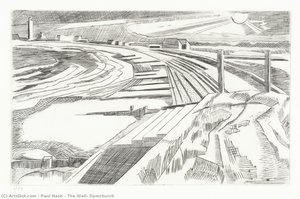
      The Wall, Dymchurch (1923) tekijä Paul Nash
      #95

      The Wall, Dymchurch

      1923 · Tate Britain

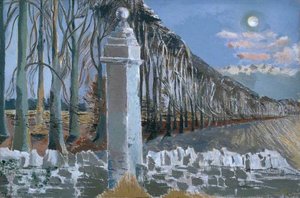
      Paul Nash’s “The Wall, Dymchurch”: A Monument to Isolation in Geometric Precision Paul Nash's "The Wall, Dymchurch," created in 1923, stands as a quintessential example of British Modernism—a…

      Tuo tämä valo kotiisi →
      Landscape (verso) tekijä Paul Nash
      #100

      Landscape (verso)

      Fitzwilliamin museo

      In the quiet corners of art history, few works capture the delicate equilibrium between the tangible world and the ethereal spirit quite like Paul Nash’s Landscape (verso). This…

      Tilaa tämä kangas →

      Paul Nash’n kankaat aikakausittain

      Mitä Paul Nash maalasi eniten

      Nämä neljä aihetta toistuvat näissä maalauksissa useimmin, ja jokaisesta on esitetty suosituin esimerkki.

      Missä Paul Nashn kankaat riippuvat

      Tämän sivun teoksista eniten sisältävät 8 museota.

      Museo Kaupunki Paul Nash teokset Tämän listan maalaukset
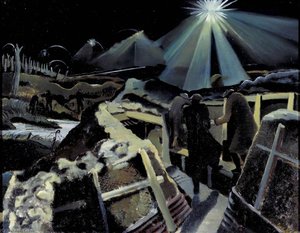
      National Gallery of Canada, OttawaNational Gallery of Canada Ottawa 9 A Night Bombardment, Void, Night Fighter
      Government Art Collection, LontooGovernment Art Collection Lontoo 5 Pink Hyacinth, Riviera Window, Cros de Cagnes, Landscape
      British Council Collection, LontooBritish Council Collection Lontoo 4 The Diving Stage, Eclipse of the Sunflower, Druid Landscape
      Leeds Art Gallery, LeedsLeeds Art Gallery Leeds 3 Circle of the Monoliths, Still Life with Bog Cotton, The Shore
      Fitzwilliamin museo, KambriaFitzwilliamin museo Kambria 3 Coronilla (recto), November Moon, Landscape (verso)
      Imperial War Museums, LontooImperial War Museums Lontoo 6 Follow the Fuhrer Above the Clouds, Battle of Germany
      Art Gallery of New South Wales, SydneyArt Gallery of New South Wales Sydney 2 Sunflower and sun, Mimosa Wood
      Walker Art Gallery, LiverpoolWalker Art Gallery Liverpool 2 Landscape of the Moon's Last Phase, Telecommunications

      Paul Nashn rakastetuin kangas vuosikymmeneltä jokaiselta

      1. 1910s
      2. 1920s
        The Separation of Light from Darkness (1924) tekijä Paul Nash
        Kangas 1 / 100

        The Separation of Light from Darkness

        Ikä 31–40

        We are looking at The Separation of Light from Darkness, a work created by Paul Nash in 1924. This piece emerged during a significant period in the artist's…

      3. 1930s
        Circle of the Monoliths (1938) tekijä Paul Nash
        5 / 100

        Circle of the Monoliths

        Ikä 41–50 · Leeds Art Gallery

        Paul Nash's “Circle of the Monoliths,” painted in 1938, isn’t merely a landscape; it’s a meticulously constructed dreamscape, a potent distillation of memory, myth, and the unsettling beauty…

      4. 1940s

      Tietoa Paul Nash -taiteilijan kankaista: vastauksia kysymyksiisi

      Mikä on Paul Nash tunnetuin maalaus?Lue vastaus

      The Separation of Light from Darkness (1924), jota seuraavat The Stackyard (1925) ja Sunflower and sun (1942).

      Kuinka vanha Paul Nash oli, kun The Separation of Light from Darkness maalattiin?Lue vastaus

      Paul Nash, syntynyt vuonna 1889, oli 35 vuotta vanha: The Separation of Light from Darkness on peräisin vuodelta 1924.

      Mitkä ovat Paul Nash 10 kuuluisinta maalausta?Lue vastaus

      The Separation of Light from Darkness, The Stackyard, Sunflower and sun, Landscape of the Moon's Last Phase, Circle of the Monoliths, The Creation of the Firmament, The Creation of Land, Oxford During the War, The Diving Stage ja The Creation of the Starry Firmament. Jokaisessa yllä olevassa sijoituksessa olevassa kankaassa on ilmoitettu sen vuosi ja museo.

      Kuinka monta teosta Paul Nash maalasi yhteensä?Lue vastaus

      Luettelossamme on 111 teosta taiteilijalta Paul Nash, aikaväliltä 1914–1945.

      Mistä voin nähdä Paul Nash'n kuuluisimmat kankaat?Lue vastaus

      Pääasiassa kohteissa National Gallery of Canada (Ottawa), Government Art Collection (Lontoo) ja British Council Collection (Lontoo); yllä oleva lista nimeää jokaisen museon ja sen teokset.

      Milloin Paul Nash maalasi rakastetuimmat teoksensa?Lue vastaus

      Aikakaudella 1920s, jolta on 35 tästä sivusta löytyvää 100 teoksesta, joukossa on The Separation of Light from Darkness.

      Mitkä ovat Paul Nash's varhaisimmat ja viimeisimmät kuuluisat maalaukset?Lue vastaus

      Varhaisin tässä kokoelmassa oleva kangas on The Orchard (1914); uusin on Solstice of the Sunflower (1945).

      Mitä Paul Nash maalasi useimmiten?Lue vastaus

      Landscape (20), Geometric shapes (8) ja British art (8), yhteensä 100 teosta tällä sivulla.

      Mitä tekniikkaa Paul Nash käytti useimmiten?Lue vastaus

      Oil On Canvas, käytetty 8 teoksessa sivun 100 teoksesta.

      Mihin taidesuuntaukseen Paul Nash's maalaus kuuluu?Lue vastaus

      Surrealism, kuten tämän sivun teokset osoittavat.

      Mitä Paul Nash -teoksia National Gallery of Canada -museossa on esillä?Lue vastaus

      National Gallery of Canada, Ottawa -museossa on 9 tämän sivun teoksista, mukaan lukien A Night Bombardment, Void ja Night Fighter.

      Voinko ostaa Paul Nash -teoksen reproduktioita kankaalle?Lue vastaus

      Kyllä. Jokainen tämän sivun maalauksista voidaan tilata omalta sivultaan joko käsin maalatun öljyreprodusktion tai taideprintinina valitsemassasi koossa.

      Paul Nash: elämä maalauksessa

      Paul Nash: Maisemien ja sodan runoilija

      Paul Nash, syntyjään John Northcote Nash, oli brittiläinen taidemaalari, jonka elämä (1889-1946) ja ura kietoutuivat syvästi sekä maiseman kauneuteen että sodan kauhuihin. Lontoon Kensingtonissa syntynyt Nash vietti lapsuutensa Iver Heathissä Buckinghamshiressa, paikka joka jätti pysyvän jäljen hänen taiteelliseen näkemyksensä. Hänen perheensä oli epätavallinen: isä lakimies ja äiti, jonka mielenterveysongelmat vaativat perheen muuttoa maaseudulle toivossa paranemisesta. Tämä varhainen kokemus vaikutti syvästi Nashin kykyyn havainnoida maailmaa sekä kauneuden että haavoittuvuuden näkökulmasta. Parsons School of Artissa ja myöhemmin Slade School of Fine Artissa saatu koulutus vahvisti hänen perinteisiä taitojaan, mutta hän kamppaili ihmiskuvien kanssa, mikä ohjasi hänet kohti maisemamaalauksen syvempää tutkimista. Nashin taiteellinen kehitys oli monimutkainen ja jatkuva prosessi. Hänen varhaiset työnsä heijastavat vahvoja vaikutteita William Blake’n ja J.M.W. Turnerin teoksista, joissa yhdistyvät romanttisen visionäärisyyden ja impressionistisen valon käsittelyn elementit. Hän löysi inspiraatiota myös muinaisista historiallisista paikoista, kuten hautakumpuista ja rautakauden linnoituksista, jotka herättivät hänessä kiinnostuksen aikaa uhmaavaa maisemaa kohtaan. Nashin tyyli alkoi vähitellen erottua, yhdistäen modernismin rohkeat värit ja geometriset muodot perinteisiin tekniikoihin. Vuonna 1928 nähnyt Giorgio de Chiricon näyttely avasi hänelle uusia ovia surrealistisen maailman suuntaan, vaikka Nash ei koskaan täysin omaksunut liikkeen dogmaattista lähestymistapaa. Hänen maisemansa muuttuivat symbolisiksi ja unenomaisiksi, joissa arkipäiväiset esineet saivat uusia merkityksiä ja luovat aavemaisen tunnelman. Ensimmäisen maailmansodan aikana Nash toimi virallisena sodan taiteilijana, kokemus joka jätti syvän jäljen hänen elämäänsä ja taiteeseensa. Hänen kuvauksensa tuhoutuneista taistelukentistä, kuten kuuluisassa teoksessaan "The Menin Road", ovat poikkeuksellisen vaikuttavia – ei niinkään glorifioivia sotatoimia, vaan pikemminkin surullisia muistomerkkejä ihmisyyden haavoittuvuudesta ja luonnon tuhoutumisesta. Toinen maailmansota synnytti Nashin tunnetun "Aerial Creatures" -sarjan, jossa lentokoneet esitetään antropomorfisina olentoina, jotka ovat pudonneet maisemaan. Nämä teokset heijastavat hänen kasvavaa huoltaan teknologian ja luonnon välisestä suhteesta sekä sodan aiheuttamasta henkisestä traumasta. Nashin taiteellinen ilmaisu oli syvällistä ja monitasoista, kykenevä vangitsemaan sekä kauneuden että kauhun ytimen. Nashin merkitys brittiläiselle modernismille on kiistaton. Hän toimi siltana perinteisen maisemamaalauksen ja modernististen esteettisten ihanteiden välillä, luoden ainutlaatuisen taiteellisen kielen, joka resonoi syvästi hänen aikalaistensa kanssa. Vuonna 1933 hän oli perustamassa Unit One -ryhmää Ben Nicholsonin ja Barbara Hepworthin kanssa, mikä vahvisti hänen asemaansa brittiläisen taideskenen keskeisenä hahmona. Nash ei ollut pelkästään maalaaja; hän oli myös arvostettu taidekirjoittaja ja suunnittelija, joka työskenteli muun muassa teatteri- ja tekstiilisuunnittelussa. Hänen vaikutuksensa ulottui laajalle, inspiroiden lukemattomia myöhempiä taiteilijoita ja jättäen pysyvän perinnön brittiläiseen taidehistoriaan. Nashin teoksia on esillä arvostetuissa kokoelmissa ympäri maailmaa, kuten Ruskin Galleryssä, Tate Britanniassa, Imperial War Museumissa ja York Art Galleryssa, todistaen hänen jatkuvaa merkitystään ja vetovoimaansa nykyisille katsojille.

      Influences and Legacy

      • Influence on Subsequent Artists: Nash's unique style and use of color influenced generations of artists who followed.
      • Connection to Romanticism: His work is often linked to the English Romantic tradition, particularly through his connection to William Blake and J.M.W. Turner.
      • Exploration of Man vs. Nature: A recurring theme in Nash's later works was the relationship between humanity and nature, explored through symbolic imagery.
      • Continued Relevance: His paintings continue to be celebrated for their beauty, symbolism, and historical significance, remaining relevant to contemporary audiences.

      Exhibitions and Collections

      • Ruskin Gallery: Nash's work has been exhibited at the Ruskin Gallery in the United Kingdom.
      • Tate Britain: His pieces can be found within the Tate Britain’s collection.
      • Imperial War Museum: Several of his war art pieces are housed in the Imperial War Museum.
      • York Art Gallery: His work is also part of the York Art Gallery's collection.
      • Government Art Collection: A selection of Nash’s artworks are displayed within the Government Art Collection.

      Kaikki 111 teosta taiteilijalta Paul Nash →