

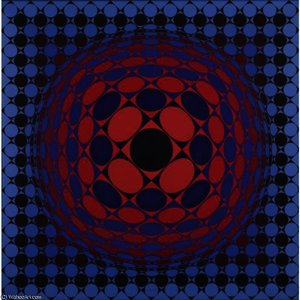
Bivega on teos, josta Victor Vasarely tunnetaan parhaiten. Quadrature ja ORION-MC täydentävät suosituimpien taideteosten kolmikon. Katalogissamme on 776 teosta taiteilijalta Victor Vasarely. Tässä ovat 100 tunnetuinta teosta vuosiluvun, museon ja jokaisen maalauksen tarinan kera.
Sijoitus perustuu suosiotulokseemme, joka yhdistää kunkin teoksen hakuja, vierailuja ja tilauksia. Päivitetty lokakuu 2026.


Victor Vasarely's *Quadrature* isn't merely a painting; it’s an invitation – an invitation to question the very nature of visual reality. Created by a visionary who anticipated the digital age, this work embodies the core tenets of Op Art, a movement that sought to manipulate perception through carefully constructed geometric forms and vibrant color fields. Painted in 1960s, *Quadrature* showcases Vasarely’s mastery of optical illusion, transforming two dynamic spheres into…

Victor Vasarely's ORION-MC is not merely a painting; it’s an invitation to experience the world through a radically altered lens. This captivating work, rendered in a vibrant palette of red, yellow, green, blue, purple, orange, and black, exemplifies the core tenets of Op Art – Optical Art – pioneered by Vasarely himself. Born Károly Vaszary in 1906 in Pécs, Croatia, his artistic trajectory began with an unexpected detour into medicine…

The artwork titled Zebras (white on black) was created by the artist Victor Vasarely. This piece features two zebras positioned against a black background. The composition includes smaller figures of animals in the background, such as two birds and three additional zebras, which contribute to the depth of the image. The visual structure utilizes geometric shapes and patterns to form the figures.

Vega-Wa-3: A Geometric Dance of Perception Victor Vasarely’s “Vega-Wa-3” isn't merely a painting; it’s an invitation into a realm where visual reality bends to the will of mathematical precision. Created in 1968, this striking artwork embodies the very essence of Op Art – Optical Art – a movement that revolutionized artistic expression during the mid-20th century and continues to fascinate audiences today. The piece immediately captivates with its bold palette:…

To stand before Victor Vasarely’s Kaglo II is to enter a realm where the boundaries between the static and the kinetic dissolve into a rhythmic dance of light and color. Created in 1986, this masterful print serves as a profound testament to the enduring power of geometric abstraction. At first glance, the eye is drawn to a central, commanding red sphere, which acts as the sun within a private cosmos.…

Victor Vasarely’s *Vega 1* isn't merely a painting; it’s an invitation. An invitation to step outside the confines of traditional representation and into a world governed by perception itself. Born in 1906 in Pécs, Croatia – then part of Austria-Hungary – Vasarely’s artistic trajectory was initially rooted in medicine before he decisively embraced the burgeoning field of visual abstraction. This pivotal shift, fueled by his studies at the Podolini-Volkmann Academy…

Victor Vasarely’s “NB 22 Caope” is more than just an abstract painting; it's a meticulously crafted portal into the heart of Op Art, a movement that sought to redefine our perception of reality. This striking work, dominated by a precisely arranged grid of black and white circles, exemplifies Vasarely’s pioneering approach to visual illusion – a technique he developed with mathematical rigor and an almost obsessive attention to detail. The…

To stand before a work by Victor Vasarely is not merely to observe paint on canvas; it is to engage in a sophisticated dialogue with perception itself. This piece, characterized by its vibrant, almost pulsating geometric network, draws the viewer into a mesmerizing optical labyrinth. It speaks directly to the intellectual curiosity of the modern collector and the design sensibility of those who appreciate art as an architectural element. The…

To stand before Harmas is to step directly into the mind of its creator, Victor Vasarely. This piece is not merely an arrangement of color and pattern; it is a vibrant intellectual puzzle, a visual meditation on structure itself. The eye is immediately drawn into the intricate dance between the bold red checks and the myriad small circles that populate the background. It possesses the undeniable energy characteristic of Op…

Victor Vasarely's Pal-Ket, painted in 1974, isn’t merely a visual experience; it’s an invitation to reconsider the very nature of perception. This vibrant acrylic on canvas piece, measuring…

Victor Vasarely's "Vonal-2" is more than just a colorful pattern; it’s a meticulously crafted portal into the heart of Op Art and a testament to the revolutionary ideas…

In this 1957 work, titled Vega II, Victor Vasarely explores the fundamental mechanics of sight. The piece is a purely abstract composition, eschewing any recognizable subject matter in…

To stand before Victor Vasarely's Axo 99 is not merely to observe a painting; it is to engage in a visual dialogue with the very mechanics of sight…

Victor Vasarely's “Abstract Composition 9” is more than just a painting; it’s an invitation to experience the world through the lens of perception itself. Created by one of…

The artwork titled Zebras was created by the artist Victor Vasarely. This piece, dated 1938, emerged from a period of intense graphic experimentation. It is considered one of…

To encounter Victor Vasarely’s Kezdi-Ga is to step away from the stillness of traditional viewing and enter a realm where the canvas breathes, pulses, and vibrates with an…

Victor Vasarely’s ‘SIR-RIS,’ a captivating sculpture rendered in meticulous black and white, stands as a cornerstone of Op Art – a movement that fundamentally challenged our understanding of…

To stand before Victor Vasarely’s "Torony-Nagy" is not merely to observe paint on canvas; it is to engage in a sophisticated dialogue with perception itself. This vibrant 1969…

Victor Vasarely's 'Quasar' is not merely a painting; it’s an invitation into the very fabric of perception, a testament to the revolutionary impact of Op Art and the…

To stand before Victor Vasarely's Zett-Ka is not merely to observe a painting; it is to step into a meticulously constructed optical puzzle. This masterful piece, a quintessential…

Victor Vasarely's "Vega-Kontosh-Va" is not merely a painting; it’s an invitation to experience the world through a radically altered lens. This vibrant composition, dominated by a pulsating red…

We are looking at Vèga 3, a significant work by the artist Victor Vasarely. Created about 1968, this piece belongs to the Op Art movement, a style that…

Zoeld V, 1967 – Victor Vasarely: A Geometric Revelation Victor Vasarely’s “Zoeld V” stands as a cornerstone of Op Art—Optical Art—a movement that revolutionized visual perception in the…

Victor Vasarely: Geometric Harmony – Exploring Abstract Composition 22 Victor Vasarely (1906–1997) revolutionized the art world with his pioneering approach to Op Art and kinetic art, establishing himself…

Sir-Ris - A Geometric Symphony of Color and Illusion Victor Vasarely’s “SIR-RIS” is more than just a painting; it's an invitation into a realm where perception bends to…

In the realm of Op Art, few works capture the hypnotic essence of visual disruption as masterfully as Victor Vasarely’s Zebras (full body white on blue-black). This striking…

Victor Vasarely's "Kezdi-All," a captivating exploration of optical illusion and geometric abstraction, stands as a cornerstone of Op Art – a movement that fundamentally challenged our understanding of…

To stand before Harmas is to step directly into the mind of its creator, Victor Vasarely. This piece is not merely an arrangement of color and pattern; it…

To encounter Victor Vasarely’s 1951 masterpiece, “Terek,” is to step away from the static world of traditional representation and enter a realm where the canvas itself seems to…

To stand before this piece is to step through a portal built entirely of color and calculated form. It is an immediate confrontation with perception itself. The composition,…

To encounter Victor Vasarely's 'Folklore' is to step away from the stillness of traditional viewing and enter a realm where the canvas begins to breathe, pulse, and vibrate…

Victor Vasarely’s “O N D - I I - V A” is more than just a painting; it's an invitation to experience the world through a radically altered…

The artwork is a grid-based abstract composition dominated by concentric circles of varying sizes and shades of red and green. It presents a highly geometric and symmetrical design,…

Victor Vasarely's "F-VERT-BLEU" is not merely a puzzle; it’s a meticulously crafted portal into the heart of Op Art, a movement that fundamentally altered our perception of space…

Victor Vasarely: Pionierin Op Art ja näkökyvyn demokratisoiminen Victor Vasarely (1906–1997) oli unkarilainen/ranskalainen taiteilija, joka muutti maailmaa geometrian avulla. Hänen työnsä ovat ikonisia Op Art -liikkeelle ja vaikuttavat…

The painting Dia-Tuz-Neg is a blue and white composition characterized by a circular pattern. At the center of the work, a large circle is prominently featured, surrounded by…

Victor Vasarely’s “Caopeo” isn’t merely a painting; it’s an invitation, a carefully constructed illusion designed to challenge and delight the viewer. Created in 1962, this seminal work exemplifies…

Sorata-T is a painted glass triptych executed in 1953. The work is composed of three panels:

The artwork Triond features three colorful balls presented in various shades of blue, purple, pink, and green. These spheres are arranged in a triangular formation, with one ball…

Step closer to observe how the eye begins to move across the surface of Domb-B. At first glance, your attention is drawn to that central blue and yellow…

VP-115 by Victor Vasarely exists as a precise study in the mechanics of sight. The work operates through a calculated arrangement of geometric shapes, specifically a sphere and…

Victor Vasarely's 'Jong,' completed in 1968, is more than just an image; it’s an invitation to question the very nature of reality. This arresting work, a cornerstone of…

The artwork consists of four circles arranged in a square configuration. Each circle is assigned a specific color: blue, orange, yellow, and purple. These shapes are positioned at…

To encounter Victor Vasarely’s “Obor” is to step away from the stillness of traditional viewing and enter a realm where the canvas itself seems to breathe, pulse, and…

Victor Vasarely (1906–1997) oli yksi modernin taiteen keskeisistä henkilöistä, jonka työ muutti käsitystä siitä, mitä abstrakti taide voi olla. Hänen ION 6-6 -teoksensa ei ole pelkästään kaunis värien…

A Dance of Circles on Crimson: Exploring Victor Vasarely's "Untitled 16" Victor Vasarely, a name synonymous with Op Art and kinetic abstraction, gifted the world a visual language…

Tridem K – A Geometric Revelation by Victor Vasarely Victor Vasarely (1906-1997) stands as an undisputed titan of Op Art, a movement that revolutionized visual perception in the…

The artwork Louisiana features a symmetrical, circular design composed of numerous small, overlapping circles in varying shades of red, orange, and brown. A blue grid subtly underlies the…

A Symphony of Geometry: Exploring Victor Vasarely's "Sikra-Z" Victor Vasarely, a name synonymous with Op Art and kinetic art, dedicated his life to unraveling the mysteries of perception…

Victor Vasarely oli yksi Op Artin ja liikkeen taiteen keskeisistä pioneereista. Hän ei pelästellä mielikuvan tutkimista ja luomaan visuaalisia kokemuksia, jotka vangitsevat katsojan huomion ja haastavat hänen havaintojaan.…

Victor Vasarely (1906–1997), a Hungarian-French artist, stands as an undisputed titan of Op Art – Optical Art – and arguably the progenitor of kinetic art. His groundbreaking approach…

Neljä ympyrää: Op Artin geometria ja liikkeen illuusio Op Art eli optinen taide on vuosien varrella kiehtonut niin katsojia kuin taiteilijoitakin. Tämä tyylisuunta syntyi 1960-luvulla, mutta sen juuret…

A Dance of Light and Geometry: Unveiling Victor Vasarely’s “Untitled 18” Victor Vasarely's "Untitled 18" isn’t merely a painting; it’s an invitation to step into a world where…

Victor Vasarely (1906–1997) stands as an undisputed titan of Op art, a movement that irrevocably altered the landscape of 20th-century visual culture. Born Győző Vásárhelyi in Pécs, Hungary…

KALOTA T is an artwork created by the artist Victor Vasarely. Born in 1906 and passing away in 1997, the French/Hungarian artist developed a visual language centered on…

Victor Vasarely's "Sikra," painted in 1966, is more than just a colorful composition; it’s a meticulously crafted portal into the heart of Op Art and a testament to…

Victor Vasarely's "Dia-Or" is not merely a painting; it’s an invitation into the very fabric of perception. This captivating work, rendered in oil with meticulous attention to detail,…

To encounter Victor Vasarely's “Mahn” is to step into a realm where the canvas ceases to be a static surface and begins to breathe, pulse, and vibrate with…

Victor Vasarelyn Maailma Geometrian Keskuudessa Victor Vasarely oli yksi 1920-luvun keskiössä ollut vaikuttava taiteilija, jonka työ määrittelee Op Artin – eli Optista Taidetta – kehittäjänä. Hän syntyi Pécsissä…

To encounter Victor Vasarely’s Caribe Negatif is to step away from the stillness of traditional viewing and enter a realm where the canvas breathes, vibrates, and dances before…

To encounter Victor Vasarely's “Tomor” is to step away from the static world of traditional imagery and enter a realm where the canvas itself seems to breathe, pulse,…

Victor Vasarely's Rhombus-B is more than just a painting; it’s an invitation to question the very nature of visual perception. Created by one of the foremost figures in…

Victor Vasarely's "Sreeh" is more than just a painting; it’s an invitation into the heart of Op Art, a visual exploration of perception itself. This striking work, dominated…

Victor Vasarely's "Hetta," a deceptively simple composition of four vibrant circles – red, orange, green, and blue – is far more than just an abstract arrangement. It’s a…

Victor Vasarely's *Opus 2604* is not merely a painting; it’s an invitation to question the very nature of visual reality. This mesmerizing work, dominated by a vibrant blue…

This vibrant artwork, designated VY-47-C, is a captivating embodiment of Victor Vasarely's groundbreaking contributions to Op Art and his pioneering exploration of geometric abstraction. Executed with a masterful…

Vega-EG: A Dance of Spheres – Exploring Victor Vasarely’s Geometric Vision Victor Vasarely (1906–1997), hailing from Pécs, Croatia, stands as a monumental figure in the realm of Op…

Guimen – Een Symfonie van Geometrie en Licht Victor Vasarely’s Guimen is een kunstwerk dat voortkomt uit een fascinatie voor de manier waarop het oog werkt, een obsessie…

Victor Vasarely's "Molnar" is more than just a painting; it’s an invitation into the mesmerizing world of Op Art, a realm where perception itself becomes the subject. This…

Victor Vasarely's Folkokta is more than just a colorful arrangement of squares; it’s a meticulously crafted portal into the heart of Op Art and a testament to the…

Victor Vasarely: Pionir Op Art i demokratizacija vizuelnog iskustва Victor Vasarely (1906–1997) bio je umetnik koji je revolucionarno promenio pogled na umetnost svojim geometrijskim pristupom i fokusom na…


Victor Vasarely's "Andromeda" isn't merely a painting; it’s an invitation into a realm where perception itself becomes the subject. This striking composition, dominated by a meticulously rendered geometric…

Victor Vasarelyn Geometrian Lumous Sinfonia Victor Vasarely oli yksi 1900-luvun keskeisistä taiteilijoista, jonka uraauurtava työ Op Art -taiteessa ja liikkuvassa kuvissa muutti käsityksenä siitä, miten ihmisen näköjärjestelmä vastaanottaa…
Victor Vasarely's "Versakk" is not merely a painting; it’s an invitation, a carefully constructed illusion that challenges our very perception of space and form. Created by the Hungarian…

Victor Vasarely's DVA-DVA is more than just a colorful square; it’s a meticulously crafted portal into the heart of Op Art and a testament to the revolutionary approach…

Victor Vasarelyn Maailma Geometrian Keskuudessa Victor Vasarely oli yksi 1920-luvun lopulla ja 1930-luvun alussa kehitettyyn Op Art -taiteeseen kuuluneista merkittävimmistä henkilöistä. Tämä innovatiivinen tyyli keskittyi käyttämään geometrisiä muotoja…

Victor Vasarely: Koska Kar – A Geometric Dance of Perception Victor Vasarely (1906–1997) was a Hungarian-born Swiss artist who irrevocably changed the landscape of modern art with his…


Koentoesh – A Geometric Dance of Color Victor Vasarely’s “Koentoosh” isn't merely a painting; it’s an invitation into a realm where perception bends and color explodes in harmonious…

To encounter Victor Vasarely’s Tridim is to step into a realm where the boundaries of the two-dimensional canvas dissolve, replaced by a pulsating, architectural depth that defies the…

Koska-Pint: A Geometric Dance of Color and Illusion Victor Vasarely’s Koska-Pint is more than just a painting; it's an invitation into the mesmerizing realm of Op Art –…


Victor Vasarelyn geometrinen lumo ja Op Artin pioneeri Victor Vasarely (1906–1997) oli unkarilainen-ranskalainen taiteilija, joka tunnetaan laajalti Op Art -liikkeeseen johtajana ja sen keskeisenä henkilönä. Hänen työnsä "Ääni"…

Illik: A Kaleidoscope of Geometric Harmony Victor Vasarely’s “Illik” stands as a cornerstone of Op Art—Optical Art—a movement that revolutionized visual perception in the mid-20th century and continues…

“MEH2,” a captivating work by Hungarian artist Victor Vasarely, is more than just a painting; it's an invitation to explore the very nature of visual perception. Executed in…

Victor Vasarely's Vega-Fel is not merely a painting; it’s an invitation to experience the world through a radically altered lens. This captivating work, dominated by a monumental blue…

Victor Vasarely's "Attam" is more than just a painting; it’s an invitation into the very heart of perception, a testament to the revolutionary impact of Op Art and…

To encounter Victor Vasarely’s “Sikra” is to step away from the stillness of traditional viewing and enter a realm where the canvas breathes, pulses, and vibrates with an…

Victor Vasarely's "Atelier Arcay" isn’t merely a painting; it’s an invitation to a perceptual adventure. Created in the heart of the Op Art movement, this vibrant geometric abstraction…

Victor Vasarelyn geometrinen lumo: Täydellinen Op Art -painos Victor Vasarelyn työ tuo esiin maailman geometrian ja liikkeen harmonisen yhteyden. Tämä abstrakti komposiitio 5 on todiste siitä, kuinka yksinkertaiset…

Victor Vasarely's Composition 7 is more than just a colorful painting; it’s a portal into the heart of Op Art and a testament to the revolutionary ideas of…

Victor Vasarely’s "Variációk" (Variations), created in 1989, is more than just an arrangement of circles; it's a vibrant exploration of perception and the underlying mathematical order that governs…

A Dance of Geometry and Color: Exploring Victor Vasarely's "Abstract Composition 13" Victor Vasarely, a name synonymous with Op Art and kinetic art, gifted the world a visual…

Victor Vasarely's Firaxo II is more than just a colorful textile; it’s a meticulously constructed portal into the heart of Op Art and a testament to the revolutionary…

A Symphony in Black: Exploring Victor Vasarely's Serigraph Victor Vasarely’s serigraphy in black is more than just an image; it’s an experience, a visual puzzle that invites the…

“Vonal-Fegn,” created by Victor Vasarely, is more than just an abstract painting; it's a meticulously crafted exploration of perception itself. Painted in hues of orange, yellow, blue, gray,…

Victor Vasarely's "Ouivar," a captivating exploration of geometric abstraction, invites the viewer into a world where perception itself becomes the subject. This artwork, characterized by its precisely arranged…

Victor Vasarely's "Abstract Composition 17" is more than just an image; it’s an invitation to experience the world anew. Born in 1906 in Pécs, Croatia – then part…
Nämä neljä aihetta toistuvat näissä maalauksissa useimmin, ja jokaisesta on esitetty suosituin esimerkki.
Tämän sivun teoksista eniten sisältävät 3 museota.
| Museo | Kaupunki | Victor Vasarely teokset | Tämän listan maalaukset |
|---|---|---|---|
 Bechtler Museum of Modern Art |
Charlotte | 4 | NB 22 Caope, SIR-RIS, Tridem K |
 Inter-American Development Bank |
Washington, D.C. | 2 | Kaglo II |
 Bilbao Fine Arts Museum |
Bilbao | 1 | Pal-Ket |
The artwork titled Zebras was created by the artist Victor Vasarely. This piece, dated 1938, emerged from a period of intense graphic experimentation. It is considered one of…
In this 1957 work, titled Vega II, Victor Vasarely explores the fundamental mechanics of sight. The piece is a purely abstract composition, eschewing any recognizable subject matter in…

Vega-Wa-3: A Geometric Dance of Perception Victor Vasarely’s “Vega-Wa-3” isn't merely a painting; it’s an invitation into a realm where visual reality bends to the will of mathematical…
Victor Vasarely's Pal-Ket, painted in 1974, isn’t merely a visual experience; it’s an invitation to reconsider the very nature of perception. This vibrant acrylic on canvas piece, measuring…

To stand before Victor Vasarely’s Kaglo II is to enter a realm where the boundaries between the static and the kinetic dissolve into a rhythmic dance of light…
Bivega, jota seuraavat Quadrature ja ORION-MC.
Bivega, Quadrature, ORION-MC, Zebras (white on black), Vega-Wa-3, Kaglo II, Vega 1, NB 22 Caope, Yon ja Harmas. Jokaisessa yllä olevassa sijoituksessa olevassa kankaassa on ilmoitettu sen vuosi ja museo.
Luettelossamme on 776 teosta taiteilijalta Victor Vasarely, aikaväliltä 1938–1986.
Pääasiassa kohteissa Bechtler Museum of Modern Art (Charlotte), Inter-American Development Bank (Washington, D.C.) ja Bilbao Fine Arts Museum (Bilbao); yllä oleva lista nimeää jokaisen museon ja sen teokset.
Aikakaudella 1960s, jolta on 10 tästä sivusta löytyvää 100 teoksesta, joukossa on Vega-Wa-3.
Varhaisin tässä kokoelmassa oleva kangas on Zebras (1938); uusin on Kaglo II (1986).
Visual perception (34), Geometric abstraction (29) ja Color field (27), yhteensä 100 teosta tällä sivulla.
Acrylic On Canvas, käytetty 41 teoksessa sivun 100 teoksesta.
Optical art, kuten tämän sivun teokset osoittavat.
Bechtler Museum of Modern Art, Charlotte -museossa on 3 tämän sivun teoksista, mukaan lukien NB 22 Caope, SIR-RIS ja Tridem K.
Károly Vaszaryna syntynyt 9. huhtikuuta 1906 Unkarin Pécsissä, mies, josta tulisi myöhemmin Victor Vasarely, aloitti polkunsa aivan eri suuntaan. Vuonna 1925 hän siirtyi Budapestin Eötvös Loránd -yliopiston saleihin opiskelemaan lääketiedettä. Ihmiskehon logiikka ja tiede täyttivät hänen ajatuksensa kaksi vuotta, mutta visuaalisen ilmaisun kutsu otti lopulta vallan. Vuoteen 1927 mennessä hän jätti lääketieteen opiskelun taakseen ja hakeutui perinteisen akateemisen maalaustaiteen pariin Podolini-Volkmannin akatemiaan.
Hänen koulutuksensa jatkui siirtyessä hän Sándor Bortnyikin műhelyyn. Tämä työpaja oli paikka, jossa Bauhaus-liikkeen periaatteet saivat juurensa, keskittyen funktionaalisen muotoilun ja geometrisen abstraktion risteyskohtaan. Täällä huomio siirtyi kohti rakenteellista ja systemaattista. Näissä studioissa opitut oppitunnit loivat pohjan hänen myöhemmille tutkimuksilleen siitä, miten muodot ja värit vuorovaikuttavat silmän kanssa.
Vuosien 1929 ja 1944 välisenä aikana Vasarely syventyi graafiseen työhön, viettäen nämä vuodet kokeillen, miten valo ja varjo kietoutuvat yhteen yksinkertaisten muotojen kanssa. Hänen varhaisen graafisen kauden tuotantoaan leimasivat teokset kuten Chess Board (1935) ja Girl-power (1934). Vuonna 1937 hän työskenteli myös teoksen Zebras parissa. Nämä työt paljastavat kasvavan kiinnostuksen sitä kohtaan, miten katsoja aistii kaksiulotteisen pinnan. Hän kääntyi pois perinteisestä maalaamisesta kohti rakenteellisempaa ja graafisempaa lähestymistapaa.
Vuosien 1944 ja 1947 välillä hänen taiteellinen suuntansa koki merkittävän muutoksen. Hän vaelsi eri tyylisuuntien halki, kokeillen kubistisia, futuristisia, ekspressionistisia, symbolistisia ja surrealistisia lähestymistapoja. Lopulta hän jätti nämä kokeilut taakseen etsiessään tarkempaa tapaa organisoida tilaa. Tämä pyrkimys kohti uutta logiikkaa johti hänet julkaisemaan keltaisen manifestinsa. Hänen työnsä muuttui yksilöllisestä ilmaisusta enemmän näkemisen mekaniikkaan keskittyväksi tutkimukseksi. Tämä systemaattinen menetelmä vakiinnutti hänet lopulta Op art -liikkeen edelläkävijäksi.
Vasarelyn lähestymistapa perustuu geometrian systemaattiseen käyttöön, jonka tavoitteena on laukaista katsojassa fyysinen reaktio. Hän ei tukeutunut perinteisiin valonlähteisiin tai klassiseen chiaroscuro-tekniikkaan muodon luomiseksi. Sen sijaan hän hyödynsi korkeakontrastisten pigmenttien hienostunutta vuorovaikutusta simuloidakseen syvyyttä ja liikettä. Manipuloimalla värien tiheyttä hän pystyi huijaamaan silmää havaitsemaan tasaisella pinnalla vetäytymistä ja työntymistä, muuttaen staattisen pinnan tilaksi, joka tuntuu turpoavan tai vetäytyvän katsojan edessä.
Hänen metodinsa, jota hän kutsui visuaaliseksi kinetiikaksi tai termillä plastique cinétique, perustuu muotojen äärimmäisen tarkkaan asetteluun. Hän käytti tekstuuriefektejä, perspektiiviä, varjoa ja valoa rakentaakseen näitä illuusioita. Teokset luottavat usein siihen, miten silmä tulkitsee rytmisen, sisäisen hehkun ulkoisen valaistuksen sijaan. Ruudukkojen ja matemaattisten periaatteiden avulla hän loi visuaalisen värinän ja pyörteisen liikkeen tuntemuksia. Lopputuloksena on liikkeen aistimus, joka elää täysin katsojan oman havainnon sisällä.
Tekniikan tarkkuus näkyy selvästi siinä, miten hän hallitsee väriä ja viivaa luodakseen arkkitehtonista syvyyttä. Teoksissa kuten Torony-Nagy, terävien valkoisten viivojen ja syvien sinisten sekä smaragdinvihreiden risteyskohta luo rytmisen optisen värinän. Nämä elementit toimivat yhdessä tuottaen sykkivän valon tuntemuksen. Hän käytti näitä työkaluja siirtyäkseen pelkän esittävän taiteen yli, keskittyen sen sijaan siihen, miten näkemisen mekaniikka itse toimii.
Vuonna 1937 syntynyt Zebra merkitsi käännekohtaa kohti sitä, mitä monet pitävät Op Art -taiteen varhaisimpina esimerkkeinä. Tämä teos irtautui perinteisestä esittävyydestä ja keskittyi sen sijaan siihen, miten silmä tulkitsee yksinkertaisia muotoja. 1960-luvulle tultaessa hänen kokeilunsa rytmin ja valon parissa saavuttivat huippunsa vuonna 1969 valmistuneessa Torony-Nagy -teoksessa. Kyseisessä työssä neljä tyyliteltyä tornia ja korkeakontrastinen sinisen, vihreän ja oranssin paletti luovat vaikutelman sisäisestä hehkusta. Sommitelma nojaa risteäviin valkoisiin linjoihin ja värien tiheyteen, mikä saa tasaisen pinnan näyttämään sykkivältä ja vetäytyvältä katsojan silmissä.
Hänen kiinnostuksensa liikkeeseen laajeni kolmiulotteiseen tilaan ja arkipäiväisiin esineisiin. Hän suunnitteli suuren kinemaattisen kohteen nimeltä Georges Pompidou, joka integroi hänen visuaaliset teoriansa fyysiseen, liikkuvaan muotoon. Tämä geometrian käytännönläheinen soveltaminen johti myös yhteistyöhön Rosenthal Studio Linnen kanssa. Tästä kumppanuudesta syntyi Suomi-astiakko-sarja, 500 kappaleen erä, joka toi hänen geometriset kuviot osaksi kodin arjen estetiikkaa.
Vuonna 1966 Victor Vasarely aloitti prosessin, joka johti Fondation Vasarelyn perustamiseen. Tämä kunnianhimoinen projekti lepäsi hänen omien, vallankumouksellisten ajatustensa varassa, jotka keskittyivät "taide kaikille" -konseptiin sekä hänen visioonsa "huomisen kaupungista". Hän tavoitteli luoda tilan, joka nousi perinteisen galleriakokemuksen yläpuolelle ja heijasteli näitä syvällisiä periaatteita. Rakennuksen fyysinen rakentaminen alkoi vuonna 1973, vähitellen muovaten visiota todeksi.
Säätiö vihittiin virallisesti käyttöön 14. helmikuuta 1976 Aix-en-Provence’ssa, Ranskassa. Paikka suunniteltiin majoittamaan hänen teoksiaan ja edistämään hänen teorioitaan siitä, miten taide ja kaupunkisuunnittelu voisivat kietoutua toisiinsa. Itse tilan arkkitehtuuri oli olennainen osa tätä visiota; rakennuksen pohjaratkaisu oli suunniteltu tukemaan juuri sitä tapaa, jolla hänen geometriset muotonsa oli tarkoitettu yleisön koettavaksi.
Hänen visuaalisen kielensä ulottuvuus vei hänet paljon kauemmas gallerioiden seinien sisäpuolelle. Hänen kuviotensa ja geometriset rakenteensa löysivät tiensä osaksi arjen tekstuureja, vaikuttaen muun muassa muodin linjoihin, sisustussuunnittelun sommitteluun ja graafisen suunnittelun logiikkaan. Jopa tietokonegrafiikan varhaisvaiheet kantavat mukanaan hänen systemaattista lähestymistapaansa muotoon ja havaintoon. Hänen ideansa eivät olleet rajoittuneet vain kankaalle; ne siirtyivät esineiden funktionaaliseen maailmaan ja digitaalisiin rakenteisiin, joita seurasi uusi visuaalinen aikakausi.
Vuonna 1982 hänen työnsä saavutti jopa avaruuden, kun serigrafi-vedokset otettiin mukaan ranskalaissaksalaiseen Salyut 7 -avaruusalukseen. Tämä hetki korosti yhteyttä hänen matemaattisen tarkkuutensa ja ihmiskunnan laajemman pyrkimyksen kohti tutkimusmatkailua välillä. Hän säilyi modernin taidehistorian keskeisenä hahmona aina kuolemaansa saakka, joka koitti Pariisissa, Ranskassa, 15. maaliskuuta 1997.
Hänen teostensa fyysisten jälkien seuraaminen vaatii matkustamista useisiin eri kohteisiin Ranskassa ja Unkarissa. Ranskan Aix-en-Provence’ssa sijaitseva Fondation Vasarely kätkee sisäänsä merkittävän osan hänen tuotannostaan. Taiteilija itse perusti tämän museon edistääkseen visioitaan taiteesta, joka on kaikkien ulottuvilla. Museotila on järjestetty seitsemään kuusikulmaiseen soluun, joista jokainen on 14 metriä leveä ja 11 metriä korkea; ne on suunniteltu majoittamaan neljäkymmentäkaksi valtavaa, 6 x 8 metrin kokoista teosta.
Hänen läsnäolonsa Unkarissa tuntuu myös omistetuissa tiloissa. Vasarely-museo sijaitsee Pécsissä, hänen syntymäkaupungissaan. Lisäksi Budapestin Óbudassa, Zichy-palatsissa, sijaitsee toinen Vasarely-museo. Nämä kohteet tarjoavat mahdollisuuden suoraan kohtaamiseen niiden geometrisien muotojen ja optisten illuusioiden kanssa, jotka määrittivät hänen taiteellista käytäntönsä. Ranskassa toinen merkittävä kohde hänen teoksilleen on Gordesissa sijaitseva Saint-Firmin-palatsin Vasarely-museo.
Näiden nimenomaisten museoiden ulkopuolella hänen vaikutuksensa ulottuu laajasti eri instituutioiden kokoelmiin. Jotkut hänen teoksistaan kuuluvat Bilbao Fine Arts Museum -museon omistukseen, kun taas toiset ovat osa Washington D.C.:n Inter-American Development Bankin ja Charlotten Bechtler Museum of Modern Art -museon kokoelmia. Nämä hajallaan olevat kohteet varmistavat, että hänen visuaaliset kokeilunsa pysyvät eri yleisöjen saavutettavissa.


