

Présenté : · Avec son cadre :
 Aperçu en situation
 Envoyer
 Partager
 Détails de l'œuvre
 Guide
Guide

 Télécharger l'image
 Articles similaires
 Radiographie
 Diaporama
 Questions et réponses
 Statistiques


€ 240
Reproduction à l'huile faite à la main
Huile sur toile peinte à la main, avec cadre et dimensions personnalisés, réalisée sur commande par nos artistes. ( Passer au format impression Passer au format numérique)
Format
·Format standard
sur mesure
CM
INCH
Choisissez parmi nos formats prédéfinis qui respectent les proportions originales de l’œuvre.
Chargement des formats...

largeur
hauteur
Saisissez la largeur et la hauteur souhaitées, pour s'adapter à votre cadre ou à votre mur. Cette œuvre est peinte à la main ; ainsi, pour un format de forme différente, l'artiste peut peindre un peu plus autour du tableau ou réduire légèrement les bords — c'est vous qui choisissez. Nous vous envoyons une maquette numérique pour approbation avant que la peinture ne commence. L'image présentée sur cette page ne reflète pas le résultat réel — seule la maquette le fait.
 En savoir plus
Finition
·
Bords blancs €1

Bords estompés €1

Bords imprimés €1

P118B €10

P118H €10

P118W €10

P438Z €10

P508JH €12

P508YH €12

P805H €10

P805Z €10

P919BZ €10

P919G €10

P919XJ €10

P959ZH €10

P968JZ €12

W106C €8

W218G €10

W218JH €8

W218Y €10

W307PJ €10

W316G €10

W316PJ €8

W316Y €10

W398PJ €8

W4111J €10

W500HY €15

W500JH €15

W692G €12

W849H €8

W940BG €15

W953PJ €8

H24-GOLD €30

H24-SILVER €30

H36-GOLD €45

H36-SILVER €45
Expédié dans un tube de protection, prêt à être encadré par votre professionnel habituel.
Options supplémentaires
optionnelQue comprennent les extras ?
Exemples de personnalisation possibles : Remplacer le visage par la photo du client ; Ajouter un animal (ex: remplacer le chat par un chien) ; Inclure un message caché en arrière-plan ; Modifier le paysage ou les éléments de l'arrière-plan.
Après la commande, l'équipe de TopImpressionists.com contactera le client par e-mail pour obtenir ses instructions et lui fournir un aperçu de la maquette
Après la commande, l'équipe de TopImpressionists.com contactera le client par e-mail pour obtenir ses instructions et lui fournir un aperçu de la maquette
Livraison dans le monde entier () en 3 à 4 semaines au lieu des 5 semaines habituelles. (3 novembre). Aucun compromis sur la qualité.
Vernis de protection
Cartel
Détails de la plaque en bronze gravée
This elegant plaque features the artist's name and the title of the artwork, finely engraved for a timeless presentation.
It is made from bronze with a refined, elegant finish. The text is precisely laser-engraved for a sharp and permanent result. Measuring 9x2 cm, the plaque is compact yet easy to read. It's built to be durable and scratch-resistant, offering a professional, museum-quality look. Mounting is simple thanks to the included adhesive backing.
Détails de la plaque en acrylique transparent
The plaque includes essential engraved details such as the artist's name, the title of the artwork, the date it was created, the type of media used-like oil on canvas or watercolor-a brief description of the piece, and a QR code that links to the complete artwork information.
It is crafted from clear acrylic, offering a sleek, modern appearance. The text is UV-engraved in black to ensure strong visual contrast. With a size of 10x15 cm, it ensures optimal readability. It comes equipped with two metal hooks for secure wall mounting. The plaque is designed to be weather-resistant, making it suitable for various environments, and it includes interactive features that work seamlessly with smartphone scanning.
Détails de la plaque en acrylique noir
This elegant plaque includes engraved information such as the artist's name, the title of the artwork, the date it was created, the type of media used (like oil on canvas or watercolor), a short description of the artwork, and a QR code for quick access to more information.
The plaque itself is made from refined black acrylic with a premium finish. The text is laser-engraved in white for high contrast and readability. Its size is 10x15 cm, designed to be easy to read. It comes with two metal hooks for professional mounting. The design is sleek and fits any interior style. It is also weather-resistant and durable, with built-in digital integration for mobile compatibility.
L'option verre n'est disponible que pour les dimensions inférieures à 110 cm.
 L'option verre n'est disponible que pour les dimensions inférieures à 110 cm.
- Livraison express gratuite dans le monde entier
- Toile de lin de qualité supérieure
- Assurance transport complète
- Garantie de remboursement des droits de douane
- Garantie de fidélité des couleurs
- Politique de retour de 100 jours (uniquement en cas de défaut)
- Garantie de remboursement à 100%
- Offre de tarifs dégressifs


Description de la pièce
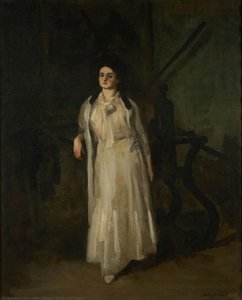
Découvrez Stein and Press (1906) de John Sloan, un portrait réaliste saisissant de NYC. Explorez ce chef-d'œuvre de l'Ashcan School.
Biographie de l'artiste
John French Sloan (1871-1951): Un peintre américain majeur de l'École Ashcan et du réalisme américain. Ses œuvres captivent la vie quotidienne à New York au début du XXe siècle.
À propos de l'œuvre
Stein et Presse : Un portrait de la mélancolie urbaine
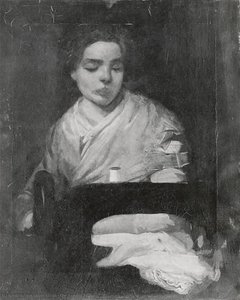
L’œuvre « Stein et Presse » (1906) de John French Sloan s'impose comme une pierre angulaire du réalisme de l'Ashcan School — un mouvement voué à dépeindre les réalités brutes de la vie citadine américaine avec une honnêteté sans faille. Bien plus qu'une simple représentation d'une femme assise dans une pièce faiblement éclairée, cette toile est une exploration de la solitude, de l'introspection et de la tristesse silencieuse inhérente à l'existence quotidienne. L'usage magistral du clair-obscur par Sloan — ces contrastes dramatiques entre l'ombre et la lumière — instaure immédiatement une atmosphère d'une profonde gravité. Le tableau se concentre sur une figure féminine unique, rendue avec un détail méticuleux sur un fond de bruns et de gris sourds qui amplifient son isolement. Sa posture, subtilement détournée du spectateur, favorise un sentiment d'intimité tout en laissant transparaître une certaine vulnérabilité. Les coups de pinceau de Sloan sont visibles, superposant les textures pour créer une surface impressionniste qui capture non seulement la forme, mais aussi l'atmosphère. La tenue de la femme — une robe sombre drapée sur une chaise — s'ajoute à la palette sombre et renforce ce sentiment de contemplation tranquille. La technique de Sloan prend racine dans les méthodes traditionnelles de la peinture à l'huile, privilégiant le dégradé tonal et le mélange des couleurs pour atteindre une profondeur et une luminosité remarquables. Il emploie avec habileté les hachures et les hachures croisées pour définir les traits du visage et les plis des draperies, témoignant d'un engagement indéfectible envers le dessin — une marque de fabrique de son approche artistique. La composition elle-même contribue de manière significative à la résonance émotionnelle de l'œuvre ; la perspective aplatie diminue subtilement la grandeur du décor, mettant l'accent sur l'état intérieur du sujet plutôt que sur son environnement extérieur. L'Ashcan School, émergeant à New York durant l'ère progressiste, s'est construite en réaction aux conventions de l'art académique pour prôner une représentation plus authentique de la vie urbaine, dépeignant souvent la pauvreté, la précarité et les communautés marginalisées. Le travail de Sloan s'inscrit dans cet éthos, reflétant les préoccupations sociales de l'époque tout en explorant des thèmes universels de l'émotion humaine. « Stein et Presse » n'est pas seulement un portrait ; c'est une méditation sur la complexité de l'expérience intérieure dans les limites d'un espace ordinaire — un rappel intemporel de la beauté trouvée dans la contemplation silencieuse et de la mélancolie omniprésente qui accompagne la solitude.- Artiste : John French Sloan
- Année de création : 1906
- Technique : Huile sur toile
- Style : Réalisme de l'Ashcan School
- Lieu : Collection privée
Résonance symbolique et influence artistique
L'utilisation délibérée par Sloan de couleurs atténuées — principalement des bruns, des gris et des ocres — sert de métaphore visuelle puissante pour la mélancolie et l'introspection. Le regard détourné de la femme symbolise un retrait du monde, invitant le spectateur à contempler ses pensées et ses sentiments profonds. De plus, les choix stylistiques de Sloan — en particulier ses coups de pinceau texturés et son éclairage en clair-obscur — ont profondément marqué les générations suivantes d'artistes, l'établissant comme une figure pivot du modernisme américain. Son dévouement inébranlable à représenter l'authenticité de l'expérience humaine continue d'inspirer, aujourd'hui encore, les peintres et les designers contemporains.Questions et réponses
Pour quelle pièce «Stein et Presse» de John French Sloan est-il recommandé ?
L'espace recommandé pour «Stein et Presse» de John French Sloan est un Espaces de vie. Cette suggestion peut bien entendu être adaptée à votre intérieur.
En quelle année "Stein et Presse" a-t-il été réalisé ?
L'œuvre «Stein et Presse» de John French Sloan date de 1906.
Est-il possible de télécharger l'image de « Stein et Presse » ?
Un téléchargement est disponible pour « Stein et Presse » : la page Téléchargement de l'œuvre propose téléchargement d'une image numérique haute résolution.
Informations clés et quiz sur l'œuvre
À propos de John French Sloan

John French Sloan
1871 - 1951, États-Unis
Biographie de l'artiste
Early Life and Artistic Awakening
John French Sloan, born August 2, 1871, in Lock Haven, Pennsylvania, emerged from humble beginnings that profoundly shaped his artistic vision. His childhood was marked by a familial need for support; his father’s struggles with mental health necessitated young John taking on responsibilities beyond his years. This early exposure to the realities of working-class life—a world often overlooked by the established art circles—would become a defining characteristic of his oeuvre. He moved with his family to Philadelphia, where he honed his skills initially not through formal academic training, but as an assistant cashier at Porter and Coates, a bookstore brimming with prints and illustrations. This environment proved formative; it allowed him to study masters like Dürer and Rembrandt, fostering a deep appreciation for draftsmanship and etching techniques. It was here, amidst the commerce of printed images, that Sloan began creating his own art, quietly developing a style rooted in observation and meticulous detail. His early work wasn’t born from privilege or leisure, but from necessity and a keen eye for the world around him—a foundation upon which he would build a remarkable career.The Ashcan School and Urban Realism
Sloan's trajectory shifted dramatically with his encounter with Robert Henri, a charismatic painter who championed artistic independence and a commitment to portraying everyday life. This connection led Sloan to the heart of what became known as the Ashcan School—a group of artists dedicated to depicting the gritty realities of turn-of-the-century New York City. Alongside William Glackens, George Luks, Everett Shinn, and others, Sloan rejected the idealized landscapes and portraits favored by many of their contemporaries, instead turning their attention to the bustling streets, crowded tenements, and vibrant social life of the city’s poorer neighborhoods. His work became a visual chronicle of this often-ignored world—capturing scenes from McSorley's Bar to women drying their hair on rooftops. Sloan wasn’t merely documenting; he was imbuing these scenes with a sense of empathy and dignity, elevating the lives of ordinary people onto the canvas. He possessed an uncanny ability to capture the *essence* of neighborhood life, the subtle gestures and fleeting moments that revealed the character of a place and its inhabitants. This commitment to realism wasn’t simply aesthetic; it was also informed by his socialist leanings, though he always maintained a distinction between his art and his political beliefs.Style and Influences
Sloan's artistic style is characterized by a distinctive blend of influences. While rooted in realism, his work wasn’t devoid of stylistic nuance. He employed dark, rich hues—often emphasizing the contrast between light and shadow—to create a sense of drama and atmosphere. His compositions were carefully constructed, often utilizing strong diagonals to draw the viewer's eye into the scene. The influence of etching is evident in his precise linework and attention to detail, even in his paintings. Beyond Henri, Sloan drew inspiration from European masters like Edgar Degas and Honoré Daumier, admiring their ability to capture movement and social commentary. However, he forged a uniquely American voice, one that resonated with the energy and dynamism of New York City. His work wasn’t about grand narratives or historical events; it was about the small moments, the everyday experiences that constituted the fabric of urban life. He found beauty in the mundane, transforming ordinary scenes into compelling works of art. Wake of the Ferry exemplifies his ability to imbue a seemingly simple scene with emotional depth and symbolic resonance.Legacy and Lasting Impact
John French Sloan’s legacy extends far beyond his contributions to the Ashcan School. He was a prolific artist who worked in various mediums—painting, etching, lithography, drawing—and consistently explored themes of urban life, social justice, and human connection. His commitment to portraying the realities of working-class America paved the way for future generations of artists who sought to challenge conventional artistic norms and engage with social issues. He was a dedicated teacher, sharing his knowledge and passion with countless students throughout his career. Even as artistic tastes evolved, Sloan remained true to his vision, continuing to paint scenes that reflected his deep connection to New York City and its people. His work continues to resonate today, offering a poignant glimpse into a bygone era and reminding us of the enduring power of art to illuminate the human condition. His paintings are not merely historical documents; they are timeless portraits of life, love, and loss. Sloan’s influence can be seen in the works of subsequent realist painters and continues to inspire artists who seek to find beauty and meaning in the everyday world.Informations clés sur John French Sloan
- Artistic Movement Or Style: Ashcan School, Realism
- Artists Who Influenced This Artist: ['Robert Henri']
- Date Of Birth: August 2, 1871
- Full Name: John French Sloan
- Nationality: American
- Notable Artworks:
- Wake of the Ferry
- McSorley’s Bar
- Place Of Birth: Lock Haven, USA
Explorez des œuvres d'art classées par thèmes, styles et caractéristiques.


John French Sloan
Stein et Presse
() ·
Avec son cadre : · Peint à la main à l'huile sur lin
Total