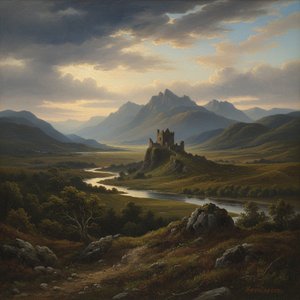
A Dramatic Rescue: Benjamin West’s “The Death of the Stag”
Benjamin West's "Alexander III of Scotland Rescued from the Fury of a Stag by the Intrepidity of Colin Fitzgerald" – often referred to as “The Death of the Stag” – is more than just a historical painting; it’s a visceral tableau of courage, loyalty, and the very essence of Highland legend. Completed in 1786, this monumental work, now residing within the Scottish National Gallery, transports us directly into a pivotal moment in Scottish history, a scene brimming with action, emotion, and symbolic weight.
West, an Anglo-American artist who forged a remarkable career bridging the worlds of Neoclassicism and Romanticism, masterfully captures the drama unfolding before him. The composition is immediately arresting – a dynamic swirl of movement centered around the imminent rescue of King Alexander III from the ravenous attack of a stag. Colin Fitzgerald, a figure steeped in Clan Mackenzie lore, stands poised with his sword, ready to deliver the decisive blow. The king himself, visibly shaken but unharmed, watches intently, embodying both vulnerability and gratitude. Surrounding them are other huntsmen, their faces etched with concern and anticipation, while horses and dogs add further layers of complexity to the scene.
A Story Forged in Legend
The painting’s narrative is rooted in a legendary tale from the late 13th century. Alexander III, known as “Alexander the Cruel” due to his violent temper, was on a hunting expedition when he encountered a particularly aggressive stag. Just as the animal lunged towards him, Colin Fitzgerald, a young and relatively unknown member of Clan Mackenzie, bravely intervened, slaying the beast and saving the king’s life. This act of valor cemented Fitzgerald's place in Highland history and established the Mackenzie clan’s reputation for courage and loyalty – a legacy that West sought to immortalize.
Francis Mackenzie, the later chieftain of the Clan Mackenzie, commissioned the painting as a testament to his ancestor’s heroism. This patronage highlights not only the importance of this particular event within Scottish history but also the clan's desire to solidify its lineage and celebrate its values. The choice of West, an artist already gaining international recognition for his dramatic historical paintings, underscored the significance of the commission.
Technique and Style: Neoclassical Drama
West’s masterful technique is a key element in conveying the painting's emotional impact. He employs a distinctly Neoclassical style, characterized by clear lines, balanced compositions, and an emphasis on heroic figures. The use of light and shadow – *chiaroscuro* – dramatically highlights the central action, drawing the viewer’s eye to Fitzgerald’s outstretched sword and Alexander III’s expression of relief. The artist's attention to detail is remarkable; from the texture of the stag’s fur to the intricate folds of the huntsmen’s clothing, every element contributes to a sense of realism and immediacy.
Furthermore, West skillfully utilizes color – rich reds and browns dominate the scene, evoking the rugged landscape of Scotland and adding to the painting's dramatic intensity. The dynamic brushstrokes create a palpable sense of movement, capturing the frenetic energy of the rescue attempt. The composition itself is carefully constructed, utilizing diagonal lines to guide the viewer’s eye through the scene and creating a powerful visual rhythm.
Symbolism and Emotional Resonance
Beyond its historical narrative, “The Death of the Stag” is rich in symbolism. The stag represents both danger and untamed nature – forces that must be overcome by courage and skill. Fitzgerald’s act of heroism embodies loyalty, bravery, and the willingness to risk one's life for another. Alexander III’s vulnerability underscores the importance of protection and the value of leadership.
The painting evokes a powerful emotional response in the viewer – a sense of awe at the scene’s drama, admiration for Fitzgerald’s courage, and perhaps even a touch of melancholy for the precariousness of life. It's a testament to West’s ability to capture not just historical events but also the underlying human emotions that drive them. Today, “The Death of the Stag” remains a captivating masterpiece, offering a glimpse into Scotland’s rich history and the enduring power of legend.



 Aperçu en situation
 Passer au tirage
 Envoyer
 Partager
 Détails de l'œuvre

 Télécharger
 Articles similaires
 Radiographie
 Diaporama


 Lire la suite






































 L'option verre n'est disponible que pour les dimensions inférieures à 110 cm.