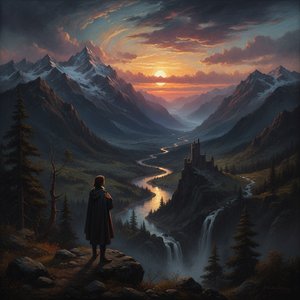
The Ruins of Eldena Abbey1
The painting “Ruins of Eldena Abbey” by Caspar David Friedrich stands as a cornerstone of Romantic landscape art, embodying the movement’s preoccupation with sublime beauty and profound contemplation. Created in 1824-25 during Friedrich's prolific period, it captures not merely a visual depiction but an emotional response to the decaying grandeur of the Cistercian monastery nestled on Usedom Island, Germany. This artwork transcends mere representation; it delves into themes of mortality, faith, and the enduring power of nature—elements central to Romantic artistic expression.
Historical Context: A Monastery Dissolved
The Eldena Abbey’s story is inextricably linked to the turbulent religious landscape of 16th-century Europe. Founded in 1199, it flourished for centuries before succumbing to the pressures of the Protestant Reformation. The dismantling of monastic orders marked a significant turning point in German history, symbolizing the decline of medieval piety and tradition. Friedrich’s artistic interest in ruins wasn't simply aesthetic; it reflected a broader intellectual concern with the passage of time and the inevitable decay inherent in all earthly endeavors—a preoccupation that resonated deeply within the Romantic sensibility. The abbey’s crumbling walls served as a potent visual metaphor for this philosophical stance.
Artistic Style: Chiaroscuro and Atmospheric Depth
Friedrich's masterful technique exemplifies the principles of Romantic chiaroscuro, skillfully manipulating light and shadow to create an illusion of depth and heighten emotional impact. Unlike the polished surfaces favored by Neoclassical painters, Friedrich opted for a muted palette dominated by browns, greens, and blues—colors that evoke the somber mood of twilight and reinforce the painting’s melancholic atmosphere. The artist meticulously rendered textures – weathered stone, moss-covered branches, and snow-laden foliage – conveying a palpable sense of materiality. Furthermore, Friedrich employed atmospheric perspective, subtly blurring distant elements to simulate the effects of air and distance, immersing the viewer in the scene's contemplative space.
Composition and Symbolism: Framing Eternity
The painting’s composition is carefully balanced, positioning the ruined abbey at its center, framed by towering trees on either side. This framing device serves as a deliberate allusion to biblical imagery—particularly the Garden of Eden—suggesting that humanity exists within a larger cosmic order governed by divine providence. The solitary figure standing amidst the ruins adds another layer of symbolism, representing human vulnerability confronted with the immensity and indifference of nature. Friedrich’s intention wasn't simply to depict a landscape; he sought to evoke an emotional experience—a feeling of awe mingled with sorrow—that captures the sublime beauty of decay and reminds us of our own mortality. The painting embodies the Romantic belief that art could communicate spiritual truths beyond rational comprehension.
Interpretation: Echoes of Transcendence
“Ruins of Eldena Abbey” continues to inspire interpretation as a profound meditation on faith, loss, and the enduring legacy of history. It speaks to the Romantic fascination with the sublime—that paradoxical blend of terror and beauty—where confronting the destructive forces of time reveals an underlying harmony and grandeur. The painting’s quiet stillness invites contemplation, prompting viewers to consider questions about existence, purpose, and the relationship between humanity and the natural world. Its enduring appeal lies in its ability to capture a timeless emotion—the bittersweet awareness that all things pass away but that beauty persists beyond temporal limitations.
The original painting is housed in the
Alte Nationalgalerie in Berlin, where it remains one of the museum's most prized possessions.



 Aperçu en situation
 Acheter l'impression
 Envoyer
 Partager
 Détails de l'œuvre

 Télécharger
 Articles similaires
 Radiographie
 Diaporama
 Lire la suite






































 L'option verre n'est disponible que pour les dimensions inférieures à 110 cm.