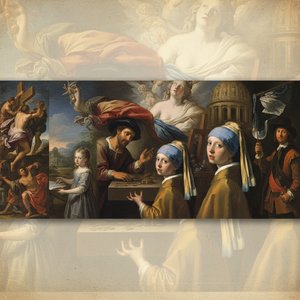
Francisco Domingo y Marqués: A Baroque Visionary
Francisco José Domingo y Marqués (1842 – 1920) stands as a prominent figure in Spanish art of the late nineteenth century, embodying the eclectic spirit of his time. Born in Valencia, he embarked on an artistic journey marked by meticulous observation and masterful execution—characteristics that define his distinctive Baroque style.
His formative years were spent at the Real Academia de Bellas Artes de San Carlos in Valencia, where he honed his skills under Rafael Montesinos y Ramiro, a fervent admirer of José de Ribera. This early influence profoundly shaped Domingo’s artistic sensibilities, prompting him to diligently copy Ribera's works as exercises in technique and composition. Recognizing Madrid as the epicenter of artistic innovation, he relocated there in 1864, furthering his studies at the Real Academia de Bellas Artes de San Fernando with Federico de Madrazo.
A pivotal moment arrived in 1868 when Domingo secured a royal pension to pursue advanced studies in Rome—a decision that would propel him into contact with the influential artistic milieu of the Italian capital. There, he immersed himself in the workshop of Eduardo Rosales and diligently submitted his paintings to the National Exhibition of Fine Arts, garnering considerable acclaim for his Baroque-inspired canvases. However, Domingo’s health suffered from recurring bouts of malaria, forcing him to return to Spain and dedicating himself to teaching at San Carlos Academy.
His portrait of Santa Clara praying achieved first prize at the 1871 exhibition—a testament to his ability to capture spiritual essence with remarkable precision. Simultaneously, Domingo’s pension was revoked due to a perceived lack of enthusiasm for resuming his Roman studies, prompting him to settle in Madrid and accepting commissions for decorating opulent buildings, including the Palace of Eduardo, Duque de Bailén.
In 1874, he married and subsequently moved to Paris—a city that would become synonymous with his artistic output. Domingo’s Parisian endeavors focused on producing detailed historical genre scenes and portraits for discerning clientele—many of whom were former patrons of Marià Fortuny—reflecting the stylistic currents circulating within Impressionist circles. He absorbed elements from Meissonier's realism, subtly brightening his palette under the influence of Impressionistic principles.
Furthermore, Domingo cultivated connections with American art dealers like William Henry Vanderbilt and Augustin Daly, securing lucrative sales for his paintings. Notably, Vanderbilt purchased “African Chief,” showcasing Domingo’s artistic prowess on an international stage. His work continued to evolve throughout his life, culminating in membership of the Academia de San Fernando in 1914—a recognition of his enduring contribution to Spanish art history.
Domingo's legacy extends beyond individual masterpieces; he played a crucial role in shaping artistic discourse and fostering connections between Spain and the United States. His paintings, particularly “African Chief” and “The Cobbler,” stand as enduring symbols of Baroque artistry—capturing not only visual beauty but also profound emotional depth.
His final years were marked by continued artistic activity and scholarly engagement, culminating in a retrospective honoring his life’s work in Valencia in 1918. Domingo's passing in Madrid in 1920 solidified his place as one of Spain’s most celebrated painters—a visionary whose meticulous technique and evocative compositions continue to inspire admiration.