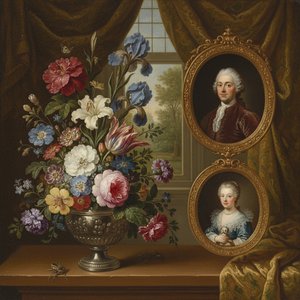
Jan van Kessel the Elder: A Flemish Master of Botanical Observation
Jan van Kessel the Elder (baptized 5 April 1626, Antwerp – 17 April 1679, Antwerp) stands as a pivotal figure in seventeenth-century Flemish art, renowned for his meticulous depictions of insects and flowers—a testament to scientific curiosity blended seamlessly with artistic skill. Descended from Jan Brueghel the Elder, a titan of Northern Mannerism, Kessel inherited a legacy of dramatic landscapes and allegorical narratives but forged his own distinctive path as a botanist-painter, securing his place among the foremost artists of his time.
Early Life & Training: Born into a family steeped in artistic tradition—his father, Hieronymus van Kessel the Younger, and uncle, Jan Brueghel the Younger—Kessel’s formative years were shaped by immersion in the atelier of Simon de Vos, Antwerp's leading history painter. This early exposure instilled in him a disciplined approach to observation and representation, skills honed further through training with his family members, establishing him as part of a vibrant artistic ecosystem. He absorbed the stylistic principles of Mannerism—characterized by stylized forms, dramatic lighting, and meticulous detail—a foundation that would inform his entire artistic career.
Guild Membership & Artistic Style: Recognizing the importance of professional recognition, Jan van Kessel joined the Antwerp Guild of Saint Luke in 1644 as a “blomschilder,” signifying his unwavering commitment to botanical painting and reflecting the intellectual fervor of the era. This distinction underscored the burgeoning fascination with scientific inquiry within artistic circles—a trend that profoundly impacted Kessel’s creative vision. His style transcended mere imitation, injecting an unprecedented level of accuracy into his compositions. Rather than prioritizing opulent ornamentation, he focused on capturing the subtle beauty of nature with painstaking precision, mirroring the meticulous approach championed by figures like Daniël Seghers and Frans Snijders.
Marriage & Family: In 1646, Kessel married Maria van Apshoven and established a large family—a testament to his devotion to domestic life and artistic heritage. Thirteen children graced his lineage, two of whom pursued careers in art, ensuring that Jan van Kessel’s legacy would extend far beyond his own lifetime. This familial dedication fostered an environment conducive to artistic exploration and upheld the traditions of his esteemed predecessors.
Notable Works & Patronage: Kessel's oeuvre encompassed a diverse range of subjects—landscapes, marines, and allegorical scenes—all imbued with botanical motifs. His paintings commanded considerable prestige and attracted the patronage of influential collectors and aristocratic families throughout Europe. Among his most celebrated masterpieces are “Assemblee d’oiseaux dans un paysage” (A Bird Assemblage in Landscape), depicting a breathtaking panorama populated by avian species rendered with astonishing realism; “A river landscape with a windmill,” showcasing Kessel's masterful depiction of rural scenery; and “The Mockery of the Owl,” an enigmatic allegory exploring themes of mortality and illusion—each demonstrating Kessel’s unparalleled technical skill and profound understanding of the natural world.
Later Life & Legacy: Despite facing financial difficulties toward the end of his life, culminating in the mortgage of his home – the ‘Witte en Roode Roos’ – Jan van Kessel persevered in his artistic endeavors until his death in 1679. His unwavering dedication to art remained steadfast even amidst adversity. He is remembered as a pioneer of botanical illustration and a champion of Mannerist aesthetics, securing his place as one of the most influential painters of the Baroque era—a testament to his enduring contribution to Flemish art history. His influence resonated throughout subsequent generations of artists who sought to emulate his meticulous observation and expressive style.