Kiyoshi Hasegawa: A Quiet Revolution in Printmaking
Kiyoshi Hasegawa (1891-1980) stands as a singular figure in Japanese printmaking history—a master craftsman who quietly championed innovation while deeply rooted in Eastern sensibilities. Born in Yokohama, Japan, his life unfolded primarily in France, where he honed his skills and established himself as a respected artist and engraver. Hasegawa’s artistic journey began with formal training under prominent painters Fujishima Takeji, Okada Saburosuke, and Kuroda Seiki, absorbing the influence of Impressionism during this formative period. This exposure to Western aesthetics would prove crucial in shaping his distinctive style—a synthesis of meticulous observation and subtle emotional expression.
Early Career & Influences: Hasegawa’s initial artistic explorations centered around woodblock printing, mirroring the traditions of Edo-period masters like Hokusai and Kunitora. He skillfully combined Eastern techniques with Western concepts, notably experimenting with “konshi kinzuri”—gold printing on indigo-dyed paper—a technique harking back to ancient Buddhist sutras. His collaborations with fellow artists Nagase Yoshio and Hiroshima Shintaro solidified his commitment to collective artistic endeavors and established the Nihon Hanga Kyokai, a pivotal organization in promoting modernist printmaking. This group of artists was instrumental in establishing *sosaku hanga*, or “open-air printmaking,” as a distinct artistic movement.
The Parisian Breakthrough: Hasegawa’s relocation to France in 1918 marked a turning point. Recognizing the potential for dialogue between East and West, he spearheaded the inaugural *sosaku hanga* exhibition in Paris in 1934—a landmark event that showcased groundbreaking works by Japanese artists. This initiative cemented his reputation as a visionary leader and solidified his contribution to establishing *sosaku hanga*, or “open-air printmaking,” as a distinct artistic movement. He meticulously arranged the exhibition, ensuring it presented a harmonious blend of Eastern and Western artistic traditions.
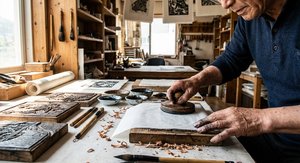
Technical Mastery & Revival of Mezzotint: Hasegawa’s dedication to craftsmanship extended beyond collaborative projects; he tirelessly pursued technical excellence, particularly in mezzotint engraving—a technique largely abandoned by European artists after the Napoleonic Wars. Through painstaking labor and unwavering focus on tonal gradation, Hasegawa resurrected this venerable method, achieving remarkable depth and nuance in his prints. He mastered the subtleties of etching and polishing steel plates, transforming them into instruments of artistic expression.
Recognition & Legacy: Hasegawa’s artistic achievements garnered considerable acclaim throughout his career. He received prestigious honors including the Légion d'honneur (1935), Chevalier des Arts et Lettres (member correspondent of the French Academy of Fine Arts, 1964), and Order of the Sacred Treasure, Third Class (Japan, 1967). His prints continue to resonate with audiences worldwide, embodying a quiet elegance and profound contemplation—a testament to Hasegawa’s enduring artistic vision. He was honored for his contribution to Japanese art history and recognized as one of the foremost printmakers of his time.
Hasegawa's art is subtle and delicate, and it comes from the heart. He revived the mezzotint technique and found the power and the depth of black in wood engraving. His art is an ideal created in the silence of the workshop with memories of the recent past, transposed by the sharpness and delicacy of oriental sensibilities.